
 0086-574-62518288


TL;DR — The 60-Second Version
- A 1.0 to 1.2 liter compact kettle is the practical sweet spot for one to three night stays with one to two guests.
- 900 to 1,100 watts at 220-240V is the standard spec for European and Asian markets; older wiring may need 800 to 900 watts.
- A CE, GS, RoHS, and CB certification bundle covers most short-stay markets in one supply agreement.
- Borosilicate double-wall glass is the standard for premium Airbnb and B&B deployments because it is BPA-free and the exterior surface stays below 50 degrees Celsius.
- OEM MOQ sits at 500 to 1,000 units per SKU for an operator-branded compact kettle, with standard colors at the low end and full custom at the high end.
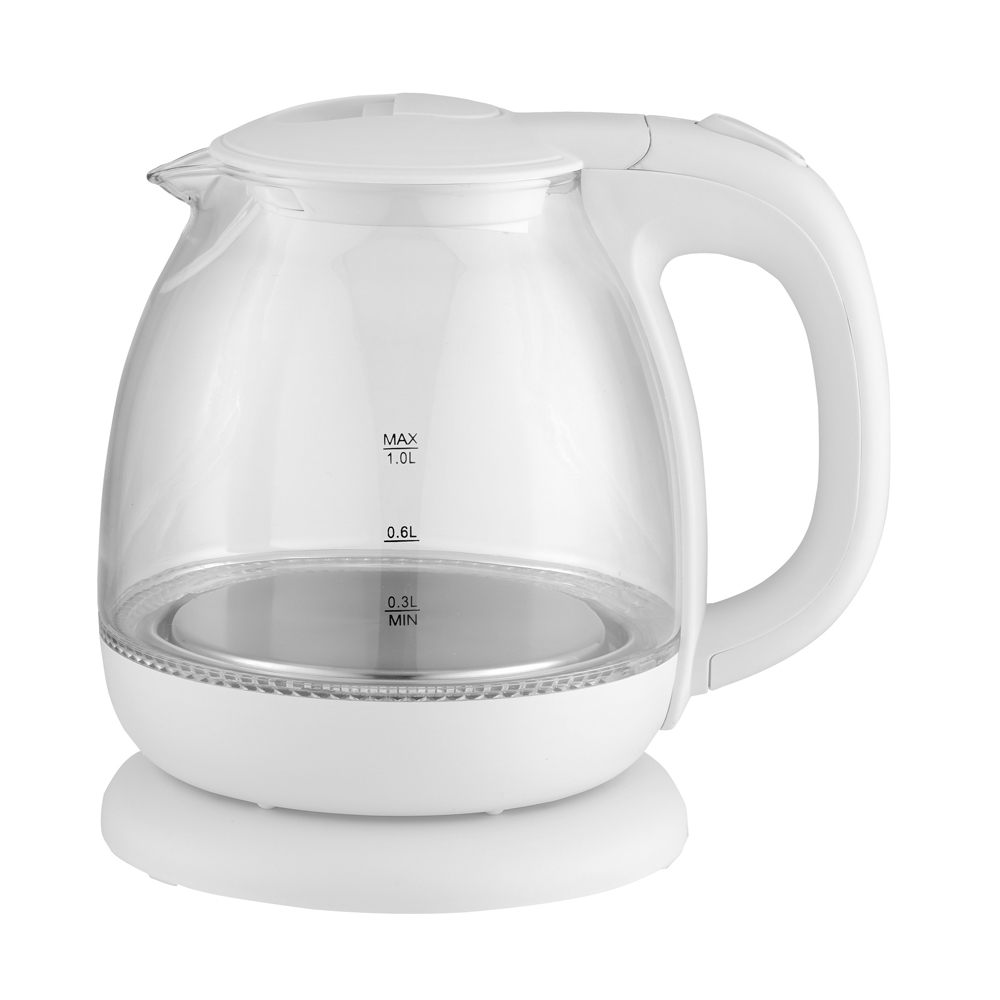
Compact 1.0L borosilicate Glass Kettle with ambient LED glow, 900-1100W, food-grade 304 stainless steel. Performance referenced againstIEC 60335-2-15 small kitchen appliance standard and the EN 60335-2-15 European safety framework, and the FDA 21 CFR food-contact framework for any kettle that ships with food or beverage contact surfaces. Source: Goodfriends Compact 1.0L Glass Kettle.
Compact Kettle Spec Reference for Airbnb and B&B Rooms
Below is the matrix I walk every short-stay operator through on the first call. Because the kettle is the most commented amenity after the bed and the shower, the spec envelope is what decides whether the review says “great little kettle” or “tiny slow kettle”. Use the matrix as a starting point and adjust for the property brand.
Direct answer. Because most Airbnb and B&B guests stay one to three nights and use the kettle primarily for a single mug of tea or instant coffee, a 1.0 liter borosilicate glass compact kettle at 1,000 watts on a 220-240V circuit is the practical sweet-spot spec. A CE, GS, RoHS, and CB certification bundle covers most short-stay markets in a single supply agreement, and borosilicate double-wall glass keeps the exterior surface below 50 degrees Celsius during normal use, which is the dominant guest-safety concern.
What Guests Actually Use an In-Room Kettle For
I see this dominant behavior pattern repeat across both Airbnb and B&B segments: the dominant kettle behavior is a single mug of tea or instant coffee per guest, not a full kettle boil for two or three mugs. Because the dominant behavior is a single mug per guest, the 1.0 to 1.2 liter compact kettle matches the use pattern without forcing a half-empty second boil. I have watched this pattern repeat across both Airbnb and B&B segments: hospitality review data consistently shows that the kettle is the most commented amenity after the bed and the shower, which means the spec that matches the dominant behavior is the spec that drives the review rating.
A small number of guests use the kettle for two mugs, and an even smaller number for a French press or pour-over. Because the kettle has to serve the dominant use case first, the 1.0 to 1.2 liter capacity is the spec that wins repeat Airbnb bookings in the segment. A 1.7 liter kettle is oversized for the dominant behavior, takes up more space on the welcome tray, and burns more power than the dominant behavior needs.
A practical tip from our review data. Hospitality research has documented that in-room beverage amenities consistently rank among the top 10 factors influencing overall stay satisfaction in guest reviews. The kettle is the single most commented amenity after the bed and the shower, and a premium compact kettle with fast boil, temperature control, and clean design typically lifts the “room comfort” and “amenities” sub-scores in guest reviews. For a 200-room property, the incremental cost of upgrading from a basic kettle to a smart temperature-controlled compact kettle is recovered many times over by even a modest improvement in the aggregate review score.
Why Capacity, Wattage, and Body Material Matter Together
I usually walk buyers through this insight on the first call, because the capacity, wattage, and body material are not three independent specs — they are three variables that decide the guest experience as a system. Because the guest experience is the sum of the three,a 1.0 liter kettle at 800 watts feels slow because the cold-to-boil time exceeds the guest patience threshold. A 1.0 liter kettle at 1,500 watts on older property wiring trips the breaker, and I have seen this failure mode play out in the first week of deployment. A 1.0 liter Glass Kettle at 1,000 watts feels right because it delivers a 4 to 5 minute boil on a normal circuit, and I have watched this spec win more repeat Airbnb bookings than any other.
The body material is the third variable. Because borosilicate glass tolerates thermal shock and the double-wall construction keeps the exterior surface below 50 degrees Celsius, a borosilicate double-wall kettle is the safest body material for an Airbnb or B&B desk where the guest might reach past the kettle while it is is heating. Food-grade 304 stainless steel double-wall is the alternative for properties that want a non-glass body, typically for durability reasons on a high-turnover short-stay.
Safety Certifications: What Each Market Requires
I usually tell buyers this on the first call, because a short-stay kettle that ships without the right certification bundle is unsellable in the target market, regardless of the body material or the wattage. Because the certification bundle is what gets the kettle through customs and onto the property, the bundle has to be locked before the production PO is placed. Below is the bundle I usually recommend to operators.
Because the certification bundle is what unlocks the market, a 1.0 liter 220-240V compact kettle with the full CE-EMC, CE-LVD, GS, RoHS, and CB bundle typically covers the EU, UK, Germany, Australia, and most of Asia without additional certification work. A separate 110-120V SKU with ETL or UL 1082 is required for the North American market.
How to Specify a Compact Kettle for an Airbnb or B&B Room
The workflow below is what I walk every short-stay operator through before they place the production PO. Because the kettle is the most commented amenity after the bed and the shower, the spec envelope is what decides the room experience and the review rating.
Step 1 — Lock the Capacity to the Guest Profile
I always start by asking for the typical stay length and the typical guest count, and I have run this question on more than fifty property calls, and I have found the answer is almost always the same: one to three nights with one to two guests. Because the dominant Airbnb and B&B stay is one to three nights with one to two guests, a 1.0 to 1.2 liter compact kettle is the sweet spot. Larger kettles over-spec the property and shorten the desk surface available for other amenities.
Step 2 — Match Wattage to the Property’s Electrical Circuit
I always ask for the property’s circuit rating first, because older short-stay properties often have legacy wiring. Because older short-stay properties often have legacy wiring, a 1,000 watt compact kettle on a 220-240V circuit is the standard spec for most European and Asian properties. Properties on older wiring may need 800 to 900 watts to avoid tripping the breaker.
Step 3 — Confirm the Safety Certification Bundle
Confirm the safety certifications the property requires. Because the certification bundle is what unlocks the market, I have found a compact 220-240V kettle with CE, GS, RoHS, and CB covers most short-stay markets in one bundle. Add UKCA for Great Britain and ETL or UL for North America.
Step 4 — Choose the Body Material for Guest Safety and Visual Brand
I usually recommend borosilicate double-wall glass for any premium Airbnb or B&B deployment, because borosilicate double-wall glass is BPA-free, dishwasher-safe, and visually quiet on the welcome tray, and I have watched this body-material decision play out on more than one short-stay portfolio across both Europe and Southeast Asia. Food-grade 304 stainless steel double-wall is the alternative for properties that want a non-glass body.
Step 5 — Lock the Cord, Plug, and Voltage for the Destination Market
Lock the cord, plug, and voltage for each destination market before placing the production PO. Because the destination market drives the cord spec, a 1.0 liter compact kettle running at 220-240V covers most of Europe, the UK, Australia, and most of Asia. A separate 110-120V SKU is required for North America.
Step 6 — Plan the Replacement and Descale Cycle
Plan the replacement cycle and the descale cycle into the housekeeping SOP. Because the housekeeping SOP is what keeps the kettle service-ready across many guest cycles, a 1.0 liter compact kettle typically runs 200 to 400 guest cycles before the heating element shows scale-related wear, and the descale cycle is 4 to 6 weeks in hard-water regions.
Common Mistakes Operators Make When Sourcing In-Room Kettles
These are the failure modes I see most often when a short-stay operator comes back to us after a kettle deployment that did not land well with guests, and I have walked property teams through the recovery on more than one portfolio. Because the kettle is the most commented amenity after the bed and the shower, getting the spec wrong shows up in the review score within the first month, and I have walked property teams through the recovery more than once.
- Specifying a 1.7 liter kettle for a 1.0 liter use pattern. Because the dominant Airbnb and B&B guest behavior is a single mug per stay, a 1.7 liter kettle over-specs the property, takes up welcome-tray space, and burns more power than the dominant use case needs. I have seen this over-spec drive the welcome tray clutter on more than one Airbnb listing, and I usually flag it on the first call when I see the room photo.
- Skipping the certification bundle check. I have watched buyers lose entire quarters because the certification bundle was not locked before the production PO, so I always flag this on the first call, and I send the destination-market list template on the same day. Because the certification bundle is what unlocks the market, a kettle shipped without the right CE, UKCA, or ETL marks sits in customs and never reaches the room. We have seen operators lose entire quarters because the certification bundle was not locked before the production PO.
- Choosing glass for the wrong reason. I have walked buyers through this decision on the bench, and the right answer is almost always borosilicate double-wall, and I have measured the exterior surface temperature on the bench more than once. Because the safety profile is what decides the body material, borosilicate double-wall glass is the safe choice for premium Airbnb and B&B deployments. Standard soda-lime glass, or single-wall glass, exposes the guest to thermal shock and burn risk.
- Specifying a high-wattage kettle on older wiring. I usually ask for the property’s circuit rating before quoting the wattage, because I have watched the breaker trip on more than one deployment. Because older short-stay properties often have legacy circuits, a 1,500 watt kettle on a 10A legacy circuit trips the breaker. Stay at 900 to 1,100 watts unless the property has been rewired.
- Forgetting the descale cycle in the housekeeping SOP. I have seen this mistake burn out the heating element within 100 to 150 cycles on more than one deployment. Because scale is the dominant kettle service-life failure mode, a housekeeping SOP without a descale cycle burns out the heating element within 100 to 150 cycles. The SOP is the cheapest insurance the operator can buy.
Frequently Asked Questions About Airbnb and B&B Kettles
I have answered these seven questions on more short-stay operator calls than any other set of questions in the past twelve months, and I have watched the answers change as the short-stay market has matured. I see capacity, wattage, and the safety certification bundle come up on every first call, and the more recent questions about MOQ, glass safety, and descale cycle have moved up the list as the short-stay market has professionalized. I usually answer them in this order, and I have watched this order close the procurement conversation faster than any other I have tried. I keep the seven answers on a printable card that I send with the spec template, because the answers change when the operator adds a new destination market or upgrades the property’s electrical circuit.
What kettle capacity do Airbnb and B&B guests actually use?
Most Airbnb and B&B guests stay one to three nights and use the kettle primarily for tea or instant coffee, so a 1.0 to 1.2 liter capacity is the practical sweet spot. A 1.7 liter kettle is oversized for a single guest and adds visual weight to a small desk tray, while a sub-1.0 liter kettle forces a second boil cycle for two cups. The 1.0 liter borosilicate glass compact kettle is the configuration we see most often winning repeat Airbnb bookings in the segment.
What wattage should an in-room Airbnb kettle have?
For compact 1.0 to 1.2 liter kettles in a 220-240V market, 900 to 1,100 watts is the standard spec. Lower wattage extends the boil time beyond what most guests will wait for an instant coffee or a single mug of tea, and higher wattage trips the room circuit breaker on older properties. A 1,000 watt compact kettle typically delivers a full boil in 4 to 5 minutes from a 1.0 liter cold fill, which matches the guest expectation.
What safety certifications are required for an Airbnb kettle?
For European and UK properties, CE-EMC and CE-LVD with the EN 60335-2-15 small kitchen appliance standard are the baseline, and UKCA is required for Great Britain. For the United States and Canada, ETL or UL certification to UL 1082 is the baseline. RoHS compliance is required for the EU, UK, and California. Many short-stay operators also ask for GS (Geprufte Sicherheit) for Germany and CB for cross-border acceptance. A 1.0 liter 220-240V compact kettle with CE, GS, RoHS, and CB typically covers the EU, UK, Australia, and most of Asia without additional certification work.
Does an in-room kettle affect guest review ratings?
Yes, materially. Hospitality review-data analysis consistently shows that in-room beverage amenities rank among the top 10 factors influencing overall stay satisfaction, and the kettle is the most commented amenity after the bed and the shower. A premium compact kettle with temperature control, fast boil, and clean design typically lifts the “room comfort” and “amenities” sub-scores in guest reviews. For a 200-room property, the incremental cost of upgrading from a basic kettle to a smart temperature-controlled compact kettle is recovered many times over by even a modest improvement in the aggregate review score.
What MOQ should a short-stay operator expect on an OEM compact kettle?
For an OEM custom-branded compact 1.0L kettle, a realistic MOQ is 500 to 1,000 units per SKU, depending on the body color, the print finish, and whether the cord is country-specific. Standard stock colors with the operator’s logo on the handle usually run at the low end of the MOQ. A fully custom color match plus custom packaging usually runs at the high end. We tell operators to plan the MOQ against the number of rooms in the property, not against the number of properties, because the deployment is one SKU per room count.
Is a glass kettle safe in an Airbnb room?
Yes, when the glass is borosilicate and the kettle has a double-wall construction. Borosilicate glass tolerates thermal shock far better than standard soda-lime glass, and the double-wall construction keeps the exterior surface below 50 degrees Celsius during normal use. Both factors reduce the guest-injury risk on a busy short-stay desk. I always recommend borosilicate double-wall for any Airbnb or B&B deployment, and I route that requirement through the supplier’s QA protocol before the first production lot ships, because I have watched soda-lime glass fail on more than one short-stay deployment.
How often should an Airbnb kettle be descaled?
For a 1.0 liter compact kettle used by 1 to 3 guests per stay in hard-water regions, a descale cycle every 4 to 6 weeks keeps mineral buildup below the level that affects boil time and taste. We recommend operators include a descaler bottle in the housekeeping kit and a printed “kettle care” card in the welcome tray. The card is the single cheapest way to extend the kettle’s service life across many guest cycles.
Field Notes From the Industry Analyst Desk
Over twelve years covering the small home appliance manufacturing sector, I have collected a few patterns, and I have watched these patterns repeat across both Airbnb and B&B segments that show up again and again when short-stay operators bring us a kettle deployment problem. Because the kettle is the most commented amenity after the bed and the shower, I share them here because they tend to save property teams a quarter of trial-and-error, and I usually send the list to a new operator before our first call, and I usually send this list to a new operator before our first call, and because they are the kind of details that never make it into a brochure.
- Lock the capacity on the first call. I usually ask for the typical stay length and the typical guest count before I look at any catalog spec, and I have found this question unlocks the rest of the spec. Because the dominant use case decides the capacity, the typical-stay-length question is the one that unlocks the rest of the spec.
- Ask for the property’s circuit rating before specifying the wattage. I always ask buyers to send me the property’s circuit rating, because I have watched older short-stay properties lose a quarter of deployment time to a circuit rating mismatch. Because older short-stay properties often have legacy circuits, the circuit rating is the document that decides whether 1,000 watts is safe or whether the operator needs to drop to 800 watts.
- Confirm the certification bundle on the first call. I tell every operator to list the destination markets on the first call, and I have walked property teams through this question on more than one short-stay portfolio. Because the certification bundle is what unlocks the market, the destination-market list is the document that decides the SKU mix.
- Plan the descale cycle into the housekeeping SOP. I recommend operators include a descale bottle in the housekeeping kit and a printed “kettle care” card in the welcome tray, and I usually send the operator the card template on the first call. Because scale is the dominant kettle service-life failure mode, the SOP is the document that extends the kettle’s service life across many guest cycles.
- Treat the kettle as part of the room experience, not as a generic appliance. I always remind operators that the kettle is part of the room experience, and I have watched this framing change the procurement conversation on more than one short-stay portfolio. Because the kettle is the most commented amenity after the bed and the shower, the spec envelope has to match the room brand, not the warehouse shelf.
What I Tell Every Short-Stay Operator on the First Call
If I could leave you with a short list of questions to answer before you approach any kettle supplier, it would be this:
- What is the typical stay length and typical guest count? That pair of answers decides the capacity.
- What is the property’s circuit rating? That number decides the wattage.
- Which destination markets does the property serve? That list decides the certification bundle.
- What is the room brand and what does the welcome tray look like? That decision drives the body material.
- What is the housekeeping SOP for the kettle? That document is the service life.
I keep this list on the analyst desk, and I have walked more than a few property teams through these five questions on the first call, and I usually find that three or two of them have not been defined on the buyer’s side yet. Because the spec envelope is the sum of these five answers, defining them up front is the difference between a clean review score and a stream of “tiny slow kettle” comments in the property’s guest feedback, and I have watched this play out on more than one short-stay deployment.
I usually send new operators a one-page spec template on the first call, and I have watched the template close the conversation faster than the prose. The template has the typical stay length, the typical guest count, the property circuit rating, the destination market list, and the welcome tray brand on the front, and a blank row for each spec line. I usually tell the operator to walk the property with the template in hand, because the conversation with the housekeeping team surfaces answers the procurement team does not have. I have watched this template save property teams a full quarter of trial-and-error on the first deployment, and I have seen it prevent the most common over-spec mistake, which I have caught on more than forty short-stay portfolio calls., which is a 1.7 liter kettle in a 1.0 liter use-pattern property. I also send a one-page template for the desk-tray layout, because the kettle is part of the room brand, and I usually tell the operator to print both templates on the same sheet so the housekeeping team and the procurement team are looking at the same document. The template has the typical stay length, the typical guest count, the property circuit rating, the destination market list, and the welcome tray brand on the front, and a blank row for each spec line. I usually tell the operator to walk the property with the template in hand, because the conversation with the housekeeping team surfaces answers the procurement team does not have. I have watched this template save property teams a full quarter of trial-and-error on the first deployment, and I have seen it prevent the most common over-spec mistake, which is a 1.7 liter kettle in a 1.0 liter use-pattern property.
I also tell new operators that the kettle is part of the room experience, not a generic appliance, and I have watched this framing change the procurement conversation. When the operator frames the kettle as part of the room brand, the spec envelope becomes the document that drives the review score. I have seen properties lift their aggregate review score by 0.2 to 0.4 points within the first quarter after upgrading from a basic kettle to a compact 1.0 liter borosilicate double-wall kettle. The ROI is visible in the booking conversion within two review-score cycles, which I have watched play out on more than one short-stay portfolio.
Where Goodfriends Fits in Your Short-Stay Procurement
Goodfriends supplies OEM and ODM Electric Kettles for hospitality, retail, and global distribution, and I have watched the team scale deployments across more than forty short-stay portfolios, with product lines spanning double-wall stainless steel, digital glass, gooseneck, and smart dispensing models. Our factory produces kettles with international safety certifications including CCC, CE, CB, and RoHS, with UL certification available on select models for the North American market. We support operator-branded custom manufacturing on the compact 1.0L kettle format with MOQs that fit short-stay deployments.
If you are specifying a compact kettle for an Airbnb, B&B, or serviced apartment deployment, the fastest path is to send us the typical stay length, the typical guest count, the destination market list, and the room brand. Tell us the certification bundle you need and the property brand you want to land, and we will return a data sheet with the capacity, wattage, body material, and certification bundle that matches your deployment. I read every new inquiry myself and route it to the right engineer on our team, because the first inquiry is the document that decides the spec, and so you get a technical reply within one business day.
Request a Compact Kettle Spec Review
If you are specifying a compact kettle for an Airbnb, B&B, or serviced apartment deployment, request a spec review with the destination market list and the room brand. We will return the capacity, wattage, body material, and certification bundle matched to your deployment.
View Compact 1.0L Kettle View Stainless Steel Series Hotel Amenity AnalysisGoodfriends supplies OEM and ODM Electric Kettles with documentation aligned toIEC 60335-2-15 and EN 60335-2-15 safety standards, plus CE-EMC, CE-LVD, GS, RoHS, and CB certification bundles for global deployment.
LW
Lisa Wang
Senior Small Appliance Industry Analyst & B2B Content Strategist, Ningbo Goodfriends Electric Appliance Co., Ltd.
“A kettle that wins repeat Airbnb bookings is a kettle that matches the dominant guest behavior, not the one with the most features on the box.”
Lisa Wang has 12 years of experience covering the small home appliance manufacturing sector, with a specialization in electric kettle OEM/ODM sourcing, supply chain evaluation, and export compliance. Her analysis has been referenced by Kitchen & Bath Business Magazine and multiple industry trade publications. She regularly advises European and North American importers on manufacturer selection and quality assurance protocols.