
 0086-574-62518288


Industry News
0102030405
Double Wall Kettle Wholesale: Cool-Touch Exterior and Fast Boil for North American Hotel Guest Rooms
2026-06-23
The hotel guest room kettle is one of those products that most travelers never consciously think about — until something goes wrong. A kettle that is too slow to boil water means a frustrating start to the morning for a business traveler who needs a quick cup of coffee before a 7 AM client meeting. A kettle with a handle that radiates heat and scalds the palm invites a guest complaint that can escalate into a liability issue for the property. And a kettle whose plastic components have developed an unpleasant odor after months of use becomes a negative review that every potential future guest can read on the booking platform. For North American hotel operators and procurement managers who source amenities for guest rooms, understanding what actually differentiates a professional-grade double wall kettle from the consumer models available at retail has become increasingly important as guest expectations continue to rise.
Why Burn Injuries from Hotel Kettles Represent a Serious Liability for North American Properties
Every year in the United States and Canada, approximately 60,000 to 80,000 people seek medical treatment for burn injuries related to household appliances, and a portion of these incidents originate from hotel guest rooms where the guest may be unfamiliar with the specific kettle model provided. In the context of the American Tort system, a guest who suffers a burn injury from a hotel-provided kettle and can demonstrate that the kettle had a known safety defect or inadequate safety warnings has a legitimate basis for a personal injury claim. For boutique hotel operators and mid-market chains competing for corporate travel contracts, a single burn incident that makes news headlines or generates a wave of negative reviews following a social media post can have a compounding reputational damage that far exceeds the direct settlement or judgment costs.
The liability exposure from poorly designed hotel kettles is not limited to the physical burn injury itself. A guest who experiences a near-miss — a kettle that does not scald but comes dangerously close — is just as likely to leave a scathing review as a guest who sustains an actual injury, and the review platform algorithms that prioritize recent negative reviews can keep those reviews prominently visible for months. We have spoken with hotel operations directors at several major North American hotel groups who told us that kettle-related guest complaints were among the top three amenity-related concerns they received from front desk staff, ranking alongside issues with mattress firmness and pillow selection. Most of these complaints traced back to a handful of recurring problems: handles that conduct heat, kettle bodies that warp under sustained use, and bases that do not provide adequate cord management.
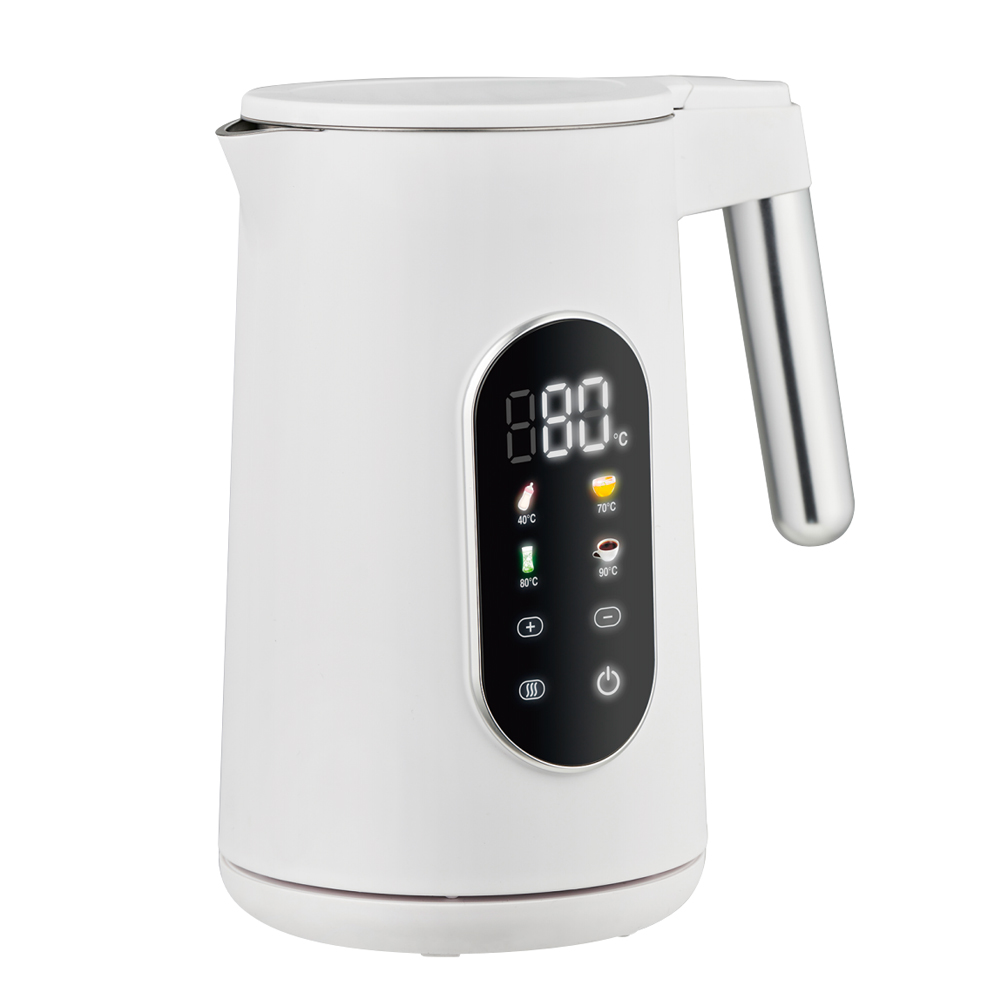
The design philosophy that eliminates these problems is double wall construction. By creating an air gap between the inner water chamber and the outer stainless steel shell, the exterior surface of the kettle remains cool enough to touch safely even when the water inside is boiling. This is not a marginal improvement — it is a categorical safety upgrade that eliminates the primary mechanism by which kettle burn injuries occur. For hotel procurement officers who are evaluating kettles for guest room use, the presence of genuine double wall construction should be considered a non-negotiable safety requirement, not an optional premium feature.
Engineering the Double Wall Structure: Why Air Gap Insulation Actually Works for Hot Beverage Equipment
The physics behind double wall insulation is well established, and it is the same principle that makes a Thermos bottle keep coffee hot and a cooler keep ice from melting. Heat transfer through a static air layer occurs through conduction and radiation, and the thermal conductivity of still air is approximately 0.025 watts per meter-kelvin at room temperature — roughly fifteen times lower than the thermal conductivity of water and thirty times lower than the thermal conductivity of aluminum. When you trap a layer of still air between the inner stainless steel water chamber and the outer stainless steel shell, the rate at which heat flows from the boiling water inside to the external surface drops dramatically compared to a single-wall kettle where the inner wall and outer surface are the same component.
In a properly constructed double wall kettle, the outer surface temperature when the inner water is boiling should not exceed 45 to 50 degrees Celsius under standard test conditions. At these temperatures, the outer surface feels warm to the touch but does not cause a burn injury even with prolonged contact. For comparison, a conventional single-wall Stainless Steel Kettle with water at 100 degrees Celsius will have an outer surface temperature of approximately 95 to 100 degrees Celsius — a temperature that causes partial-thickness burn injuries with just a few seconds of contact. The magnitude of this difference is not a matter of incremental safety improvement; it is a fundamental redesign that eliminates the hazard entirely under normal use conditions.
The quality of double wall construction varies significantly between manufacturers, and this is where the difference between hotel-grade and consumer-grade products becomes apparent. In high-quality double wall kettles, the air gap is maintained by precisely engineered internal support structures that keep the inner and outer walls concentric and prevent the gap from collapsing under the pressure changes that occur during heating and cooling cycles. The inner chamber is typically fabricated from food-grade 304 stainless steel with a wall thickness of 0.6 to 0.8 millimeters, and the joints where the inner chamber connects to the lid and base are welded with food-safe procedures that meet FDA food contact material requirements. Inferior double wall constructions may use thinner inner walls, less precise spacing structures, or lower-quality welding that can lead to the inner chamber developing leaks into the air gap over time — at which point the double wall benefit is lost and the kettle effectively becomes a single-wall product with a hidden moisture reservoir between the walls.
The distinction between a hotel-grade double wall kettle and a consumer retail model is not primarily about brand or price — it is about whether the kettle was engineered for the specific demands of commercial hospitality use, where a kettle must perform reliably for thousands of heating cycles per year with minimal maintenance and zero safety incidents.
Fast Boil Performance: Why North American Hotel Guests Cannot Wait Six Minutes for Water
North American business travelers and leisure guests have fundamentally different expectations around hot beverage preparation compared to their counterparts in regions where kettle use has been culturally dominant for decades. In the United States, the standard expectation for boiling a full kettle of water — approximately 1.5 to 1.7 liters — is four minutes or less. This expectation is shaped by the realities of morning routines in business hotels where guests are often racing to make early morning flights or meetings, by the behavior of American consumers who have grown accustomed to the fast boiling performance of single-serve coffee brewing systems that have become ubiquitous in North American kitchens, and by the general pace of life in markets where time is treated as a scarce and valuable resource in ways that hotel operators must respect if they want to maintain positive guest satisfaction scores.
A kettle that takes six or seven minutes to bring a full liter of water to boiling creates a genuine friction point in the guest experience. When we survey hotel guests about their most common amenity frustrations, slow boiling kettles appear frequently, particularly in reviews from Extended Stay and all-suite properties where guests may be making multiple hot beverages — coffee, tea, instant oatmeal, cup noodles — throughout the day as part of a routine rather than a single morning ritual. The cumulative time cost of a slow kettle over a multi-day stay can approach fifteen to twenty minutes of waiting, and this is time that the guest would much rather spend productively or relaxingly.
The heating element technology inside the kettle is the primary determinant of boiling speed, and here again the difference between hotel-grade and consumer-grade products is substantial. Professional hotel kettles typically use a disc heating element rated between 2,200 and 3,000 watts that provides rapid and even heat distribution across the bottom of the inner stainless steel chamber. The disc element design, where the heating element is fully encapsulated and in full contact with the inner stainless steel wall, provides better thermal transfer efficiency compared to the coil heating elements used in many consumer kettles, where the exposed heating coil has a larger surface area but less precise thermal contact with the water. The result is that a 2,400-watt disc element kettle will consistently boil a full liter of water in approximately three to three and a half minutes under normal voltage conditions, while a 1,500-watt coil element kettle of similar capacity may require five to six minutes for the same task.
The Critical Differences Between Hotel Guest Room Kettles and Consumer Home Kettles
When we work with North American hotel procurement teams who are evaluating kettle options, we find that many buyers initially approach the selection process with criteria borrowed from consumer retail shopping — price per unit, aesthetic appearance, brand recognition from consumer markets. These are not irrelevant factors, but they are insufficient on their own to identify the product that will perform reliably over the demanding usage patterns of commercial hospitality environments. The gap between consumer kettle design assumptions and commercial hospitality requirements is significant, and failing to account for it during procurement is one of the most common reasons that hotel kettle replacement programs underperform expectations.
A consumer home kettle is designed for personal or family use — perhaps 20 to 50 boiling cycles per month, with regular cleaning intervals, with a knowledgeable owner who reads the instruction manual and understands the product's limitations. A hotel guest room kettle is used by a new person every few days, is operated by people with widely varying levels of familiarity with kettle technology, and may go through 100 to 300 boiling cycles per month during peak occupancy periods. The design requirements for these two use cases are fundamentally different in almost every dimension: the hotel kettle must have a more durable heating element, a more robust switch mechanism that can survive repeated actuation by strangers, a cordless base with a more secure docking mechanism, and surfaces that can be cleaned and sanitized between guests without degrading.
Dry-boil protection is perhaps the single most important safety feature that distinguishes hotel-grade kettles from consumer models. A dry-boil scenario occurs when the kettle is switched on without sufficient water inside — either because a guest accidentally turned it on empty or because the water level was too low to register on the auto shut-off sensor. In a consumer kettle without robust dry-boil protection, the heating element can overheat to temperatures exceeding 200 degrees Celsius, potentially causing a fire hazard or permanently damaging the kettle's internal components. Hotel-grade kettles incorporate bimetallic thermostat switches that physically disconnect the heating circuit when the water chamber temperature exceeds a safe threshold, providing a mechanical fail-safe that operates independently of electronic sensors that could fail. This is the kind of redundant safety engineering that hotel procurement officers should require as standard, not as a premium option.
Materials and Food Safety Standards That Matter for Hotel Guest Room Kettles
Food-grade stainless steel is the material standard for professional hotel kettles, and for good reason. The 304 stainless steel grade used in high-quality kettle inner chambers is fully austenitic, non-magnetic, and highly resistant to corrosion and staining. It does not impart flavor to the water it heats, does not react with tea or coffee acids to release metallic compounds, and maintains its structural integrity through thousands of heating and cooling cycles without the warping or pitting that can occur with lower-grade stainless steel or aluminum constructions. Under NSF International food equipment standards, 304 stainless steel is the baseline requirement for food contact surfaces in commercial cooking and beverage equipment, and hotel procurement officers should request evidence of NSF certification as part of their supplier evaluation process.
The lid and handle materials are equally important from a food safety and durability standpoint. High-quality hotel kettles use polypropylene or polycarbonate lid components that are BPA-free, food-safe, and rated for continuous use at temperatures up to 130 degrees Celsius. These materials should not emit odor or flavor compounds when repeatedly heated — a problem that afflicts lower-quality kettles where the plastic components are manufactured from recycled materials or formulations that are not properly tested for food contact safety. The handle is typically overmolded onto a stainless steel structural frame using a soft-touch polymer that provides secure grip even when the handle surface is warm, which it will be on single-wall kettles even when the kettle itself is functioning normally.
For hotel properties operating in the United States, the FDA's Food Safety Modernization Act has heightened awareness of the materials used in food-contact devices provided to guests, and hotel legal and compliance teams are increasingly scrutinizing the material safety certifications for amenity products. We recommend that hotel procurement officers request a complete material disclosure and safety certification package from their kettle suppliers that includes FDA food contact material compliance documentation, California Prop 65 compliance for lead and phthalate content, and UL or ETL electrical safety certification for the heating element and electrical components. A supplier who cannot provide this documentation should be treated as a significant procurement risk.
Matching Kettle Specifications to Your Property Type and Guest Profile
Not all North American hotel properties have the same kettle requirements, and the differences matter for both guest satisfaction and operational efficiency. A full-service business hotel with primarily single-night stays by corporate travelers needs a kettle that boils quickly, looks clean and professional on the guestroom desk, and has straightforward controls that require no instruction. An extended-stay property where guests may be living out of the room for weeks needs a kettle that is durable enough to survive heavy daily use, has a capacity that supports multiple cups per boiling cycle, and is easy to descale when mineral deposits accumulate from tap water use. A boutique property where aesthetic design is part of the guest experience needs a kettle that is visually coordinated with the room design, perhaps in a matte black or brushed bronze finish rather than the standard polished stainless steel option.
Capacity is a frequently overlooked variable in hotel kettle selection. The standard capacity range for hotel guest room kettles is 1.0 to 1.7 liters, and we generally recommend the larger capacity for properties where the primary demographic includes families, extended-stay guests, or international travelers from cultures where tea is a significant daily beverage consumed in larger volumes per sitting. For business hotels where single-cup preparation for individual beverages is the dominant use case, a 1.0 to 1.2 liter kettle is typically sufficient and offers the advantage of faster boiling time for smaller water volumes.
Voltage and plug configuration must be matched precisely to the destination market. North American hotel properties require kettles configured for 120-volt 60-hertz electrical systems with NEMA 5-15 grounded plugs, which is a three-prong configuration with two flat parallel blades and a grounding pin. Properties operating in Canada use the same configuration, while hotel developments in Caribbean markets may use 220-volt systems that require different kettle specifications. We strongly recommend confirming the voltage and plug requirements with the property facilities team before finalizing kettle procurement orders, as mismatched voltage specifications can create safety hazards and will void the electrical safety certifications that procurement teams should be requiring from their suppliers.
A Procurement Framework for North American Hotel Operators Sourcing Kettles at Wholesale
Sourcing hotel guest room kettles at wholesale prices requires a procurement approach that is calibrated to the volume requirements and quality expectations of the commercial hospitality sector. Unlike consumer retail purchasing where the price is set by the manufacturer and the buyer's primary decision variable is where to purchase, wholesale procurement for hotel kettle programs involves negotiating unit pricing against volume commitments, establishing quality standards that are enforceable contractually, and building supply chain relationships that can provide responsive replenishment as properties open, renovate, or expand their room counts.
For hotel groups with 50 to 200 rooms, we recommend establishing a blanket order arrangement with a wholesale supplier that provides for quarterly delivery releases against an annual volume commitment. This structure gives the hotel group the benefit of negotiated volume pricing while maintaining flexibility to adjust delivery timing as actual room occupancy and renovation schedules evolve. For larger hotel groups operating 500 or more rooms across multiple properties, a competitive RFP process among three to five qualified wholesale suppliers typically produces the best pricing and service terms, with contracts structured for an initial 12 to 24 month term with options to renew based on supplier performance against quality and delivery metrics.
Quality enforcement is the element of hotel kettle procurement that separates successful programs from those that produce persistent guest complaints. We recommend specifying in your purchase agreements that all kettles must pass a pre-shipment quality inspection protocol that includes boiling time verification, dry-boil protection functional testing, exterior surface temperature measurement during boiling operation, and visual inspection for cosmetic defects. Some hotel procurement teams also require a sample evaluation period where an initial production batch of 25 to 50 units is deployed across a single property for a 60 to 90 day field evaluation before committing to larger volume orders, which provides real-world performance data that can identify issues that laboratory testing might miss.
Frequently Asked Questions About Hotel Guest Room Kettles for North American Properties
What is the ideal kettle capacity for a standard North American hotel guest room?
For the majority of North American hotel properties, a 1.5 to 1.7 liter capacity kettle strikes the optimal balance between versatility and boiling speed. This capacity accommodates everything from a single cup of tea or instant coffee to multiple servings for a guest sharing the room or preparing multiple hot beverages throughout the day. A 1.7-liter kettle at 2,400 watts will bring a full load to boiling in approximately four minutes at 120-volt supply, which meets the performance expectations of most North American business travelers. Properties serving a high proportion of international guests, particularly from markets where tea is consumed in larger volumes, may find that 1.7-liter capacity is the better choice to avoid the frustration of repeatedly boiling small quantities.
How do we prevent mineral scale buildup in hotel guest room kettles?
Mineral scale buildup from hard water is one of the most common causes of reduced boiling efficiency and early kettle failure in hotel applications. The most effective preventive approach is to provide guests with distilled or filtered water for kettle use — many hotel properties in hard water regions have guest room water filtration systems that can serve this purpose. For kettles that have already accumulated scale, regular descaling with a food-safe descaling solution every 60 to 90 days restores performance. Hotel-grade kettles with stainless steel inner chambers are significantly more resistant to scale adhesion compared to aluminum inner chambers, which is another reason to specify stainless steel construction as a baseline requirement.
How many boiling cycles should a hotel-grade kettle be designed to withstand before replacement?
A properly specified hotel-grade kettle should be designed for a service life of 3,000 to 5,000 boiling cycles under typical hotel occupancy conditions. This translates to approximately 3 to 5 years of service in a high-occupancy business hotel, and potentially 6 to 8 years in a lower-occupancy property. The primary failure modes that limit service life are typically the switch mechanism wearing out after repeated actuation, the heating element developing hot spots that reduce efficiency, and the power cord developing internal fractures from repeated flexing during cord wrapping. Choosing kettles with mechanical thermostat switches rather than electronic controls, and specifying models with cord wrap management built into the kettle base, directly extends the serviceable life of each unit.
What electrical safety certifications must hotel guest room kettles have for the US market?
In the United States, hotel guest room kettles must carry UL or ETL listing to applicable Underwriters Laboratory standards for household cooking appliances, which validates the safety of the heating element, the electrical cord and plug assembly, the auto shut-off and dry-boil protection mechanisms, and the structural integrity of the kettle body under heating stress. The FDA food contact material regulations govern the safety of the stainless steel inner chamber and plastic components that contact food or beverages. California properties must also ensure compliance with California Prop 65 requirements for lead, cadmium, and phthalate content. We recommend requesting copies of all relevant certifications from your supplier before placing orders and verifying that the certification numbers can be confirmed on the certifying organization's public database.
What is the typical wholesale price range for hotel-grade double wall kettles in the North American market?
Wholesale pricing for hotel-grade double wall kettles from established manufacturers typically ranges from 28 to 55 USD per unit depending on capacity, finish specification, and the volume commitment associated with the order. Entry-level hotel-grade double wall models in the 1.5-liter capacity range with standard polished stainless steel finish are available in the 28 to 38 USD range at moderate volumes of 200 to 500 units. Premium models with enhanced finishes, higher wattage for faster boiling, and certifications that meet the requirements of luxury hotel brands typically fall in the 42 to 55 USD range. Properties purchasing fewer than 50 units at a time should expect to pay unit prices at the higher end of these ranges or to source through a hospitality amenity distributor rather than direct from the manufacturer.
If you are evaluating double wall kettle options for your North American hotel property, we invite you to browse our complete product selection on our products page, where you can view the full range of capacities, finishes, and specifications available for hospitality procurement programs. Our team has extensive experience supplying kettle programs for hotel groups across the United States and Canada, and we can provide sample units for evaluation along with volume pricing structures calibrated to your property count and ordering patterns.
For a closer look at our dedicated hotel kettle product lines and the engineering design features that distinguish them from consumer market alternatives, please visit our double wall stainless steel kettle series page where we provide detailed technical specifications and application guidance for hospitality procurement professionals.