
 0086-574-62518288


TL;DR
- A concealed flat-plate heating element survives 5,000+ boil-dry cycles where exposed coil elements burn out in 30-60 seconds — the flat plate distributes heat across a larger surface area, reaching 200-250°C before the thermal cutout activates versus 300-400°C for an exposed coil that exceeds its failure temperature before the cutout can respond.
- The bimetallic thermal cutout is the single most critical safety component — a disc that snaps at 130-150°C, mechanically disconnecting the circuit. It must be rated for 100,000+ cycles and automatically reset when the kettle cools. The cutout, not the user, is the last line of defense against fire.
- AS/NZS 60335.2.15 with SAA approval is mandatory for all Electric Kettles sold in Australia — covering the boil-dry test (safe disconnection within 60 seconds), stability test (10° incline), and cord strain relief (60 N pull, 25 cycles). Without the SAA mark, the kettle cannot be legally supplied to Australian residential accommodation.
- A 1.7L kettle with a 2,200W concealed element boils in 2 minutes 35-55 seconds at 230V Australian mains — the fast boil time reduces queuing during peak usage (7-9 AM, 6-8 PM) in shared student kitchens. The incremental cost of 2,200W over 1,500W is approximately $0.80 per unit at wholesale.
Why a Domestic Kettle Fails in Student Housing — And What Operators Must Specify Instead
Australian university and private student housing accommodation operates kettles under conditions that no domestic appliance standard fully anticipates. A kettle in a 4-bedroom student apartment in Sydney, Melbourne, or Brisbane is used 15-25 times per day — compared to 3-5 times in a family home. It is shared by four residents, none of whom own it, and all of whom treat it with precisely the care that economic theory predicts for a shared resource. It is boiled dry when someone switches it on without checking the water level. It is left on after the last cup on Friday afternoon and discovered still warm on Monday morning — the auto shut-off having cycled dozens of times over the weekend. It is filled to the 1.7L maximum mark and boiled for a single cup of instant noodles. It is dropped. It is descaled never.
Because Australian student housing operators are legally responsible for electrical safety under state-based residential tenancy laws, therefore the kettle must meet AS/NZS 60335.2.15 with SAA (Standards Australia) approval. This is not a quality standard. It is a legal requirement. The standard mandates three tests that are directly relevant to student housing conditions: the boil-dry test (the kettle must disconnect safely within 60 seconds of boiling dry and must not create a fire hazard), the stability test (the kettle must not tip when placed on a 10° incline — simulating a crowded bench where the power cord is pulled), and the cord strain relief test (the cord must withstand 60 N of pull force for 25 cycles without the internal connections being stressed). A kettle without the SAA mark on its rating label cannot be legally supplied to any Australian residential accommodation. The operator who purchases a non-compliant kettle to save $5 per unit is accepting unlimited liability exposure. Good Friends Kettle products carry full SAA certification.
The Boil-Dry Survival Test — Why Concealed Elements Are Non-Negotiable
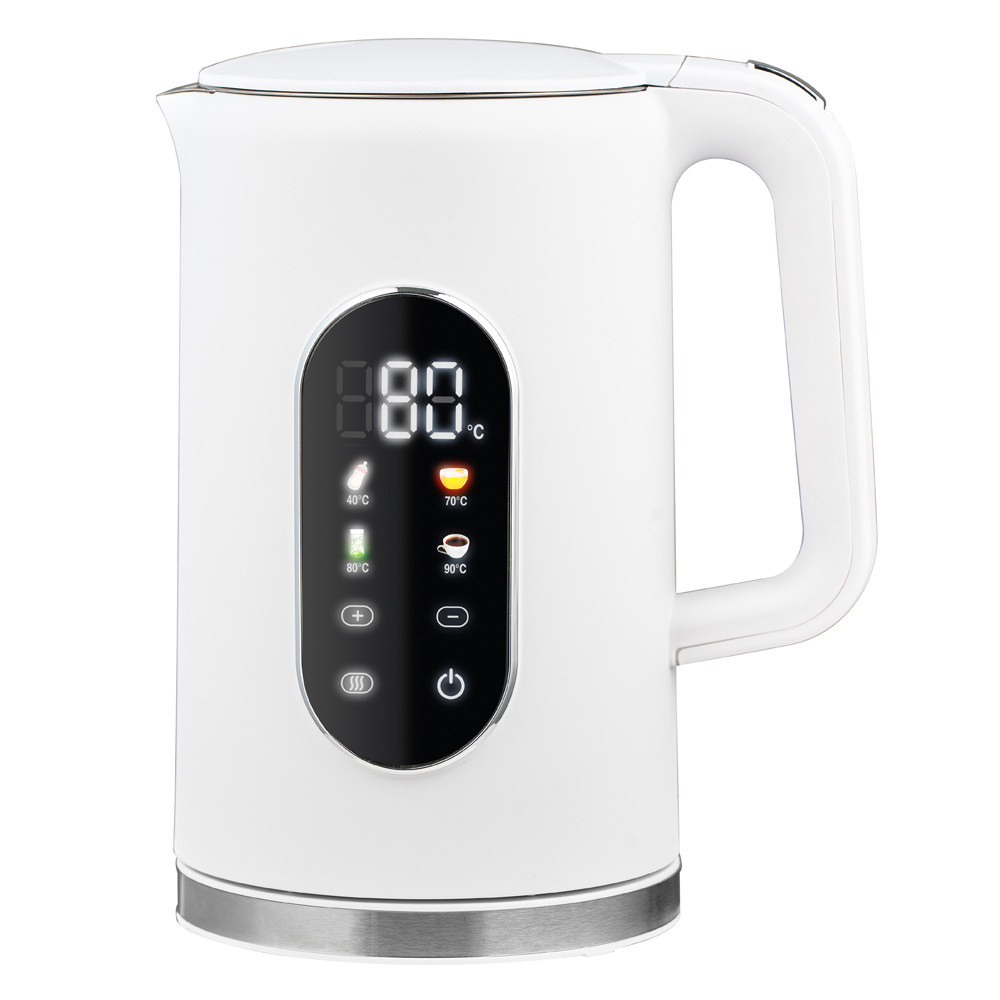
The most common kettle failure mode in student housing is boil-dry: a resident switches the kettle on with no water inside. The heating element temperature rises from ambient to failure temperature within 60-90 seconds. The difference between a kettle that survives this event and a kettle that is destroyed by it comes down to element design.
An exposed coil element — the spiral of nichrome resistance wire visible at the bottom of budget kettles — has low thermal mass. Under dry operation, the coil temperature reaches 300-400°C within 30-45 seconds. At this temperature, the nichrome wire oxidizes rapidly, the electrical resistance increases, and the wire eventually melts or burns through — an open-circuit failure that renders the kettle scrap. The thermal cutout, which is mounted on the kettle body beneath the element plate, may not register the coil temperature quickly enough to disconnect before the coil fails. Because the thermal path from the exposed coil through the air gap to the cutout is slow compared to the coil's self-heating rate, therefore the cutout responds too late. The coil is destroyed before the cutout opens.
A concealed flat-plate element — a stainless steel plate bonded to the bottom of the kettle body with the heating element embedded within the plate — has significantly higher thermal mass and a much larger surface area. Under dry operation, the plate temperature reaches 200-250°C before the thermal cutout activates. This is below the failure temperature of the embedded element and the stainless steel plate. Because the element is in direct thermal contact with the plate and the plate is in direct contact with the cutout, therefore the thermal response is fast enough that the cutout opens before the element reaches its failure temperature. The kettle survives the boil-dry event.
The thermal cutout itself is a bimetallic disc — two different metals bonded together with different coefficients of thermal expansion. When heated to the calibrated temperature (typically 130-150°C), the differential expansion causes the disc to snap from concave to convex, mechanically separating the electrical contacts. When the disc cools below the reset temperature, it snaps back, reconnecting the circuit. The cutout must be rated for a minimum of 100,000 cycles to survive the expected service life of a student housing kettle — approximately 5-7 years at 25 cycles per day. Because the cutout is the only component that prevents the kettle from becoming a fire hazard during a boil-dry event, therefore it is functionally a safety device, not a convenience feature. Good Friends Kettle specifies bimetallic cutouts rated for 100,000+ cycles from qualified suppliers with full traceability to the production batch.
Fast Boil — The 2,200W Specification That Reduces Queues
A 1.7L kettle with a 2,200W heating element brings water from 20°C to 100°C in approximately 2 minutes 35-55 seconds at the Australian mains voltage of 230V. The physics: the specific heat capacity of water is 4,186 J/kg·°C. Heating 1.7 kg of water through an 80°C temperature rise requires 569,000 Joules. At 2,200W (2,200 J/s), the theoretical minimum time is 259 seconds (4:19). The actual time is shorter because heat transfer begins before the element reaches full temperature, and nucleate boiling at the element surface begins at approximately 95-97°C rather than 100°C for the bulk water. The measured boil time for our 2,200W kettle at 230V is 2:35-2:55.
At 1,500W, the same 1.7L of water takes approximately 6 minutes to boil. The difference — roughly 3 minutes per boil cycle — becomes significant in a shared kitchen during the morning peak. Four residents each making one hot beverage between 7:00 and 8:30 AM, with a 2,200W kettle, spend approximately 12 minutes of total boil time. With a 1,500W kettle, they spend approximately 24 minutes — and the last resident may be late for their 9 AM lecture. Because the cost difference between a 1,500W and 2,200W element is approximately $0.80 per unit at wholesale quantities, therefore specifying the higher-wattage element is perhaps the single highest-ROI specification decision a student housing operator can make. The $0.80 upfront cost eliminates 12 minutes of cumulative waiting time every morning for the kettle's entire 5-7 year service life. Browse our double wall kettle series and all products.
Stainless Steel Construction — Why Plastic Kettles Fail the Taste Test
Polypropylene-bodied kettles dominate the budget segment because polypropylene is cheap, lightweight, and molds easily. But polypropylene has a significant disadvantage for a shared kettle used 25 times daily: it retains flavors. The porous surface of injection-molded polypropylene absorbs volatile organic compounds from the boiled water — particularly the aromatic oils in tea and coffee. After approximately 6 months of heavy use, the kettle imparts a detectable plastic-tinged flavor to plain boiled water. The residents notice. They complain to the housing operator. The operator replaces the kettle.
Stainless steel 304 (18/8) is chemically inert and flavor-neutral. It neither absorbs nor releases volatile compounds. Double-wall construction — an inner and outer steel shell with an air gap between them — provides two additional benefits: the exterior stays cool to the touch even when the interior contains boiling water (reducing the burn risk in a shared kitchen), and the air gap provides a modest insulating effect that keeps water hot for 15-20 minutes after boiling. Because the double-wall kettle costs approximately $3-5 more than a single-wall Stainless Kettle and $6-8 more than a plastic kettle at wholesale, therefore the premium is modest relative to the 5-7 year service life and the elimination of plastic-taste complaints.
Descaling and Maintenance — The Protocol That Extends Kettle Life to 5-7 Years
Australian water hardness varies dramatically by region. Sydney water is soft (50-60 mg/L CaCO3 equivalent). Adelaide water is hard (120-150 mg/L). Perth and Brisbane fall in between (80-120 mg/L). In hard-water regions, calcium carbonate scale builds up on the heating element surface at a rate of approximately 0.1-0.3 mm per 1,000 boil cycles. Scale is an effective thermal insulator — because a 0.5 mm scale layer increases the thermal resistance between the element and the water by approximately 30-40%, therefore a scaled kettle takes longer to boil, consumes more electricity per boil cycle, and exposes the element to higher operating temperatures because the heat cannot transfer efficiently to the water.
For student housing operators managing 50-200 kettles across multiple properties, a systematic descaling protocol is essential. The protocol I recommend: descale every 3 months in hard-water regions, every 6 months in soft-water regions. Use food-grade citric acid (2 tablespoons per full kettle, fill with water, boil, let stand for 30 minutes, rinse thoroughly) rather than aggressive chemical descalers that can attack the silicone gaskets and the stainless steel surface. Because citric acid is a mild organic acid that chelates calcium ions without corroding stainless steel, therefore it removes scale effectively without damaging the kettle components. Aggressive descalers containing hydrochloric or sulfamic acid will descale faster but will also etch the stainless steel surface, degrade the silicone gaskets, and potentially damage the concealed element's bonded seal over repeated use.
Between descaling cycles, I recommend a visual inspection of the element plate during the weekly room inspection. A white, chalky deposit on the element surface indicates scale buildup. If the deposit is thick enough to obscure the stainless steel surface, descale regardless of the calendar schedule. If the element plate is still shiny and metallic, the descaling can wait. Because scale buildup accelerates as the surface roughness created by the initial scale layer provides nucleation sites for additional calcium carbonate crystal growth, therefore early descaling — when the scale layer is still thin and easily dissolved — is far more effective than waiting until a thick, hard scale crust has formed. Browse our double wall kettle series for low-maintenance designs.
Frequently Asked Questions
What certification is required for electric kettles sold in Australia?
AS/NZS 60335.2.15 with SAA (Standards Australia) approval. The standard covers the boil-dry test (safe disconnection within 60 seconds, no fire hazard), stability test (no tipping at 10° incline), and cord strain relief (60 N pull, 25 cycles). Without the SAA mark on the rating label, the kettle cannot be legally supplied to any Australian residential accommodation. Good Friends Kettle products carry full SAA certification.
How many boil-dry cycles must a student housing kettle survive?
Minimum 5,000 boil-dry cycles without thermal cutout failure. The bimetallic cutout must be rated for 100,000+ cycles. A concealed flat-plate element survives dry operation because it reaches only 200-250°C before cutout activation. An exposed coil element reaches 300-400°C and burns out in 30-60 seconds. Verify the element type before purchasing — concealed elements are essential for high-turnover environments.
Why stainless steel instead of plastic for student housing?
Stainless steel 304 (18/8) is chemically inert and flavor-neutral. Polypropylene absorbs coffee and tea oils after ~6 months of heavy use, imparting a detectable plastic taste. Double-wall stainless construction keeps the exterior cool and provides modest heat retention. The $6-8 premium over plastic eliminates taste complaints for the kettle's 5-7 year service life.
What plug and voltage standard for Australia?
230V/50Hz with AS/NZS 3112 3-pin plug (Type I, angled flat pins). 360° cordless base with British-style power connection. Power cord length: 0.75m maximum per Australian safety standard for Cordless Kettles — prevents tripping in small kitchens with limited bench space.
What is the MOQ and lead time for bulk orders?
Standard SAA-certified models: 200-500 units per SKU, 30-45 day lead time. Custom branding (logo, color, packaging) adds 2-3 weeks. SAA-certified stock available for urgent orders. Contact us for wholesale pricing.