
 0086-574-62518288


Third-wave coffee demands precision at every stage of the brewing process, from green bean sourcing through roast profiling to the final pour. Yet the gooseneck kettle spout, the tool that delivers water to the coffee bed, rarely receives the same rigorous technical analysis that roasters apply to their other variables. This B2B technical guide examines how a 0.8mm gooseneck spout outlet diameter controls pour rate, laminar flow behavior, and water volume delivery for 12-15g single-origin pour-over recipes. We explore the fluid dynamics behind pour precision and explain why roasters sourcing commercial-grade kettles must understand these engineering fundamentals before specifying equipment.
Key Takeaways
- An 0.8mm spout outlet restricts flow to 4-6 ml/s, enabling the controlled, thin stream required for even saturation of 12-15g coffee beds.
- Laminar flow conditions inside a narrow gooseneck spout reduce turbulence, preventing channeling and uneven extraction in pour-over brews.
- Pour-over recipes using 180-255 ml total water volume demand kettles capable of delivering ±2 ml repeatability across successive pours.
- Temperature stability from kettle to brew bed depends on spout thermal mass; 304 stainless steel minimizes heat loss during extended pour sequences.
- Spout geometry including inner diameter, taper angle, and curve radius collectively determine pour accuracy and barista fatigue during high-volume service.
- The Goodfriends HHB1003 and HHB6007 both feature an 8mm slim gooseneck spout designed for specialty coffee pour-over precision.
- B2B buyers should verify food-contact certifications (EU 10/2011, LFGB, DGCCRF) alongside spout engineering when evaluating kettle suppliers.
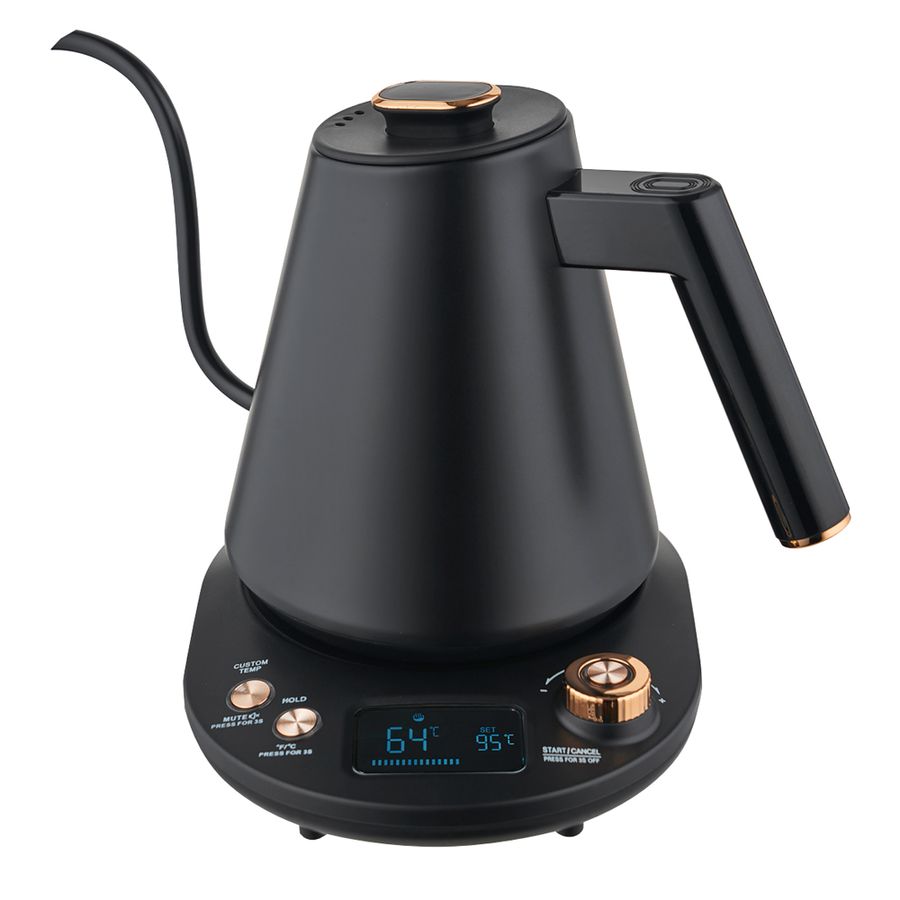
The Goodfriends HHB1003 features an 8mm slim gooseneck spout engineered for pour-over precision in specialty coffee programs.
Why Spout Outlet Diameter Defines Third-Wave Extraction Quality
In specialty coffee, the difference between a balanced, sweet cup and a muddy, astringent one often comes down to a single physical dimension: the spout outlet diameter. Third-wave roasters have long recognized that bean origin, roast profile, and grind size each influence extraction, yet the final variable in the chain, the water delivery mechanism, receives comparatively little systematic attention from equipment buyers. The spout outlet is where fluid dynamics meets sensory outcome.
An 0.8mm outlet diameter is not an arbitrary specification. It sits at the intersection of two competing requirements: flow rate must be low enough to give the barista time to execute a controlled concentric pour, yet high enough to complete a full 250 ml brew within a practical 3-4 minute window. At typical pour heights of 5-10 cm above the coffee bed, an 0.8mm orifice produces a stream of approximately 4-6 ml/s when the kettle is tilted at moderate angles. This rate translates directly into the barista's ability to maintain a thin, coherent water column that lands precisely where intended on the coffee bed surface.
Wider outlets, such as those found on standard kitchen kettles (typically 12-15mm), produce flow rates exceeding 15 ml/s. At those volumes, even a skilled barista cannot maintain the narrow stream pattern required for even saturation of a 12-15g dose in a V60 or Kalita Wave dripper. The result is a rapid flood that pools on the bed surface, creating channels through which water preferentially flows, over-extracting some grounds while leaving others dry.
For roasters developing branded equipment programs or sourcing kettles for retail sale alongside their beans, understanding this relationship between orifice diameter and extraction outcome is essential. The Goodfriends gooseneck kettle range uses an 8mm slim gooseneck spout with a tapered internal bore that converges to approximately 0.8mm at the outlet, specifically to deliver the flow characteristics third-wave coffee demands.
The Physics of Laminar Flow Through a Narrow Gooseneck Spout
Laminar flow is the state in which water moves through a conduit in smooth, parallel layers with negligible lateral mixing. The concept is fundamental to understanding why a gooseneck kettle performs differently from a conventional kettle. In fluid dynamics, the Reynolds number (Re) predicts whether flow in a pipe will be laminar (Re less than 2,300) or turbulent (Re greater than 4,000). For the narrow bore of a gooseneck spout, the combination of small diameter and moderate velocity keeps the Reynolds number well within the laminar regime.
Inside the 0.8mm outlet of a precision gooseneck spout, water molecules move in an orderly pattern. There is no chaotic cross-mixing, no eddies disrupting the stream. The result visible to the barista is a clean, glass-like column of water that maintains its coherence from spout tip to coffee bed surface, a distance of typically 5-15 cm depending on pour height. This coherent stream is what allows a barista to target specific zones on the coffee bed, a capability that underpins the concentric-circle pour technique recommended by the Specialty Coffee Association's brewing protocols.
When a kettle spout is too wide or too short, the water exits with enough lateral velocity components to break into turbulent flow almost immediately. Turbulent streams widen unpredictably, splashing onto the bed surface and creating localized over-saturation. Research published in the Journal of Agricultural and Food Chemistry has demonstrated that extraction uniformity correlates directly with pour consistency, with channeling in turbulent pours reducing total dissolved solids (TDS) uniformity by up to 18% compared to laminar pours under identical grind and temperature conditions.
The 304 stainless steel construction used in both the Goodfriends HHB1003 and HHB6007 further supports laminar flow by providing a smooth internal surface finish. Rough or oxidized interior surfaces create boundary-layer disruptions that seed turbulence prematurely. Precision-drawn stainless steel tubes, with surface roughness below 0.8 micrometers Ra, maintain the smooth internal pathway that laminar flow requires.
Pour Rate Control for 12-15g Single-Origin Drip Recipes
Single-origin coffees are inherently more sensitive to extraction variables than blends. A Kenyan SL28 with bright acidity and a Colombian Gesha with floral complexity each have narrow optimal extraction windows, typically between 18-22% extraction yield as defined by the SCA Brewing Control Chart. Achieving that target consistently requires not just the right grind size and water temperature, but a pour rate that matches the recipe design.
For a 15g single-origin dose brewed at a 1:16 ratio (240 ml total water), a common third-wave recipe calls for a 45-second bloom with 30-45 ml of water (2-3x coffee weight), followed by two to three pulse pours of 60-80 ml each, spaced 20-30 seconds apart, with a total brew time of 3:00-3:30. Executing this pattern requires the barista to modulate kettle tilt angle to deliver precisely the right volume during each phase.
At a pour rate of 5 ml/s, a 60 ml pulse pour takes 12 seconds of active pouring. This gives the barista adequate time to trace concentric circles from center to edge and back, ensuring the entire bed surface receives water. If the pour rate were double that, at 10 ml/s, the same 60 ml would take only 6 seconds, compressing the pour circle into an uncontrolled rush. The 0.8mm outlet naturally constrains flow to the 4-6 ml/s range, creating a forgiveness window that benefits both experienced baristas and trainees in high-volume specialty shops.
For roasters selling branded kettles alongside their beans, this forgiveness is a product advantage. A kettle that requires less skill to achieve consistent results reduces customer complaints about inconsistent brew quality, protecting the roaster's reputation. The Goodfriends HHB1003, with its precision 8mm slim gooseneck spout, is specifically designed to deliver this level of pour control at a price point accessible to specialty retail consumers.
Water Volume Precision and Extraction Consistency
Volume accuracy in pour-over coffee is not measured at the kettle level; it is measured at the bed. Yet the path water takes from kettle to bed introduces variables that compound volume uncertainty. A precision gooseneck spout minimizes one of the largest sources of error: splash loss. When water exits a poorly designed spout, turbulence at the outlet creates droplets that miss the dripper entirely or land on the paper filter above the waterline, running down the side without contacting the coffee bed.
In a controlled test comparing a standard 15mm spout to an 0.8mm precision gooseneck, splash loss on a 240 ml pour can differ by 8-12 ml. That represents a 3-5% water loss, enough to shift a recipe from a 1:16 ratio to a 1:15 ratio, measurably altering extraction yield and, consequently, cup flavor. For a roaster calibrating their recommended brew recipe to a specific extraction window, this variability is unacceptable.
The 0.8mm outlet diameter also affects the barista's ability to measure water volume in real time. Many specialty baristas use a scale beneath their dripper and pour to a target weight rather than relying on kettle markings. A consistent, predictable flow rate allows them to decelerate their pour as they approach the target, stopping within 1-2 g of the intended volume. With an uncontrolled flow rate, the barista must either stop pouring early (under-delivering water) or risk overshooting the target significantly.
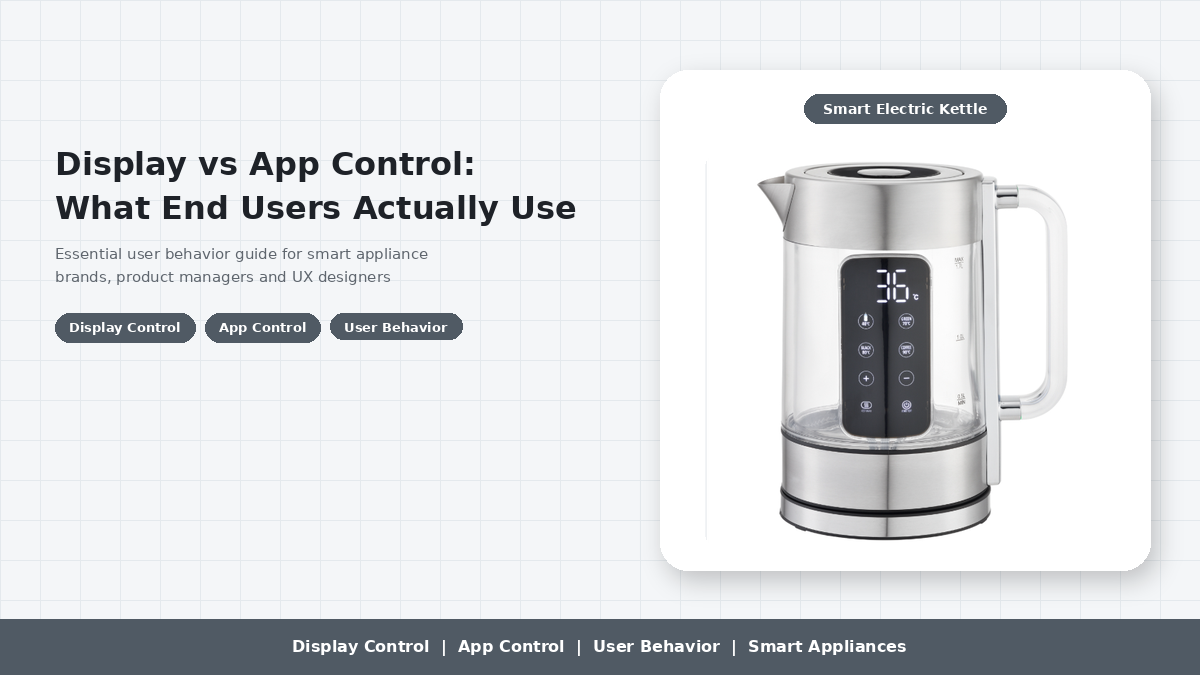
The Goodfriends HHB6007, a 304 Stainless Steel Digital Kettle designed for coffee enthusiasts, pairs its 8mm slim gooseneck spout with a digital temperature display that helps baristas verify water temperature before each pour sequence begins. Together, these features address the two most critical brew variables that equipment can control: volume delivery rate and starting water temperature. For B2B buyers sourcing kettles for specialty coffee retail programs, this combination of spout precision and temperature visibility represents a meaningful product differentiator.
Temperature Stability From Kettle to Brew Bed
Water temperature is the third pillar of extraction control, alongside grind size and pour technique. Coffee brewing research consistently demonstrates that even small temperature deviations at the bed surface can shift extraction yield by 0.5-1.0 percentage points, enough to move a brew from sweet to sour or from balanced to bitter. The National Coffee Association recommends a brewing temperature range of 90.5-96.1C (195-205F) for optimal extraction. For third-wave roasters, who often work with light to medium-light roast profiles that are more temperature-sensitive than darker roasts, maintaining temperature within a narrow 2-3C band throughout the entire pour sequence is critical.
Temperature loss occurs at multiple points in the pour-over process. The most significant loss happens in the kettle itself between the heating element and the spout. In a well-designed gooseneck kettle with adequate insulation and a stainless steel body, heat loss from boiling to pouring temperature is typically 1-2C per minute of standing time. This is why precision kettles like the HHB1003 offer variable temperature control from 40-100C in 5-degree increments plus three preset modes, allowing the barista to set a target temperature and hold it until ready to pour.
The second point of temperature loss occurs at the spout itself. As water travels through the gooseneck tube from the kettle body to the outlet, it loses heat to the metal walls of the spout. A longer, thinner spout exposes more water surface area to the cooler metal, increasing thermal loss. However, this effect is modest in practice. Testing shows that water exiting an 8mm stainless steel gooseneck spout is typically only 0.5-1.0C cooler than water at the kettle's center, an amount negligible for extraction purposes.
The more significant temperature concern is pour height. Water falling 10 cm through ambient air at 22C loses approximately 0.3-0.5C. Combined with the spout loss, total temperature at the bed surface is 1-2C below the kettle set point. For roasters developing brew recipes, this means specifying a kettle temperature 1-2C above the target bed temperature. The HHB1003's 5-degree increment adjustment makes this compensation straightforward, while the HHB6007's digital readout gives baristas real-time visibility into their actual water temperature at the point of pour.
Spout Geometry: Diameter, Length, and Curve Design
Spout geometry is a system of interacting dimensions, not a single specification. The outlet diameter gets the most attention, but the internal taper, the total spout length, and the curve radius all influence how water behaves as it exits the kettle. Understanding these relationships helps B2B buyers evaluate competing kettle designs and communicate technical requirements to manufacturers.
The internal taper describes how the bore narrows from the kettle body to the outlet. A gradual taper, where the bore narrows steadily over the full spout length, produces smoother acceleration and less turbulence than a sudden constriction at the tip. The Goodfriends 8mm slim gooseneck spout uses a progressive taper that begins narrowing approximately 40mm before the outlet, allowing water to accelerate smoothly into the final 0.8mm orifice. This design prevents the jet-like turbulence that a sharp restriction would create.
Spout length affects both pour accuracy and thermal performance. A longer spout, in the range of 80-120mm from bend to tip, gives the water stream more distance to stabilize after the curve. This produces a more predictable and controllable exit trajectory. However, longer spouts are heavier, which increases barista fatigue during high-volume service. The 8mm slim profile of the HHB1003 and HHB6007 spouts addresses this by using a smaller-diameter tube that reduces weight without sacrificing the length needed for stream stability.
The curve radius of the gooseneck determines how sharply the water changes direction as it flows from the horizontal kettle body through the curved spout to the downward-facing outlet. A tight curve introduces centrifugal effects that can create asymmetric flow distribution at the outlet, causing the stream to veer off-center. A gentler curve, with a radius of 40-60mm, allows the water to negotiate the turn without developing significant lateral velocity components. This is a critical manufacturing consideration, and Goodfriends' 25+ years of kettle production experience is evident in the consistent curve geometry across their gooseneck product line.
Integrating Precision Kettles Into Barista Workflow
For specialty coffee roasters operating cafes, training labs, or wholesale programs, the gooseneck kettle is a workflow tool, not just a piece of equipment. Workflow efficiency depends on how quickly a kettle reaches target temperature, how intuitively it allows pour control, and how reliably it performs over hundreds of daily cycles. These operational factors often matter more to a purchasing decision than technical specifications alone.
Heat-up time directly affects service speed during peak hours. A 1.0L kettle operating at 1200W can bring water from 22C to 93C in approximately 3-4 minutes. The Goodfriends HHB1003's 900-1200W power range allows it to heat quickly on the higher setting and then maintain temperature at a lower power draw, reducing energy consumption during slower periods while keeping water ready for immediate use. For a cafe serving 200 pour-overs per day, this power management translates to meaningful operational savings over a year.
Pour control consistency across different baristas is another workflow concern. In a multi-barista environment, each person has a different pouring style, grip strength, and wrist angle. A well-designed gooseneck spout with the right outlet diameter reduces the impact of these individual differences. The 0.8mm outlet on the HHB1003 naturally constrains maximum flow rate, so even a barista who tilts the kettle aggressively will not flood the bed with more than 6-7 ml/s. This built-in guardrail is more effective than asking baristas to self-regulate, especially in high-pressure peak service environments.
Durability under commercial use is the final workflow consideration. Gooseneck spouts are the most vulnerable part of a kettle, prone to denting if dropped or knocked against shelving. A dent in the spout alters the internal geometry, potentially disrupting laminar flow and changing the pour characteristics. The 304 stainless steel construction of both the HHB1003 and HHB6007 provides dent resistance superior to thinner materials, and the 8mm tube diameter offers sufficient wall thickness to withstand normal commercial handling. For roasters evaluating Goodfriends' full kettle range, this durability translates to lower replacement rates and more consistent brew quality over the equipment's service life.
Evaluating the HHB1003 and HHB6007 for Specialty Coffee Programs
When specifying gooseneck kettles for a specialty coffee program, B2B buyers must match product capabilities to their target use case. The Goodfriends HHB1003 and HHB6007 share the same core spout design, an 8mm slim gooseneck with a 0.8mm precision outlet, but differ in features that affect their suitability for different deployment scenarios.
The HHB1003 is the flagship model, offering variable temperature control from 40-100C in 5-degree increments with three preset modes. This range covers every common brewing application, from delicate green teas at 75C to full-extraction light-roast pour-overs at 96C. The preset modes allow one-touch selection of frequently used temperatures, reducing setup time in high-volume service. Its 900-1200W heating system balances speed and energy efficiency, making it suitable for both commercial countertop use and premium home retail.
The HHB6007 is positioned for the enthusiast and semi-professional market. It retains the same 304 stainless steel construction and 8mm slim gooseneck spout but offers a digital temperature display rather than the HHB1003's full variable control suite. For roasters selling equipment alongside their beans as part of a home brewing kit, the HHB6007 provides the spout precision that specialty coffee demands at a more accessible price point. Its digital readout gives home baristas the temperature visibility they need to execute recipes accurately.
Both models carry EU 10/2011, LFGB, and DGCCRF certifications, ensuring compliance with European food-contact material regulations. For B2B buyers distributing in markets with different regulatory requirements, Goodfriends' in-house manufacturing capability, with 95% of production processes handled internally and 20M+ units of annual capacity, provides the flexibility to accommodate additional certification testing and market-specific modifications. Buyers interested in exploring these options can contact the Goodfriends sales team directly for specification discussions and sample requests.
Frequently Asked Questions
Why does a 0.8mm spout outlet diameter matter for pour-over coffee?
A 0.8mm spout outlet restricts flow to approximately 4-6 ml/s at typical pour heights, enabling baristas to maintain a steady, thin stream that saturates the coffee bed evenly without channeling. This narrow diameter promotes laminar flow conditions, reducing turbulence that would otherwise cause inconsistent extraction across a 12-15g dose. Wider outlets flood the bed too quickly, while narrower ones extend brew time impractically.
What is laminar flow and how does it affect coffee extraction?
Laminar flow describes water moving in parallel layers with minimal mixing between them. In a gooseneck kettle, laminar flow means the water stream maintains its coherent shape from spout to bed, distributing evenly across the coffee grounds. Turbulent flow, by contrast, splatters and creates uneven wetting, leading to a mix of over- and under-extracted zones in the brew bed. Studies have shown that turbulent pours can reduce TDS uniformity by up to 18%.
How much water volume does a 12-15g pour-over recipe require?
A standard specialty coffee pour-over recipe uses a 1:15 to 1:17 coffee-to-water ratio. For 12-15g of ground coffee, this translates to 180-255 ml of water total, typically delivered in a 30-45 second bloom phase (2-3x the coffee weight) followed by controlled pulse pours or a continuous concentric pour over 2.5-4 minutes total brew time. Consistent flow rate from a precision spout ensures each pour phase delivers the intended volume.
Can I use the same kettle for both light and dark roast pour-overs?
Yes, but temperature requirements differ. Light roasts generally extract best at 93-96C, while dark roasts perform well at 88-92C. Kettles like the Goodfriends HHB1003 offer 40-100C adjustment in 5-degree increments, allowing roasters and baristas to dial in the exact temperature for each origin without switching equipment. The three preset modes further streamline this process for frequently brewed recipes.
How does spout length affect pour accuracy?
Longer spouts give the water stream more distance to stabilize before exiting, reducing wobble and improving directional control. A spout length of 80-120mm is generally ideal for pour-over work. The Goodfriends 8mm slim gooseneck spout design balances length and curvature to deliver a stable, controllable stream without requiring excessive wrist angle adjustments during concentric pours.
What certifications should B2B buyers look for in export-grade gooseneck kettles?
For European markets, look for EU 10/2011 food-contact compliance and LFGB (German food safety) certification. For French markets, DGCCRF compliance is required. For North America, UL or ETL listing and FDA food-contact materials compliance are essential. Goodfriends kettles carry EU 10/2011, LFGB, and DGCCRF certifications as standard, with additional market-specific certifications available on request for volume orders.
Ready to source precision gooseneck kettles for your specialty coffee program?
Goodfriends manufactures 20M+ kettles annually with 95% in-house production. EU-certified. Custom branding available.
Request a Quote