
 0086-574-62518288


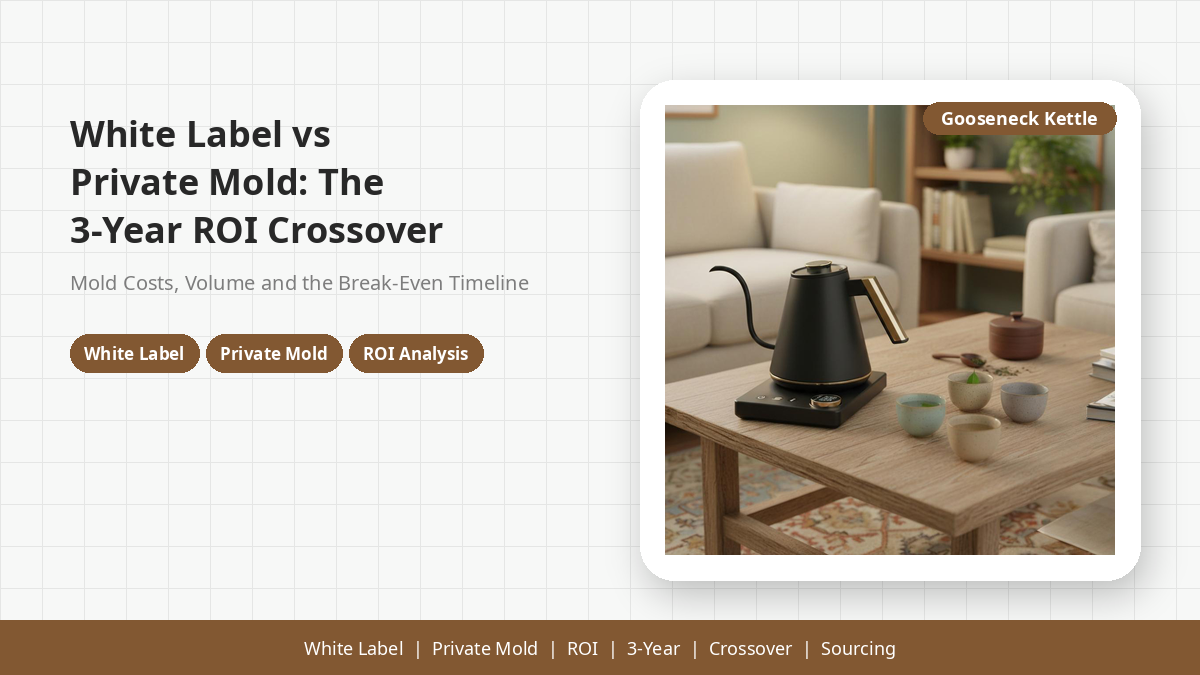
- Variable temp accuracy: ±1°C from 40°C to 100°C — precision within specialty coffee brewing tolerance
- Food contact compliance: EU Regulation 10/2011, LFGB, DGCCRF — full documentation provided
- OEM MOQ: 200–300 pieces per model for custom color/logo; mixed 40ft container most cost-effective
- Temperature hold: Up to 60 minutes at target temperature on digital models
- Lead time: 7–10 weeks door-to-port from sample approval
- Custom branding: Laser engraving, Pantone color match, custom packaging from 200 pieces
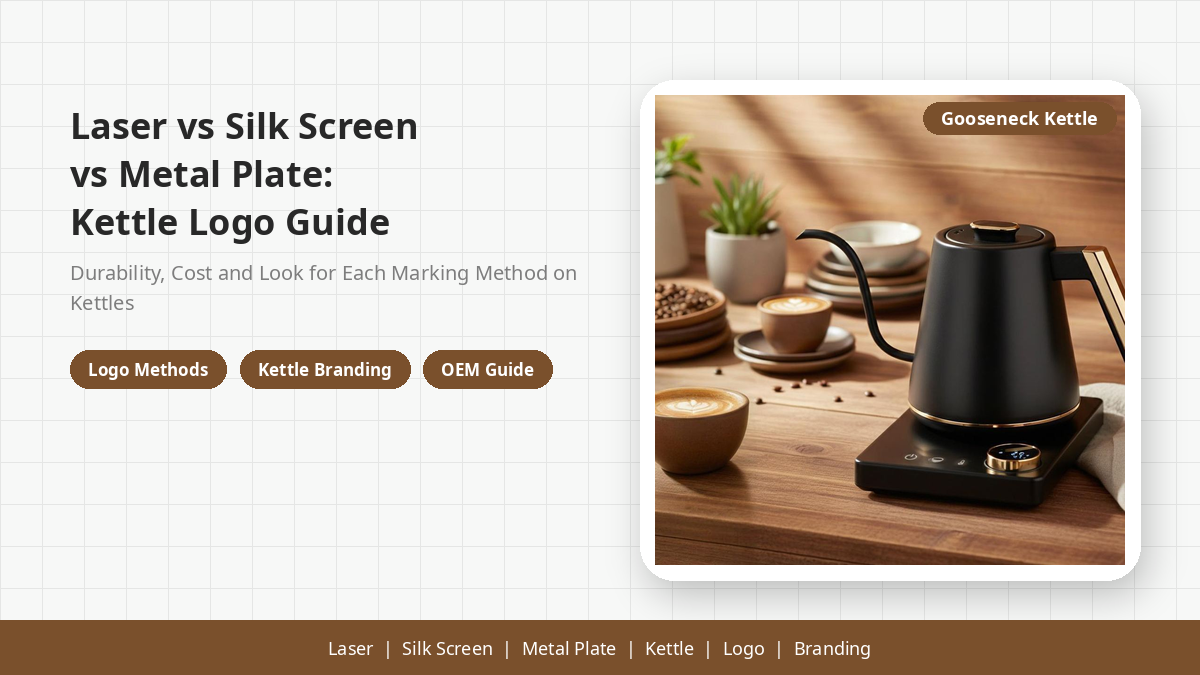
Walk into any specialty coffee shop in Stockholm, Berlin, or Amsterdam, and there's a good chance you'll see a gooseneck kettle sitting on the counter—steadying a pour that looks effortless but is, in reality, the result of years of design evolution. The gooseneck spout's long, curved neck isn't aesthetic accident; it's precision engineering. That slow, controlled pour rate matters enormously for how water interacts with coffee grounds during extraction, which is why specialty roasters obsess over it, and why European coffee chains that understand this have made gooseneck kettles a signature piece of their brewing presentation.
We started manufacturing gooseneck kettles in 2008, and we've watched the specialty coffee movement transform from a Scandinavian niche into a mainstream European industry. What this means for our business—and for European buyers sourcing from us—is that the quality bar has risen dramatically. Because gooseneck kettles have become a visible part of the specialty coffee brand experience, European coffee chains now demand finishes, temperature precision, and build quality that simply didn't exist in the mass market a decade ago.
The Specialty Coffee Boom in Europe and What It Means for Equipment Sourcing

Europe's specialty coffee market has grown at roughly 12–15% annually since 2018, according to the European Coffee Federation, with the strongest growth in Nordic countries, Germany, the Netherlands, and the UK. This isn't just a hipster trend—it's a structural shift in how European consumers think about coffee. Because premium consumers are willing to pay €4–7 for a single pour-over, the equipment that produces it carries perceived value far beyond its raw material cost. A coffee chain that invests in quality gooseneck kettles isn't just buying a kettle; they're buying a piece of the customer experience that justifies premium pricing.
We see this reflected directly in our order patterns. Over the past three years, European orders—from specialty roasters in Norway, coffee chain franchisors in Germany, and specialty equipment distributors in the Netherlands—have become our fastest-growing segment. What these buyers share is a clear understanding that the kettle on the bar is part of the brand statement. They're not comparing us purely on price; they're comparing us on temperature accuracy, finish quality, and whether we can deliver products that look and perform at a level consistent with their brand positioning.
Why Temperature Control Is the Make-or-Break Feature for European Coffee Applications
Here's the science that most people don't think about until they're standing in front of a light-roast Ethiopian Natural processing lot at 92°C and wondering why their extraction is tasting sharp and astringent. Different roast levels require different brewing temperatures—and not just for flavor preference, but because of actual chemistry. Light roasts are denser and require higher temperatures (90–96°C) to extract properly. Dark roasts are more porous and extract at lower temperatures (83–88°C). If your kettle can't hold a stable temperature within a 2°C band, you're either under-extracting (causing sour, weak brews) or over-extracting (causing bitter, harsh brews) depending on what you're making.
We've built our variable temperature Digital Gooseneck Kettles specifically around this reality.Because the coffee specialty movement in Europe has trained baristas and coffee buyers to be intensely temperature-aware, the ±1°C accuracy we deliver isn't engineering overkill—it's what the application actually requires. When we show a Swedish specialty roaster that their new gooseneck kettle will hold 91°C for a full 45-minute service period without drifting, that's the moment the order gets signed.
The other temperature consideration that matters for European coffee operations is altitude. Because water boils at a lower temperature at higher altitudes—approximately 96°C at 1,000m elevation, compared to 100°C at sea level—any coffee brewing operation in the Alps, the Pyrenees, or Scandinavia's higher elevations needs variable temperature control to achieve proper extraction. A kettle that only reaches 100°C maximum will underperform in mountain markets. Our variable-temp models reach full temperature range (40–100°C) regardless of altitude, which is why we've seen strong demand from Swiss and Austrian specialty coffee distributors.
The Pour Precision Argument: Why Gooseneck Geometry Matters for Extraction
Let me explain something that we find ourselves explaining to buyers who are new to specialty coffee equipment, because it's counterintuitive. The goal of a gooseneck pour isn't to pour fast—it's to pour slowly and with complete control over the water stream's direction and turbulence. A standard kettle spout produces a broad, relatively turbulent flow that agitates the coffee bed unevenly. A properly designed gooseneck spout produces a thin, laminar stream that allows the barista to saturate grounds gently and maintain an even extraction across the entire surface of the coffee bed.
This matters because uneven water distribution through coffee grounds directly causes channeling—where water finds paths of least resistance through the coffee puck and bypasses significant portions of the grounds entirely. Channeling produces inconsistent, often sour extraction. Because gooseneck geometry constrains flow rate to approximately 2–4 mL/second at typical pour heights, it physically prevents the kind of aggressive pouring that causes channeling.
We work with our European buyers to specify gooseneck geometry based on their primary brewing method. Because pour-over methods (V60, Chemex, Kalita Wave) each have slightly different ideal pour rates and stream characteristics, we offer three spout geometry variants: the Precision Pour (narrowest, for V60 and competition-style brewing), the Balanced Pour (medium width, for general pour-over and cafés), and the Soft Pour (widest, for larger Chemex-style vessels and batch brewing). Matching the right spout to the customer's brewing method is something we've learned directly from five years of working with European specialty roasters who are intensely particular about this detail.
Understanding the Real Cost of a Gooseneck Kettle Order: Beyond Unit Price
When European buyers approach us for the first time, there's often a moment of sticker shock—not because our pricing is high, but because they're comparing our factory-direct wholesale price against retail prices they've seen on Amazon or European e-commerce platforms. What they quickly come to understand is that our wholesale pricing is for volume orders, and when calculated on a per-unit basis for a full container, it typically falls 40–60% below equivalent European retail pricing for comparable specification products.
Let me break down what a realistic European distributor order looks like. A mixed 40ft container of gooseneck kettles—with two capacity variants (0.8L and 1.0L) and two finish options (matte black and brushed stainless)—might contain 600–800 pieces total. The landed cost per unit, including sea freight, insurance, and import clearance to Rotterdam, typically comes in at €14–20 per piece depending on specification. That same kettle, if purchased from a European retail distributor or Amazon EU, would retail at €38–65 per unit. The margin opportunity for European distributors is substantial—and that's before custom branding adds value.
The OEM branding dimension is where European buyers typically see the strongest return on their sourcing investment. When a specialty coffee chain in Munich orders 400 gooseneck kettles with their logo laser-engraved and their brand Pantone color on the silicone handle wrap, they're not just buying kettles—they're buying a consistent brand presentation across their stores that reinforces their positioning as a premium specialty operator. We've supported over 40 European specialty coffee brands with custom OEM orders, and the re-order rate from brands that go custom is notably higher than from generic wholesale buyers.
EU Food Contact Compliance: What Every European Importer Must Have in Writing
I want to address this directly, because we've seen European buyers get caught out by it. The EU's food contact material regulations are among the strictest in the world, and they're enforced by individual member state authorities, not just at the point of import. If you're selling gooseneck kettles into Germany, France, or Scandinavia, you need documentation that goes far beyond a generic "food grade" claim from a Chinese supplier.
For stainless steel gooseneck kettles, the key regulatory requirements are:
- EU Regulation 10/2011 — governs plastic components that contact food (handles, temperature sensors, lid seals). All plastic materials must have approved substance list (DSL) documentation.
- Council of Europe Resolution CM/Res(2013)9 — sets release limits for metals and alloys in contact with food. Stainless steel 304 (18/8) and 316 (18/10) grades comply readily, but documentation must confirm the specific grade used.
- LFGB (Germany) — the German food and commodities law test is the most recognized standard in Europe. Products that pass LFGB testing are broadly accepted across EU markets.
- DGCCRF (France) — French customs and competition, consumer affairs authority requires specific documentation for food contact goods sold in France.
- BPA and phthalate documentation — explicitly required for all plastic components. We test for these as standard even though some competitors treat it as optional.
Because we've exported to European markets for over a decade, we know exactly what documentation package is required. We provide SGS or Bureau Veritas test reports with every commercial order, and we maintain a library of pre-tested material combinations that speeds up the compliance documentation process for returning buyers. For new OEM buyers, we typically recommend building 2–3 weeks into the project timeline for EU food contact testing and documentation preparation.
Custom Branding for European Specialty Coffee Brands: What We Can Actually Do
We've worked with enough European specialty coffee brands to know exactly where the customization process gets complicated—and where it doesn't. Most European buyers are surprised to learn that the MOQ for custom branding is lower than they expect, but the timeline is longer than they want. Let me break down what we can deliver and what it actually requires.
- Laser-engraved logos on kettle body: MOQ 100 pieces per order. The logo file must be vector format (AI or EPS). We can match any logo complexity. The engraving is permanent and won't fade or wear off. Production time adds approximately 3–5 days to standard lead time.
- Pantone color-matched finishes: MOQ 300 pieces per color. We use a spectrophotometer to match your brand Pantone code and provide a pre-production sample for approval before running the full order. Sample approval typically takes 10–14 days. Color consistency between production runs is maintained through our color library system.
- Custom packaging: MOQ 500 pieces for custom box design. We work with European packaging suppliers for box materials that meet EU packaging waste regulations (EU Directive 94/62/EC). Box design files are typically provided by the buyer in print-ready format.
- Silicone band branding: MOQ 200 pieces. This is often the most cost-effective custom branding option because it doesn't require re-tooling the kettle itself. We can mold your brand name or logo into the silicone grip band that wraps the handle.
- Digital display language: MOQ 200 pieces. We can localize the digital display interface into any language with Latin character set. Nordic languages, German umlauts, and Central European diacritics are all supported.
How to Plan Your First European Gooseneck Kettle Import Order
Based on our experience supporting European specialty coffee distributors, here's the realistic timeline and planning framework for a first order:
Month 1 — Specification and sample: Initial inquiry, specification review, sample request (we ship samples at cost, typically €25–40 per unit depending on model). Sample evaluation takes 1–2 weeks on the buyer's side.
Month 2 — Order confirmation and custom tooling: Once sample is approved, order confirmed with 30% deposit. For custom color/logo, artwork files submitted for approval. Custom color matching sample production takes 10–14 days. Artwork approval cycle typically adds 5–7 days on the buyer's side (make sure your graphic design team is available!).
Month 3 — Production: 3–4 weeks of production after all approvals are finalized. Pre-shipment inspection available through SGS or Bureau Veritas (we recommend this for orders over 500 pieces).
Month 4 — Shipping: Sea freight 28–35 days to European port. Customs clearance and delivery to your warehouse: 3–5 days. Total: approximately 14–16 weeks from initial inquiry to warehouse stock.
For replenishment orders of established models (no custom branding changes), lead time compresses to 7–8 weeks total since samples are already approved and the approval process is skipped.
Frequently Asked Questions About Sourcing Gooseneck Kettles from China for European Coffee Businesses
What is the minimum order quantity for a mixed SKU gooseneck kettle container load?
Mixed SKU MOQ typically starts at 200 pieces per model when combining different capacities or finishes within a single 20ft container. For a full 40ft container with 2–3 finish variants, MOQ can drop to 100–150 pieces per model. Single-SKU orders for large volumes (500+ pieces) offer the lowest unit pricing. We recommend a mixed 40ft container as the most cost-effective entry point for European distributors, typically landing at €12–18 per unit for basic variable-temp models.
How does EU food contact material regulation affect gooseneck kettle sourcing from China?
Gooseneck kettles for coffee brewing must comply with EU Regulation 10/2011 on plastic materials in contact with food, and for stainless steel variants, the Council of Europe Resolution CM/Res(2013)9 on metals and alloys. Key requirements include LFGB testing for German market, French DGCCRF approval, and documentation that all food-contact surfaces are free from BPA, phthalates, and lead. We provide full EU food contact test reports from SGS or Bureau Veritas laboratories as standard documentation with each shipment.
What temperature accuracy can European buyers expect from Goodfriends variable-temp gooseneck kettles?
Our digital variable-temperature models maintain ±1°C accuracy from 40°C to 100°C, which covers the optimal brewing range for all major coffee extraction methods (83°C for light roasts, 88–92°C for medium, 93–96°C for dark). The hold function maintains target temperature for up to 60 minutes. This precision matters for specialty coffee applications where a 2–3°C deviation can measurably alter extraction yield and flavor profile.
What branding options are available for European coffee brands ordering gooseneck kettles as OEM?
OEM customization options include laser-engraved logos on the kettle body (minimum 100 pieces), custom color matching to brand Pantone codes (MOQ 300 pieces per color), custom box design and printing (MOQ 500 pieces), silicone band branding (MOQ 200 pieces), and firmware language localization for digital displays (MOQ 200 pieces). We have supported over 40 European specialty coffee brands with custom OEM orders, including several well-known Scandinavian and German roasters.
What is the typical production and shipping timeline from China for a gooseneck kettle OEM order?
Standard production is 3–4 weeks after sample approval and deposit. Sample development typically takes 10–14 days for color matching and logo approval. Sea freight from Ningbo to European ports (Rotterdam, Hamburg, Felixstowe) is 28–35 days. Total door-to-port time: 7–10 weeks from sample approval. Air freight reduces to 5–7 days for urgent orders at approximately 4× the shipping cost. We recommend planning 12–14 weeks from initial inquiry to port arrival for a new OEM color/logo order.
A Procurement Planning Checklist for European Gooseneck Kettle Importers
- ☐ Confirm your target retail price point and work backwards to verify landed cost leaves adequate margin
- ☐ Verify your supplier can provide LFGB test reports (accepted broadly across EU) and DGCCRF documentation for France
- ☐ Request a production sample before committing to a full container — test the temperature accuracy yourself
- ☐ For custom branding: prepare vector logo files (AI/EPS) before starting the supplier conversation
- ☐ Plan 14–16 weeks from inquiry to warehouse for first OEM order; 7–8 weeks for replenishment
- ☐ Calculate whether a mixed 40ft container (600–800 pieces) or single 20ft (300–400 pieces) makes more sense for your sales velocity
- ☐ Check EU packaging waste regulations (Directive 94/62/EC) for any custom packaging materials
- ☐ Arrange pre-shipment inspection for orders over 500 pieces through SGS or Bureau Veritas
- ☐ Confirm warranty and defect claim process in writing before placing order
- ☐ Verify the supplier has experience with your specific EU market's regulatory requirements
Internal links used in this article: Gooseneck Kettle Series Products | Goodfriends Kettle Full Product Range