
 0086-574-62518288


Industry News
0102030405
Hold-Temperature Drift: 30-Minute Stability on 6 Models
2026-11-04
Digital Kettles are sold on temperature accuracy, and accuracy is published. Hold drift is not. Here is what six glass kettle platforms actually publish, what they leave out, and how to test the missing number yourself before you sign an order.
TL;DR
- Two different numbers are being sold as one. Control accuracy is published as 0.5°C variance for advanced PID control; hold drift over 30 minutes is published for none of these six models.
- The published hold data is uneven. Two of the six models state a keep-warm duration and a preset count; the rest publish vessel, wattage and certification but no hold figure at all.
- Drift is a system property. Vessel, shell, fill level, lid state and the control loop all move it, so it cannot be read off a component datasheet.
- A 30-minute test is cheap. Three units, a stated fill level, a calibrated probe and a log every 30 seconds produce a number you can write into the agreement.
- Hold performance and safety certification are different files. Low Voltage, food contact and UL 499 say nothing about how steadily a kettle holds its setpoint.
What 30-Minute Stability Should Actually Mean
Before comparing anything, the metric has to be defined, because two different quantities are being sold under the word precision. The first is control accuracy: how tightly the controller holds the setpoint while it is actively working. That number is published, and for advanced PID control the published description states that temperatures are maintained within 0.5°C variance.
The second is hold drift: how far the water temperature moves away from the setpoint over a period of minutes once the kettle is idle at temperature. Almost nobody publishes it, because it depends on the ambient, the fill level, the lid state and the starting condition, and a single number without those conditions is not a measurement.
So a 30-minute stability requirement has to be written as a band with its conditions attached: the setpoint, the maximum permitted deviation, the fill level, the ambient, whether the lid is closed, whether the base stays powered, how often the temperature is sampled and how many units are tested. Without those, "stable for 30 minutes" is not a specification, it is a hope.
The Six Models and What They Publish
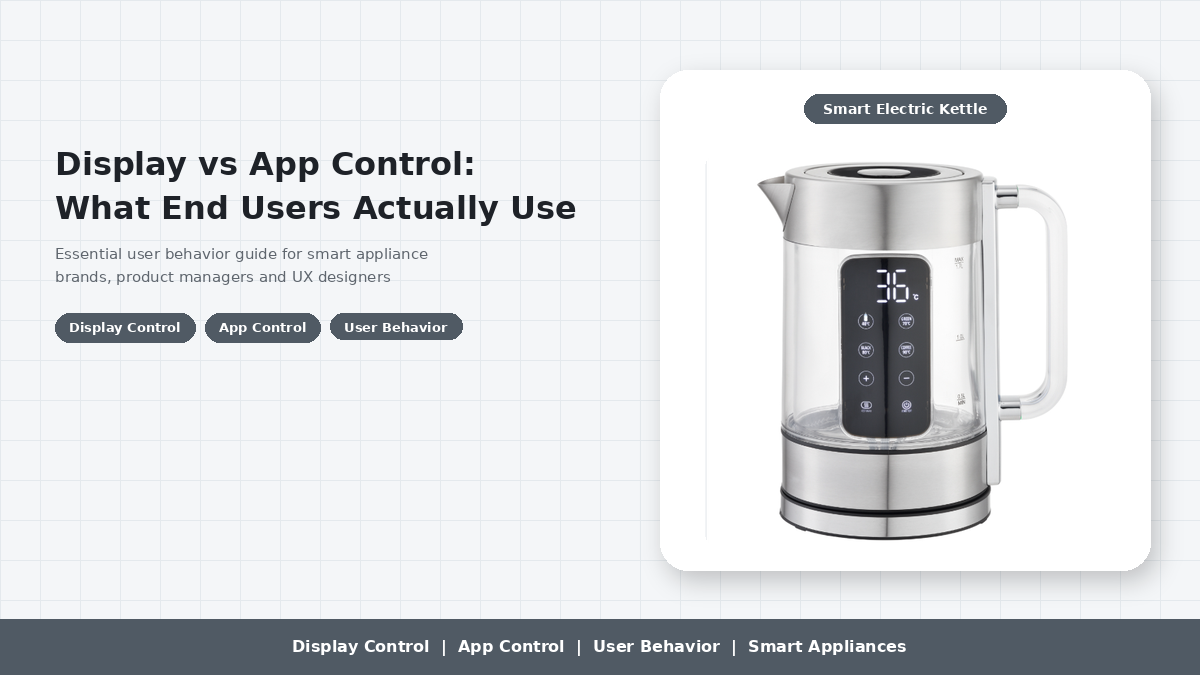
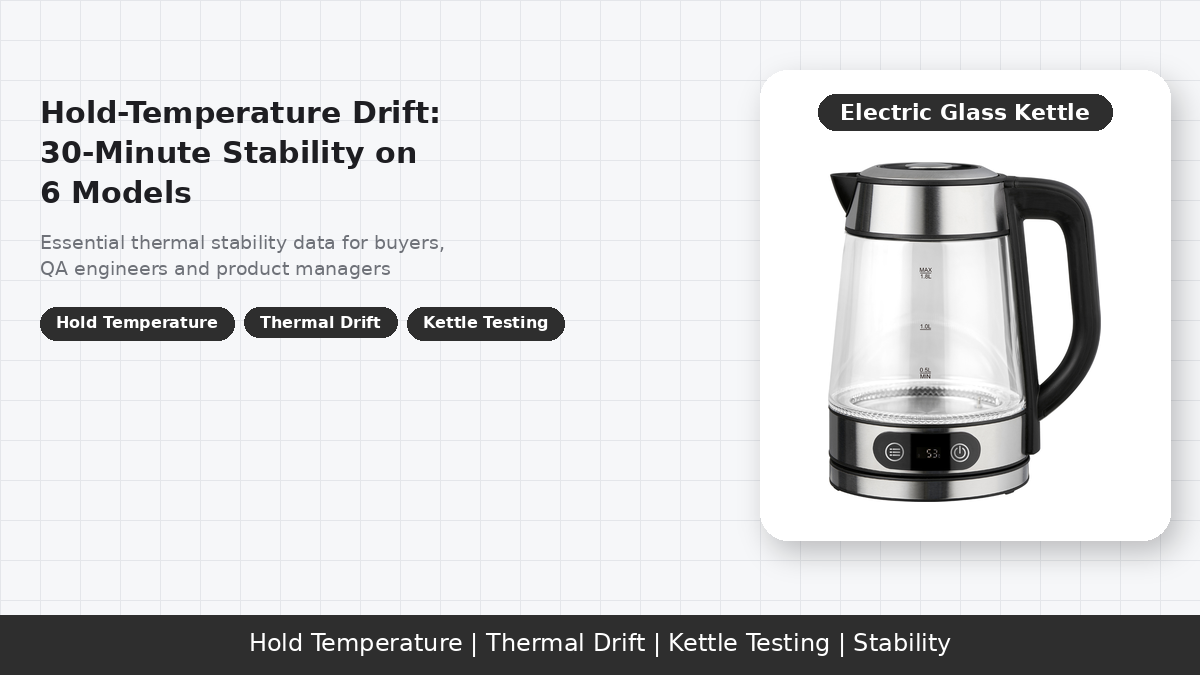
All six platforms below are published Digital Glass Kettles, and the point of the table is not which one is best. It is how uneven the published information is, even across one series from one manufacturer, which is exactly why a buyer has to ask the questions the datasheets leave open.
| Model | Published temperature spec | Published hold spec | Vessel and shell | Published certification |
|---|---|---|---|---|
| 7-Level LED Glass Electric Kettle with Removable Tea Filter, HHB6801D1 / D2 / D3 | 7 presets, 40°C to 100°C | Memory module, 2 h keep-warm | Borosilicate glass, 304 stainless steel | CE, GS, RoHS |
| Digital Touch Glass Kettle with 13-Level Precision Temperature Control | 13 levels, 40°C to 100°C | Memory and keep-warm, PID-class accuracy | Borosilicate glass, 304 stainless steel, PC double-wall shell | CE, GS, RoHS |
| Smart LED Glass Kettle with Precision Temperature Control, HHB1771 / HHB1806D | LED temp-control with tea filter, 1.8L | Not separately stated | Borosilicate glass, 304 stainless steel | CE, GS, RoHS |
| Variable Temperature Digital Glass Kettle with Keep-Warm, HHB1703DT | 4 presets | 2 h keep-warm | High borosilicate glass body, 304 stainless steel element, 1850-2200W, 220-240V 50/60Hz | CE, GS, RoHS |
| Variable Temperature Digital Glass Kettle with Filter | Five temperature levels, 1.8L with LED indicator | Not separately stated | High borosilicate glass body, 304 stainless steel element, 1850-2200W, 220-240V 50/60Hz | CE, GS, RoHS |
| Smart Double-Wall Glass Kettle with Precision Digital Touch, HHB6706D | Precision digital touch, double-wall | Not separately stated | Borosilicate glass, 304 stainless steel, PC shell double wall | CE, GS, RoHS |
Read down the hold column and the pattern is clear. The seven-level LED glass kettle with removable tea filter and the HHB1703DT both state a two-hour keep-warm cycle, and the thirteen-level model pairs its keep-warm with PID-class control. The other three publish a vessel, a wattage, a voltage and a certification set, and stop there.

What the Published Figures Do Not Tell You
The gap between what is published and what a brewing programme needs is the whole subject of this article. What is published, across this range, is the preset structure, the vessel and shell materials, the electrical rating and the certification set. The 40°C step for infant formula, the 70°C and 80°C steps for honey and green tea, the 85°C to 95°C band for oolong and French press, and the 100°C rolling boil are all documented.
What is not published for any of the six is measured drift over a half hour, and that omission is not a criticism of the manufacturer. It is how the specification works: drift is a property of a system in a room, not of a product on a shelf, so it cannot be quoted without conditions that vary by customer, fill level and season.
The practical consequence for a buyer is that the published figures narrow the field but do not close it. They tell you that two models keep warm for two hours, that one holds thirteen levels between 40°C and 100°C, and that the PID description claims 0.5°C variance around the setpoint. They do not tell you whether the water in the pot is still within a degree of 80°C after twenty minutes, and that is the number a tea programme is judged on.
Why Two Kettles With the Same Setpoint Hold Differently
Four variables move drift, and none of them is the display. The first is the control loop itself: a PID controller corrects continuously against the measured value, while a stepped or relay controller corrects in bands, and the published 0.5°C variance for advanced PID control is a description of the first rather than the second.
The second is the vessel and the shell. Across this range the wetted parts are high borosilicate glass and food-grade 304 stainless steel, and the double-wall models add a PC shell, which adds both insulation and thermal mass. Glass and stainless steel lose heat differently, a double wall holds differently from a single wall, and a full kettle holds longer than a half-full one for the simple reason that there is more water to keep at temperature.
The third is the lid and the base. A lid on and a base still powered are the difference between a kettle that holds and a kettle that coasts, and the fourth is the starting condition, which is why a 30-minute test that begins thirty seconds after the setpoint is reached measures something different from one that begins after five minutes of settling. Drift is a property of the whole arrangement, and it is why no single component datasheet can answer the question.
Running a 30-Minute Hold Test on Your Own Units
A drift test is inexpensive enough that there is no reason to accept a number you have not measured. The protocol that works is short and needs three units of the model, a calibrated probe and a spreadsheet.
Fill each kettle to the same stated level, preferably the maximum mark so the thermal mass is consistent, and record that level as part of the result. Note the ambient temperature. Bring the kettle to the setpoint, then let it settle for five minutes before starting the clock, because the interesting number is the steady state rather than the recovery. Sample the temperature every 30 seconds for 30 minutes, measuring in the middle of the water column rather than against the glass wall or the base, where the reading reflects the heater rather than the water.
Record four outputs rather than one: the maximum deviation from the setpoint, the percentage of the half hour spent inside your band, the time taken to return inside the band after the lid is opened three times, and the difference between the three units. That last figure is the one that separates a platform from a sample, and a single unit is an anecdote rather than evidence.
What to Write Into the Supply Agreement
The value of doing the test yourself is that it converts a vague requirement into a clause someone can be held to. Write the tolerance as a band with conditions attached: a setpoint, a maximum permitted deviation over 30 minutes, a fill level, an ambient range, lid closed, base powered, a sampling interval and a number of units.
Also write the acceptance rule and what happens when it is missed, because a tolerance without a consequence is a preference. If the buyer measures it, the manufacturer should be entitled to see the raw log rather than a summary, and the units tested should be units from the same production batch as the order.
Keep this file separate from the safety file. A kettle sold in the European Union sits under the Low Voltage Directive 2014/35/EU, and its wetted parts are assessed under Regulation (EC) No 1935/2004 on food contact materials; North American buyers work to a listing to UL 499 for electric heating appliances. Those files establish that the product is safe. None of them says how steadily the water holds its temperature, and a buyer who expects one document to cover both will be disappointed at the audit rather than in the test.
A Buyer's Decision Path
Five questions narrow a shortlist quickly, and all five can be answered before a purchase order.
- Which temperature band does your product need? Formula at 40°C, honey and green tea at 70°C and 80°C, oolong and French press at 85°C to 95°C, or a rolling boil at 100°C. Four levels cover a lot of programmes; thirteen cover a catalogue.
- How long does it have to hold? If the answer is two hours, the platforms that publish a two-hour keep-warm are the shortlist, and the rest need a measured figure from you.
- Does the vessel have to be visible glass? Glass and stainless steel do not hold identically, and the ceramic and double-wall options change the answer again.
- What does your market require on the compliance file? Low Voltage, food contact and the North American listing are separate from hold performance.
- Can you test before you commit? A sample unit and a calibrated probe cost less than one returned container.
The digital glass kettle series and the smart LED glass kettle with precision temperature control are the two pages that carry most of the published specification, and the smart kettle programme for tea rituals sets out how the brewing side of it is built. Send your preset list, fill level, ambient range and hold requirement to our contact page and the answer should come back with the platform, the minimum order quantity and the test protocol in one document.
1. What is a realistic hold-temperature tolerance for a digital kettle?
Write it as a band, not as a word. The published control figure for advanced PID control is 0.5°C variance around the setpoint, but that is the controller, not the pot. For a 30-minute hold, specify the maximum permitted deviation, the fill level, the ambient, the lid state, the sampling interval and the number of units, and require the measured result against those conditions.
2. How long should a keep-warm function last?
Two hours is the duration published on the seven-level LED glass kettle with removable tea filter and on the HHB1703DT variable temperature glass kettle, and the thirteen-level precision model also publishes a keep-warm with memory. If your service needs a longer hold than the published one, that is a specification change and it should be quoted as a development, not assumed.
3. Does a glass kettle hold temperature better than a stainless steel one?
Not in a way that can be stated without conditions. The published range pairs borosilicate glass and food-grade 304 stainless steel in both wetted and shell roles, and the double-wall models add a PC shell that adds insulation and thermal mass. Glass, single-wall steel and double-wall steel hold differently and lose heat at different rates, which is why the measurement belongs on your units rather than on a comparison chart.
4. How many temperature presets do I need?
Only as many as your programme uses. The published steps are 40°C for infant formula, 70°C and 80°C for honey and green tea, and 100°C for a rolling boil, which four presets cover; the thirteen-level model adds the 85°C to 95°C band for oolong, French press and specialty roasts. Specifying more levels than you brew is paid for in cost and in interface complexity.
5. How do I verify hold performance before placing a bulk order?
Run the 30-minute protocol on three sample units: fixed fill level, recorded ambient, five minutes of settling after the setpoint is reached, a reading every 30 seconds taken in the middle of the water column, and the lid opened three times to test recovery. Record the maximum deviation, the share of the half hour inside your band and the spread between the three units, then put those conditions into the supply agreement.
6. Is 0.5°C drift realistic for a PID-controlled kettle?
Around the setpoint, while the controller is working, the published description of advanced PID control states that temperatures are maintained within 0.5°C variance. Over a 30-minute idle hold the question becomes drift rather than control accuracy, and that is a different quantity that depends on the vessel, the fill level and the lid. Treat the 0.5°C figure as the controller's claim and measure the hold yourself.
Published 4 November 2026 · Last verified 4 November 2026 · Preset ranges, keep-warm durations, model codes, vessel and shell materials, electrical ratings and certification sets for the six platforms verified against the published Goodfriends product pages and the digital glass kettle series on 4 November 2026; the PID variance description and the company capability and certification statements verified against the same manufacturer pages. This is sourcing guidance and is not a substitute for a written specification, a measured result or the applicable market compliance documentation. No price, cost, profit or margin figure is quoted in this article.