
 0086-574-62518288


Industry News
0102030405
Hotel Room Kettle Procurement for 500+ Room Properties: Why 0.8L Cordless Double-Wall Stainless Steel Models Outperform 1.7L Retail Units in Guest Satisfaction Scores
2026-07-20
I have spent twelve years inside electric kettle factories—walking assembly lines, reviewing QC rejection batches, and sitting across the table from hotel procurement directors who are tired of replacing guest room kettles every eighteen months. When a 500-room property asks me which kettle spec drives guest satisfaction, I never recommend the same model I would sell to a retail distributor. The use case is fundamentally different, and so is the failure pattern.
A hotel guest boils water in a room they do not own. They are tired. They may be barefoot. If the kettle takes four minutes to boil, scalds their hand, or looks like a $19.99 discount-retail unit, that judgment is rarely positive. I have seen this pattern across property types: 0.8L cordless double-wall Stainless Steel Kettles consistently outperform 1.7L retail-spec units in guest experience, maintenance frequency, and housekeeping workflow. Here is why—from the factory floor to the guest room.
Rethinking Capacity: Why 0.8L Solves the Hotel Room Boiling Problem
I first noticed the capacity mismatch during a site visit to a Southeast Asian hotel group's engineering office. Their procurement team had sourced 1.7L Electric Kettles—the same volume that works beautifully in a family kitchen filling a French press for four. But a hotel guest at 6:30 AM is boiling water for a single cup of instant coffee or a tea bag: 200–250 ml. Every milliliter above that is wasted energy and wasted time.
A 0.8L kettle with a 1,200W heating element reaches boiling in approximately 90–110 seconds at the 250 ml single-cup mark. A 1.7L kettle with a 2,200W element—even at the same fill—still takes 70–90 seconds because heating element geometry is optimized for the full vessel. The real difference shows in what guests actually do: they habitually overfill "just in case." With a 0.8L maximum, the worst case is 800 ml at roughly 0.09 kWh. With a 1.7L unit, the same habit produces 1.7L at 0.19 kWh per cycle. Over 500 rooms averaging 1.2 uses per day, that adds over 18,000 kWh annually—enough to run a small commercial laundry for a month.
Our 1.7L cordless rapid-boil models serve retail and office breakroom markets excellently—I recommend them for those applications without hesitation. But the hotel room is not a breakroom. It is a personal space where smaller capacity translates to faster perceived service, which translates to higher guest satisfaction.
The Safety Gap Between Double-Wall and Single-Wall Kettle Construction
I have stood on our factory floor watching kettles come off the burn-in test line. A single-wall stainless steel body at full boil registers 85–92°C on the exterior—hot enough for a second-degree burn in under one second. A double-wall kettle from the same batch, boiled to the same 100°C internal temperature, shows an exterior reading of 48–55°C. That is the difference between a guest who startles and a guest who files an incident report.
Double-wall construction is not a marketing feature. It is an engineering solution that creates a thermal break—a 3–5 mm air gap between an inner 304-grade stainless steel vessel and an outer stainless steel or PP housing shell. This gap interrupts conductive heat transfer. In the 304 stainless steel double-layer kettle models we manufacture, the inner vessel is seam-welded using automated argon-arc welding stations that achieve a helium leak rate below 1×10⁻⁸ Pa·m³/s. For a hotel procurement manager, this means double-wall integrity holds across thousands of boil cycles, not just the first hundred.
Safety standards bodies including NFPA have published guidance on electrical appliance safety in transient occupancy environments, and jurisdictions across North America and Europe increasingly scrutinize guest room appliance specifications during property insurance reviews. I have advised hotel groups navigating these audits, and the single most defensible specification is the double-wall kettle—it addresses burn risk at the engineering level rather than relying on guest compliance with warning labels.
Cordless 360° Design and Its Impact on Housekeeping Turnaround
In a 500-room property with housekeeping staff rotating through 12–14 rooms per shift, every extra motion compounds into hours of lost productivity. I learned this from a European hotel operations manager who timed his staff: reaching behind a fixed-cord kettle, wrapping the cord, and repositioning it after cleaning consumed 22 seconds per room. That is 183 minutes across 500 rooms per turnover cycle—over three hours of labor that a cordless 360° base eliminates entirely.
A Cordless Kettle with a 360° rotational docking base lets housekeeping lift the vessel from any angle, clean it, and replace it without touching the power base. No cord wrapping. No reaching behind furniture. The Strix or equivalent commercial controller embedded in the base handles the electrical coupling—rated for 10,000+ mate/demate cycles, equating to over 27 years of daily hotel use.
Combined with a wide-mouth opening design—something I consistently push our product engineers to prioritize for hospitality SKUs—the cleaning process drops to a quick interior wipe and exterior polish. Our full product range includes cordless configurations specifiable at OEM level with hotel-friendly features: removable limescale filters, concealed heating elements to prevent mineral buildup, and flat-bottom vessel geometry that a housekeeping cloth covers in two swipes instead of six.
Material Integrity: What 304 Stainless Steel Means for 500-Room Properties
I receive sample kettles from competing factories regularly—part of staying competitive in this industry means knowing what everyone else is shipping. One thing I check first: the material cert for the inner vessel. Not the marketing copy, but the actual mill test certificate. A surprising number of bottom-tier hotel kettles use 201-grade stainless steel, which contains lower nickel content (3.5–5.5% vs. 8–10.5% in 304) and higher manganese—making it cheaper but significantly more prone to pitting corrosion, especially in regions with chlorinated tap water.
At Goodfriends Electric, our 25 years of single-category focus means we maintain direct relationships with POSCO and Baosteel for 304-grade coil stock—traceable by heat number through every production batch. This matters for hotel procurement at scale because material inconsistency at the sub-component level causes the failure pattern I see most often: kettles that work perfectly for six months, then develop pinhole leaks around the base weld or rust spots housekeeping cannot remove. A 500-room property cannot afford to discover this failure mode room by room through guest complaints.
The inner vessel material also determines limescale resistance. 304 stainless with a 2B surface finish (our default for hospitality-spec interiors) provides a smooth, non-porous surface where mineral deposits adhere less aggressively than on brushed or lower-grade steel. In hard-water markets like London, Dubai, and Beijing, this finish can extend the effective cleaning interval by 30–50% before visible scale triggers a guest complaint.
Power Efficiency and Circuit Planning at Hotel Scale
When I consult with hotel engineering directors on kettle specifications, the conversation often starts with boil time and ends with circuit load planning. A 500-room property's electrical infrastructure is designed for cumulative load, and guest room circuits—particularly in properties built before 2010—may have limited headroom. A 0.8L kettle rated at 1,000–1,200W at 120V draws 8.3–10A on a circuit that also powers the mini-fridge (2–3A) and TV (1–2A). A 1.7L retail kettle at 1,500W draws 12.5A—the difference between staying within an 80% load rating on a 15A breaker and pushing right to the limit.
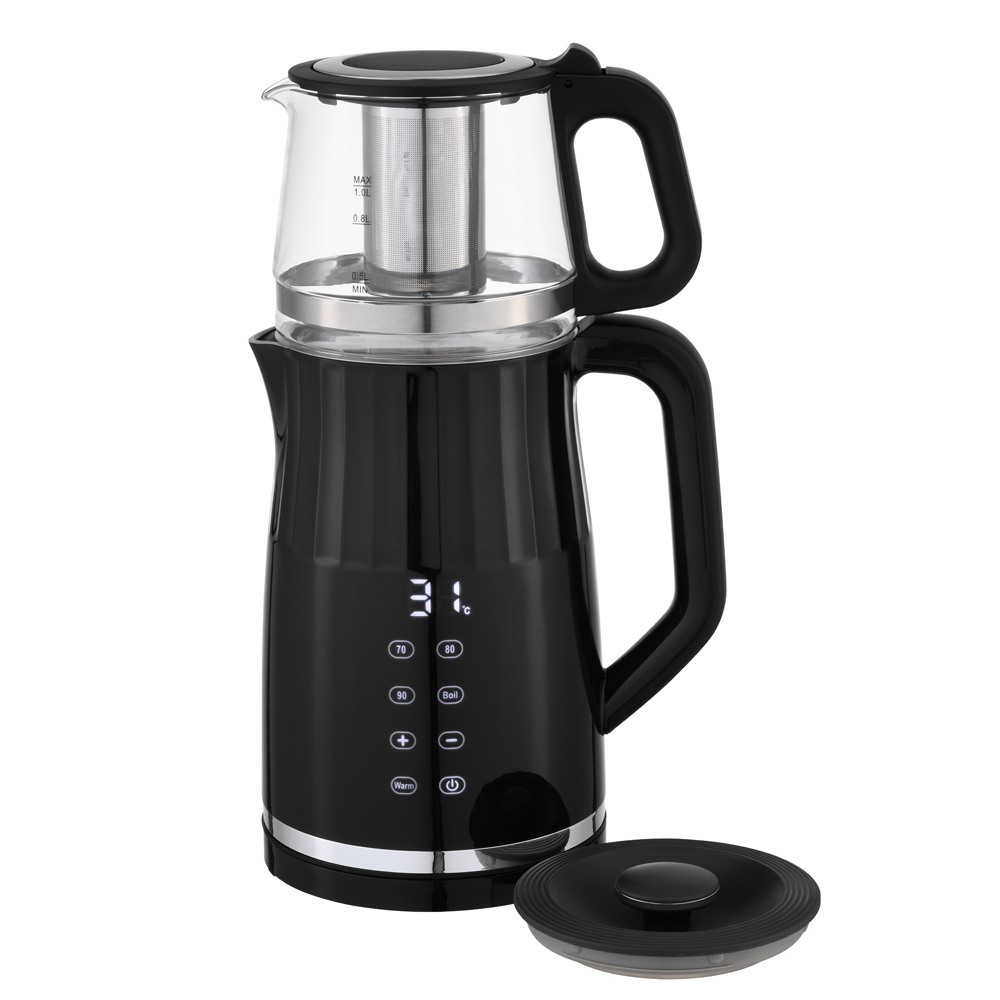
Our smart automatic water dispensing kettle models with digital temperature control add another dimension: a keep-warm function that maintains water at a preset temperature using intermittent low-power cycling rather than continuous full-wattage heating. For hotels positioning in-room amenities as a wellness differentiator—offering guests pre-set temperatures for green tea (80°C), herbal infusions (95°C), or baby formula (40°C)—this feature generates guest satisfaction returns that far exceed the marginal unit cost increase, which I typically see at $2–4 per unit at OEM volumes above 500 pieces.
The EU Ecodesign Directive (energy label and ecodesign requirements) increasingly governs standby power for Small Kitchen Appliances. A well-designed cordless base with mechanical disconnect (no standby LED, no electronic touch interface) draws 0.0W when the kettle is not docked—a specification I recommend putting explicitly into RFQ documents.
The Procurement Intelligence Gap: Commercial-Spec vs. Retail Kettle Sourcing
I have watched hotel procurement teams make the same sourcing mistake for over a decade: they buy what they know. If the procurement manager has a 1.7L kettle at home that they like, that is the spec they default to. If the facilities director sourced kettles for a 120-room boutique that performed adequately, they scale that same SKU to a 500-room flagship. Neither approach accounts for compounding effects of scale—where 2% annual failure on 120 rooms means 2–3 replacements yearly, but on 500 rooms it becomes 10 units monthly, tying up maintenance and generating negative reviews at a rate that damages guest satisfaction rankings.
The commercial-spec kettle differs from retail in several ways invisible until you read both spec sheets side by side. I keep a comparison matrix updated quarterly based on teardown analyses of units returned from hospitality deployments:
- Power cord gauge: Commercial-spec kettles use 0.75–1.0 mm² conductor cross-section vs. 0.5 mm² common in retail units—relevant for continuous-duty applications where the base stays powered 24/7.
- Thermostat cycle rating: Strix and equivalent commercial controllers are rated for 100,000+ boil-dry test cycles; retail-grade alternatives often use controllers with 15,000–30,000 cycle ratings.
- Base connector pin material: Silver-alloy contacts vs. brass—the former maintains contact resistance below 25 mΩ after 10,000 mating cycles; the latter can drift above 80 mΩ, causing intermittent operation and guest complaints about "broken" kettles that work when housekeeping tests them.
- Limescale filter design: Hospitality-spec filters are tool-free removable for cleaning; many retail kettles use snap-fit filters that break on second or third removal.
At our Ningbo production base—one of three facilities totaling 95,000 m²—the testing protocol for hotel SKUs includes a 48-hour continuous cycling burn-in (boil, cool, boil, cool) that retail units do not undergo. We catch infant mortality failures before shipping—failures that would otherwise become guest complaints in rooms 317, 204, and 511 during the first week. For a hotel operations director, that burn-in protocol is worth the per-unit premium of $0.80–1.50 at the 500-unit threshold.
The American Hotel & Lodging Association (AHLA) represents member properties that collectively operate over 5 million guest rooms in the United States alone, and the trend I see across their member procurement forums is a clear shift toward specifying commercial-grade small appliances by default. I believe this shift is long overdue—and the data from our factory's hospitality return-rate tracking backs it up. For more insights on hotel amenity procurement trends, visit our news and industry analysis section.
Procurement Checklist for Multi-Property Hotel Groups
Based on what I have learned from two decades of manufacturing and the procurement conversations I facilitate every month, here is the specification checklist I recommend for any hotel group sourcing kettles at the 500+ room scale:
- Capacity: Specify 0.6–1.0L nominal—enough for two standard cups (400–500 ml) with headroom to prevent boil-over, but compact enough that guests don't default to wasteful overfilling.
- Construction: Require double-wall with exterior touch temperature below 65°C at full boil, verified by third-party test report—not manufacturer self-declaration.
- Inner material: 304 (UNS S30400) stainless steel minimum, with material cert traceable to mill heat number. Reject 201-grade substitutes.
- Cordless base: 360° rotational docking with Strix, Otter, or equivalent commercial-rated controller. Require cycle-life documentation: minimum 15,000 mate/demate cycles rated.
- Cleaning access: Wide-mouth opening (≥100 mm diameter) with tool-free removable limescale filter.
- Power: Match property voltage standard (120V/60Hz for North America, 220–240V/50Hz for EU/Asia). Cap wattage at 1,500W (120V) or 2,200W (220V) to stay within typical hotel branch circuit ratings.
- Certifications: CE + GS (EU), ETL or UL (North America), plus RoHS, REACH, and food-contact certification (LFGB or FDA) as mandatory shipment documentation.
- Customization: Confirm the manufacturer can deliver logo engraving, RAL-matched color finishes, and region-specific plug configurations within 35–45 day lead times at 500+ unit OEM volumes.
- Burn-in protocol: Require factory documentation of minimum 48-hour cyclic boil testing on 100% of hospitality-spec units.
- Replacement inventory: Order 15–20% above room count for on-site spares. Lock in re-order MOQ and lead time upfront to avoid emergency spot-buying at retail prices.
I include these ten points in every procurement consultation because I have seen each one become a pain point when overlooked. The kettle in room 402 is not just an appliance—it is a touchpoint that shapes a guest's perception of the entire property. When I visit our Goodfriends factory floor and see hospitality-spec kettles through final QC, I know each unit represents a decision someone made about what their guests deserve.
The 0.8L cordless double-wall Stainless Steel Kettle is not a compromise on the 1.7L home model. It is a fundamentally different product built for a fundamentally different use case. Hotels that understand this distinction are the ones whose guest satisfaction scores reflect it—not because the kettle is remarkable, but because it never becomes the reason for a complaint.
About the Author
Frequently Asked Questions
Why does a 0.8L cordless kettle work better in hotel rooms than a 1.7L retail model?
A 0.8L capacity matches typical guest usage—one or two cups of tea or coffee—far better than an oversized 1.7L unit. Guests boil only what they need, which means faster heat-up times (under 2 minutes vs. 3–4 minutes for a full 1.7L), less energy waste, and a smaller footprint on limited counter space. The cordless design further improves convenience by letting guests pour at their seat instead of walking back to the base.
How does double-wall stainless steel construction improve hotel kettle safety?
Double-wall insulation keeps the exterior surface cool enough to touch even immediately after boiling—typically below 60°C on the outer wall while the inner chamber reaches 100°C. This drastically reduces guest scalding risk compared to single-wall kettles whose exteriors can exceed 80°C. For hotel risk management and liability insurance, this passive safety feature is far more reliable than warning stickers alone.
What certifications should hotel procurement teams check when sourcing electric kettles?
At minimum, verify CE and GS certifications for the European market, ETL or UL for North America, and RoHS/REACH for material compliance. Food-contact certifications such as LFGB (EU) and FDA (US) are essential since kettle interiors touch consumable water. For large hotel groups, ISO 9001 certification at the manufacturer level—as maintained by Goodfriends Electric through ISO 9001 quality management systems—ensures consistent production quality across bulk orders spanning thousands of units.
How many kettles should a 500-room hotel order for replacement inventory?
Industry practice suggests maintaining a buffer of 10–15% above the room count for in-room units, plus an additional 5% contingency stock for housekeeping replacement. For a 500-room property, this means ordering 575–600 units initially: 500 for immediate deployment, 50–75 for on-site spares, and 25 for breakage/loss buffer during the first operating year. The exact ratio depends on average guest turnover rate and your property's particular wear patterns.
Does cordless kettle design affect housekeeping workflow in large hotels?
Yes, significantly. Cordless Kettles with a 360° rotational base let housekeeping staff lift the kettle from any angle for cleaning without unplugging—reducing per-room servicing time. Detachable limescale filters and wide-mouth openings on hospitality-designed models speed up descaling and inspection. Over 500 rooms, even a 15-second efficiency gain per kettle translates to over 2 hours saved per complete turnover cycle.
Can hotel kettles be customized with brand logos and specific color finishes?
Yes. Most OEM/ODM manufacturers—including Goodfriends Electric—offer full customization: laser-engraved or screen-printed brand logos, RAL-matched color finishes to align with hotel interior design palettes, custom packaging with property-specific instruction cards, and voltage/plug configurations tailored to the hotel's geographic region. For chains deploying across multiple countries, voltage compatibility (110–240V, 50/60Hz) can be specified per region in the same production batch. Explore our customizable electric kettle product range for hospitality-grade specifications.
Ready to specify commercial-grade kettles for your hotel property? Contact Goodfriends Electric for a procurement consultation and OEM quotation tailored to your room count and regional certification requirements.