
 0086-574-62518288


TL;DR:The silicone gasket inside a Glass Kettle is a food-contact part, and the cure method — peroxide or platinum — decides whether the kettle passes FDA 21 CFR 177.2600 and LFGB § 30/31 with margin or barely. Platinum-cured silicone is the safer default for any kettle that supports a baby-milk temperature preset; peroxide-cured silicone can pass but is increasingly rejected by European private-label buyers.
Why the Seal Material Matters in Hot-Water Glass Kettles
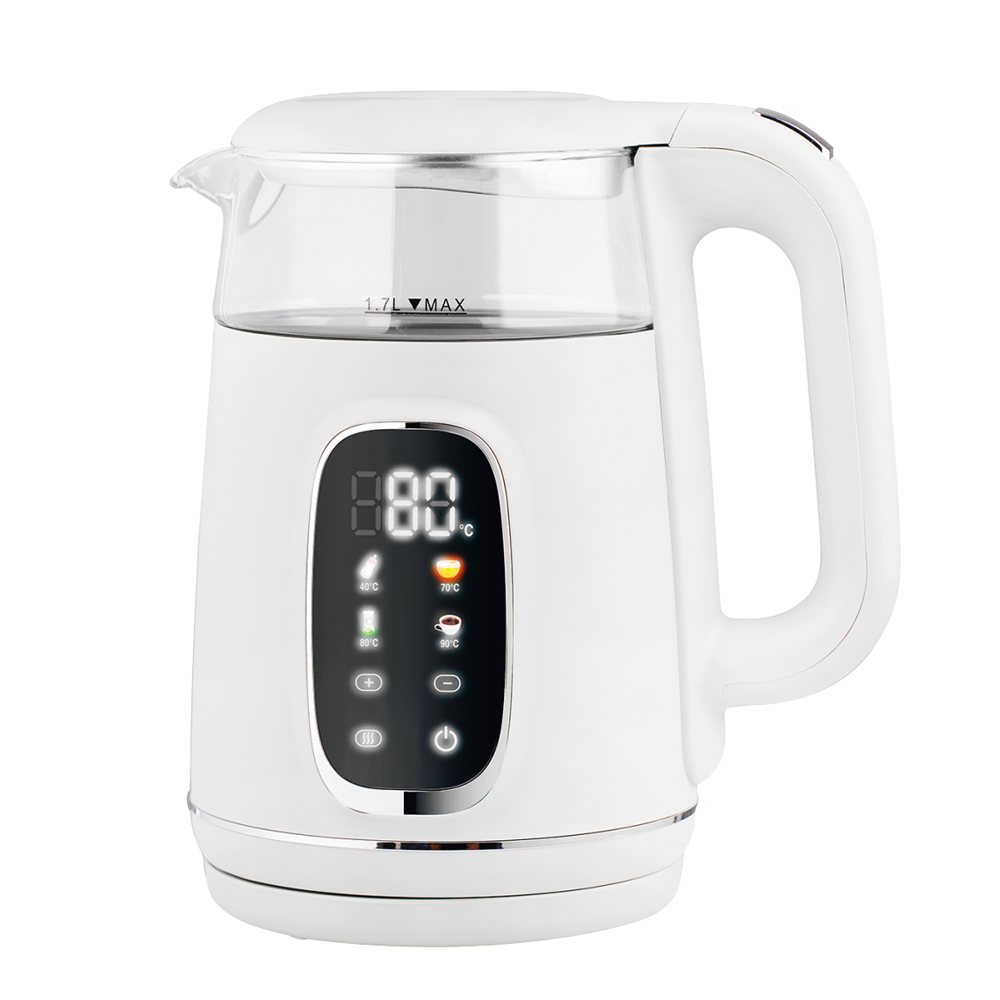
A Glass Kettle is not just glass. Inside the lid, around the spout, and between the inner body and the outer housing sits a silicone gasket that is in continuous contact with steam and 100°C water. The buyer who reads only the kettle spec sheet sees "food-grade silicone" and moves on. The factory that chose peroxide-cured silicone to save a few cents per unit knows that the curing residue can pass the FDA total-extractable test but still produce a faint taste in the first weeks of use — exactly the kind of complaint that lands in a private-label brand's customer service inbox. The cure method matters because it is the difference between a food-contact part that passes with margin and one that passes on paper only.
Peroxide-Cured vs Platinum-Cured Silicone: 6 Property Differences
Six properties separate the two cure methods in a kettle application. None of them is decisive on its own, but together they tell buyers which material is in the lid.
| Property | Peroxide-cured | Platinum-cured |
|---|---|---|
| Cure byproducts | Organic peroxide residues | Clean (no peroxide residue) |
| Extractables level | Higher | Significantly lower |
| Odor / taste transfer | Possible faint taste in early use | None under normal use |
| Compression set | Good (industrial standard) | Better (longer sealing force retention) |
| Optical clarity | Slight yellow tint possible | Water-clear |
| Unit cost | Lower | ~10–20% higher |
The last row is what tempts factories to use peroxide-cured silicone on budget lines. The second row is what makes European private-label buyers ask for platinum-cured as a default.
Why the seal is a food-contact part but rarely audited like one
A kettle lid gasket is a food-contact component under FDA 21 CFR 177.2600 and LFGB § 30/31, but it is rarely audited to the same depth as the glass body or the heating element. The reason is structural: the gasket is small, embedded in the lid assembly, and easy to overlook during a factory audit. The consequence is that peroxide-cured silicone gaskets are common in budget kettle lines even though they are widely known to fail LFGB sensory evaluation. The cure method is the single most common silent failure point in private-label Glass Kettle programs, and most buyers only learn about it after the first customer service ticket about taste.
The cost arithmetic that explains the factory default
The unit-cost difference between peroxide-cured and platinum-cured silicone is in the 10–20% range — meaningful on a high-volume kettle line, almost irrelevant on a premium line. A factory that bids aggressively for a 5,000-unit RFQ may quote peroxide-cured silicone because the cost savings flow directly to the bid price, which is what the buyer is comparing. The buyer who wants platinum-cured silicone has to specify it explicitly; otherwise the factory will default to peroxide-cured to win the price comparison. This is one of the rare cases where the cheapest quote and the correct spec are pulling in opposite directions.
FDA 21 CFR 177.2600 and LFGB § 30/31 Compliance Pathways
Both cure methods can clear FDA 21 CFR 177.2600, which sets the total extractables limit under specified simulant and time-temperature conditions. The LFGB § 30/31 framework in Germany goes further: it requires a sensory evaluation (odor, taste) that peroxide-cured silicone can struggle with even when extractables are within limits. Buyers selling into both the US and EU private-label channel should plan for the stricter of the two tests as the design baseline.
| Framework | Region | Key test | Pass margin for peroxide-cured | Pass margin for platinum-cured |
|---|---|---|---|---|
| FDA 21 CFR 177.2600 | United States | Total extractables | Comfortable | Wide |
| LFGB § 30/31 | Germany / EU | Extractables + sensory | Tight on sensory | Wide on both |
| USP Class VI (optional) | Pharma reference | Systemic toxicity | Sometimes | Almost always |
Migration Test Data: What Buyers Should Look For
A migration test report should specify three things before a buyer can act on it: the simulant (deionized water, 10% ethanol, or 3% acetic acid), the temperature (typically 100°C for kettle applications), and the duration (typically 2 hours × 3 cycles). What separates a meaningful report from a marketing PDF is the disclosure of the actual extractables value, not just a "pass" stamp. Platinum-cured silicone typically reports values 30–50% below the regulatory limit; peroxide-cured silicone often reports values close to the limit. The difference does not change the pass/fail outcome, but it changes how confident a buyer should be in the result.
What "less than 12 months old" actually means
Migration test reports carry a practical shelf life of roughly 12 months for two reasons: silicone formulation can drift over time (especially if the masterbatch supplier changes), and regulatory limits can be revised. A report from 18 months ago is technically still valid for the lot it covered, but it does not necessarily represent the silicone the factory is using today. Buyers who require "less than 12 months old" force the factory to re-test on a rolling basis, which keeps the report aligned with the current production line. For private-label programs with multi-year supply windows, this is the single most important line in the RFQ.
How to read an actual extractables value
A migration report that discloses an extractables value of, for example, 4 mg/dm² against an FDA limit of 50 mg/dm² is showing a comfortable pass. A report that discloses 42 mg/dm² against the same 50 mg/dm² limit is showing a barely-passing result. Both pass, but the second one has no margin for formulation drift over the next 12 months. Buyers who read only the pass/fail stamp will treat both reports as equivalent; buyers who read the actual value will treat them very differently.
How Curing Method Affects Taste, Odor, and Service Life
Three operational effects separate the two cure methods in the field. First, taste transfer: a brand new kettle with peroxide-cured silicone can carry a faint chemical note in the first 5–10 boil cycles, which then fades. Platinum-cured silicone has no such note at any point. Second, compression set: a silicone gasket that loses sealing force over time leaks steam around the lid. Platinum-cured silicone retains sealing force longer, which extends the visible service life of the kettle. Third, optical clarity: a peroxide-cured silicone that sits against a clear glass lid can yellow slightly under UV exposure; platinum-cured silicone stays water-clear.
Five RFQ Specification Lines for Seal Sourcing
The cleanest way to lock the seal material into a kettle RFQ is to write five explicit lines. None of them requires the factory to disclose the masterbatch supplier; they only require the factory to confirm what the cure line already says.
- Cure method. Platinum-cured silicone, declared on the mill certificate. (Use "peroxide-cured acceptable" only for non-EU / non-baby-milk lines.)
- Hardness. 50–60 Shore A, confirmed on the COC per shipment batch.
- Migration report. FDA 21 CFR 177.2600 + LFGB § 30/31, less than 12 months old at the time of shipment.
- Post-cure. 4 hours at 200°C post-cure to drive off volatiles, mandatory for baby-milk temperature lines.
- Batch retention. Retain 5 gasket samples per 1,000 units for 24 months, available on buyer request.
What "Shore A 50–60" means in plain terms
Shore A is a hardness scale for elastomers. A Shore A of 50 is a soft, compressible gasket; a Shore A of 60 is firmer; a Shore A of 70 is hard and is rarely used in kettle applications because it does not compress enough to seal against the lid surface. Most Glass Kettle gaskets ship at Shore A 55 ± 5, which balances sealing force against ease of assembly. A factory that quotes a Shore A of 70 is either specifying the wrong material or making the gasket too firm to seal correctly. Either way, the spec should be questioned.
Why post-cure matters for baby-milk lines specifically
Post-cure is the 4-hour 200°C heat treatment that drives off residual volatiles from the silicone after molding. Without post-cure, peroxide-cured silicone can leave detectable volatiles in the first weeks of use. With post-cure, even peroxide-cured silicone becomes acceptable for most non-baby-milk applications. For baby-milk temperature lines (40°C preset for infant formula), post-cure is mandatory regardless of cure method, because the baby-milk preset is the first use case where taste transfer is unacceptable. Buyers selling into the infant-formula channel should treat post-cure as a non-negotiable spec line, not an optional one.
Supplier Audit Checklist: 6 Questions for O-Ring Vendors
A factory that buys silicone gaskets from a third-party O-ring vendor — not all of them do — needs to be able to answer six questions about the upstream supply chain. Buyers should ask for these answers in writing before signing the PO.
- Is the O-ring vendor supplying platinum-cured or peroxide-cured silicone?
- Does the O-ring vendor supply a migration test report per batch, or one master report?
- Is the post-cure step performed at the O-ring vendor or at the kettle assembly line?
- What is the lot retention policy for gasket samples?
- Has the O-ring vendor been audited by any third-party lab for LFGB § 30/31 sensory compliance?
- What is the fallback plan if the primary O-ring vendor fails a batch migration test?
BOFU: How to Specify a Safe Seal in 4 Procurement Steps
For buyers who need to write a procurement specification without becoming a polymer engineer, the following four steps lock in the food-grade silicone kettle gasket without forcing the factory to disclose proprietary process data.
- Step 1. Declare platinum-cured silicone on the spec sheet, with peroxide-cured acceptable as a fallback for non-EU lines.
- Step 2. Require FDA 21 CFR 177.2600 + LFGB § 30/31 migration report per shipment batch, less than 12 months old.
- Step 3. Require 4-hour 200°C post-cure on all gaskets that touch the baby-milk temperature zone.
- Step 4. Lock batch retention (5 samples per 1,000 units for 24 months) into the PO so any field complaint can be cross-referenced to a retained lot.
A Glass Kettle that meets these four steps will pass EU and US private-label audits with margin. A kettle that specifies only "food-grade silicone" will pass the inbound inspection and may still fail in the field.
For sourcing teams building a private-label Glass Kettle line from scratch, the same procurement discipline that locks in the seal also locks in the body — see ourwholesale glass kettle buying tips for the matching checklist.
FAQ
When should buyers default to platinum-cured silicone over peroxide-cured?
Platinum-cured is the default for any kettle that supports a 40°C baby-milk preset, for private-label programs selling into Germany/Austria/Netherlands, and for any line positioned above the budget tier. Peroxide-cured is acceptable for cost-sensitive non-EU lines without infant-formula presets.
Where does peroxide-cured silicone tend to fail first?
The first failure is usually sensory — a faint taste or odor in the first 5–10 boil cycles. This is not a safety failure, but it triggers customer service tickets and warranty claims that are expensive to handle downstream.
Who in the supply chain actually decides which cure method is used?
The decision is made by the kettle factory's procurement team when they source the O-ring or molded gasket from an upstream vendor. The buyer cannot control this decision unless the cure method is explicitly written into the RFQ spec sheet and confirmed in the mill certificate.
Why does the LFGB sensory test matter more than the FDA extractables test?
FDA 21 CFR 177.2600 sets a quantitative extractables limit, which a peroxide-cured silicone can pass at the margin. LFGB § 30/31 adds a sensory evaluation (odor and taste) that catches the borderline cases the FDA test allows through. For European private-label, LFGB is the binding test.
Is peroxide-cured silicone ever the right choice for a kettle?
Yes — for non-EU, non-infant-formula, cost-sensitive lines where the buyer has explicitly weighed the unit cost savings against the field-failure risk. The choice is acceptable only when the buyer has made it consciously, not when the factory has made it by default.