
 0086-574-62518288


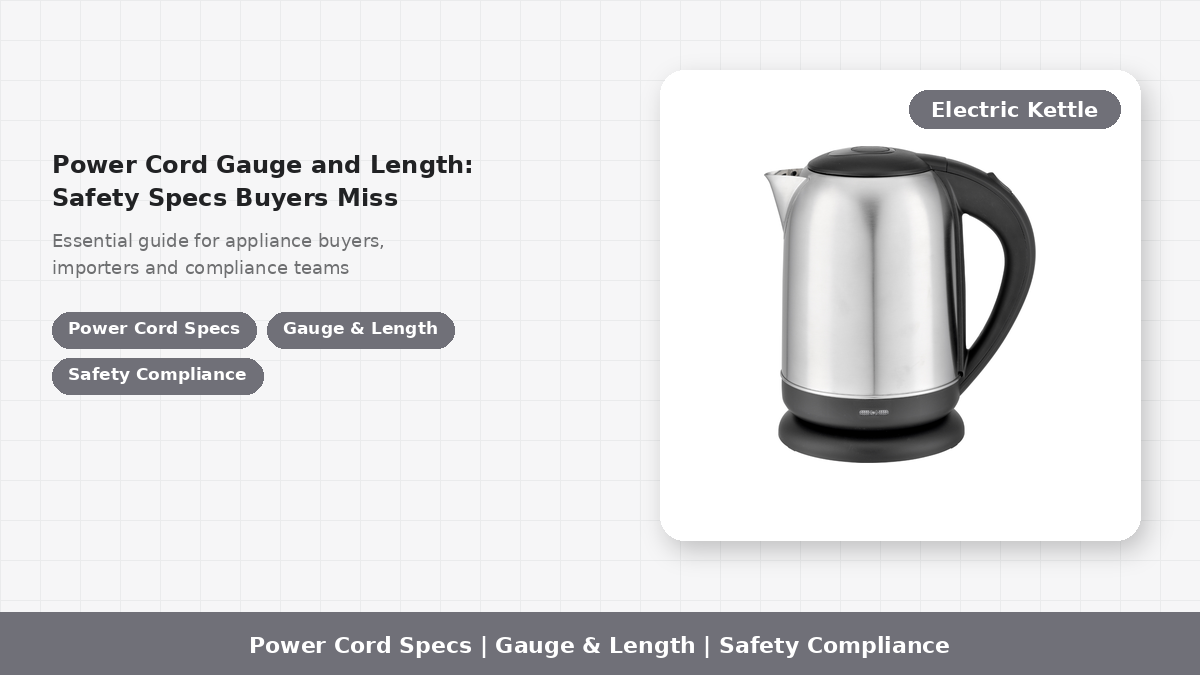
A kettle spec sheet says 2,200 W and 220–240 V and stops there. Nine fields decide whether that product is legal and safe in the market you are shipping it into, and on a typical published sheet eight of them are simply absent.
TL;DR
- Current is a function of voltage, not watts. The same 2,200 W kettle draws about 9.2 A at 240 V and about 18.3 A at 120 V, so a product approved for 220–240 V is not a North American product until the cord has been re-specified and re-certified.
- The conductor cross-section, the insulation type, the cord length, the routing from the appliance to the base, whether the cord detaches, the strain relief, the flex test, the cord's own certification and the spare part number are the nine fields that decide compliance, and eight of them rarely appear on a published sheet.
- Cord length is the line that looks free on the quotation and is paid for three times over: in copper, in heat generated in the cable, and in voltage drop at the far end of the run.
- A cord fails from fatigue at the point where it enters the appliance, not from a cut and not from a burn, which is why the flex test on the cord set matters more than a pull test on the finished product.
Electric kettle power cord specifications are decided by current, and current is a function of voltage rather than of the wattage that appears in bold on the product page. A kettle published at 2,200 W and 220–240 V draws roughly 9.2 A at 240 V, and the identical 2,200 W kettle on a 120 V circuit draws roughly 18.3 A. And that second number is the one that changes the bill of materials. Because the wattage figure is identical in both cases and the current behind it has almost doubled, so a buyer comparing kettles on watts is comparing a number that conceals the entire cord specification underneath it.
I have been asked to review kettle programmes for twelve years, across Europe, North America and the Gulf, and the cord specification is the item that most often turns out to be missing when the product is otherwise compliant and the approval file looks complete. The kettle is fine. The material is fine. The approvals are there. And then the importer asks whether the cord is the right size for the market and there is no answer on the page. My guide to choosing a wholesale kettle covers the product decisions, and this article covers the one that gets skipped. If you only read one section, read the arithmetic, because that is where the money and the liability live. I have sat with importers who had a complete approval file and no answer to the cord question, and that is a five-minute conversation that takes three months to fix afterwards.
What the Published Kettle Spec Sheet Does Not Tell You
Nine fields decide whether a kettle is safe and legal in your destination market, and a typical published specification sheet contains two of them. The two it contains are the wattage and the voltage, and both of those are the least informative of the nine for the question you actually need answered. Because the other seven are the ones an inspector, a customs officer or an insurer will ask for, and so a specification sheet that answers the question a buyer is asking rather than the question a regulator is asking is a sheet that will fail one day.
| Field | What it has to state | Why an inspector asks | What happens if it is missing |
|---|---|---|---|
| Rated current | Amperes at the rated voltage, and the maximum current the cord may carry. | The cord is rated for current, not for power, so current is the number the whole cord is sized against. | A certificate with no amperage on it cannot be checked against the cord. |
| Conductor cross-section | Square millimetres or the equivalent American wire gauge, per conductor. | Cross-section determines ampacity, and ampacity determines whether the cord is legal on that circuit. | The importer assumes the thinnest conductor that still passes and discovers the assumption in a recall. |
| Insulation type and temperature rating | The polymer and its rated temperature, for example PVC or silicone with a stated rating. | A cord near a steam path and a hot base sees a different temperature from a cord in free air. | Heat damage appears as a hardening and embrittlement of the sheath, usually well after the warranty. |
| Cord length | The measured length of the cord set, and whether it is fixed or detachable. | Length sets the resistance, the voltage drop and the temperature rise in the conductor. | A 3 m cord quietly becomes a 1 m cord in the quotation and nobody notices until it reaches the customer. |
| Cord routing from appliance to base | How the cord leaves the kettle and whether it can lie against a hot surface. | This is a construction requirement, not a styling preference, and it is checked on the assembly. | A cord that rests against the hot body is a thermal failure waiting for a customer to find it. |
| Strain relief design | The anchorage method at the appliance entry and at the base, and the pull and torque values it is tested to. | This is where the conductors actually fatigue, and the failure is invisible outside. | Intermittent faults that read as a product defect and get returned as a kettle rather than a cord. |
| Flex test evidence | The flex test performed on the cord set and the number of cycles. | Flex testing is what models daily use, and it is separate from the pull test on the finished appliance. | A cord that passes a pull test can still fail in a year of ordinary kitchen use. |
| The cord's own certification | The listing or approval of the flexible cord and the plug as components in their own right. | The flexible cord and the coupler each carry a separate approval from the appliance. | The single most common finding at an inspection is a cord listed for a different appliance class. |
| Spare cord part number | The orderable part number, its lead time and its minimum order quantity. | A cord that is not orderable turns a repairable product into a disposal. | The customer replaces the whole kettle over a cable, and your returns rate doubles for one avoidable reason. |
Read that table and you can see which two fields are usually published and which seven are not. The wattage and the voltage are the two, because they are the two a buyer asks for on a product comparison. Because the fields that regulate are the fields a buyer does not ask for, so they stay unwritten until the day somebody in customs or a certification body asks, and by then the product is on a vessel.
Current Is a Function of Voltage, Not Watts
A 2,200 W kettle draws about 9.2 A at 240 V, about 9.6 A at 230 V and about 18.3 A at 120 V, and the wattage on the box is identical in all three cases. This is the single arithmetic that every kettle programme needs to get right before anything else, because it determines the cord, it determines the plug, it determines the socket, and in North America it determines whether the appliance can legally live on a household branch circuit at all. I do this calculation in the first call, before the quotation, because it is the cheapest hour of the programme and the one that saves the most.
| Rated output | At 240 V, 50/60 Hz | At 230 V, 50/60 Hz | At 120 V, 60 Hz | What changes |
|---|---|---|---|---|
| 2,200 W | about 9.2 A | about 9.6 A | about 18.3 A | The current almost doubles. A cord sized for the 240 V column is not sized for the 120 V column. |
| 1,850 W | about 7.7 A | about 8.0 A | about 15.4 A | Still above a 15 A household branch circuit limit once you allow for the appliance and the circuit together. |
| 1,500 W | about 6.3 A | about 6.5 A | about 12.5 A | The 120 V figure starts to sit inside a normal 15 A circuit, which is why 1,500 W is the usual North American ceiling. |
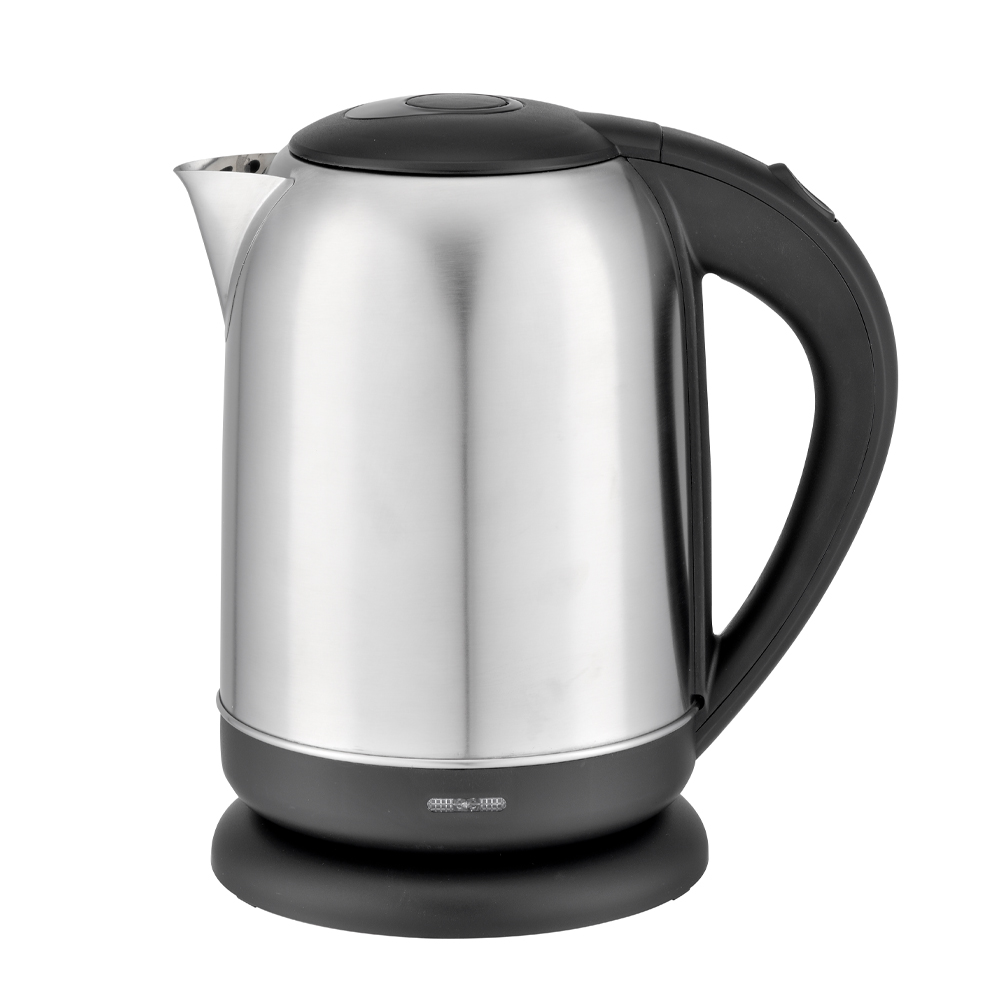
Our own published product is a good illustration because the range is wide. The HHB1705 and HHB1705S are published at 1,850 to 2,200 W and 220 to 240 V, 50/60 Hz, with a concealed heating element and 360-degree cordless docking, and they carry CE, GS, RoHS and LFGB compliance with automatic shut-off at boil and boil-dry protection. Because that published voltage band makes it a 230 V product, and so a North American programme is not a packaging change and a plug change, it is a new electrical design and a new approval.
There is a consequence that catches importers regularly. The plug is the cheap part of the problem. The plug at 120 V is a 15 A type, which is a known part, and the socket is a known part. The problem is the cord between them and the cord at the appliance end, and the appliance approval, which was written against the 230 V current and has to be re-issued against the 120 V current. Because the approval follows the current rather than following the box, so a kettle with an unchanged certificate and a re-labelled plug is a kettle that is not approved for the market it is being sold into, and that is a regulatory problem and not a customs one.
Cord Gauge: The Number That Decides Whether the Cord Is Legal
Conductor cross-section is the only field in the table that determines whether the cord is permitted to carry the current the kettle draws, and it is the field most often absent from the sheet. The specification should state the cross-section in square millimetres or the equivalent American wire gauge, and the ampacity that the conductor is approved for, and the insulation polymer with its temperature rating.
In North America the flexible cord itself is a listed component under UL 817, and the heating appliance is assessed separately under UL 499, which means the cord on a kettle and the kettle itself carry two different approvals. In Europe the flexible cord is covered by the cable standards and the appliance by the liquid heating appliance standard. Because the cord and the appliance are assessed as separate components in both regions, so the certificate you hold for the kettle does not silently cover the cable that came with it.
| Conductor size | Equivalent AWG | Typical continuous current | Where it belongs on a kettle |
|---|---|---|---|
| 0.75 mm² | about 18 AWG | up to about 6 A | Sub-1,000 W appliances and control and signal conductors. Not a cord for a 2,200 W kettle. |
| 1.0 mm² | about 16 AWG | up to about 10 A | The usual 230 V choice for a kettle in the 1,850 to 2,200 W band. This is the column most cord specifications quote. |
| 1.5 mm² | about 14 AWG | up to about 15 to 16 A | The typical North American choice at 1,850 W on 120 V, and the conservative choice everywhere else. |
| 2.5 mm² | about 12 AWG | up to about 20 A or more | What a 2,200 W kettle on 120 V actually needs, and the reason that variant costs more to build. |
Those ampacity figures are the general ratings for flexible cord in free air, and the real number on your certificate will be whatever the standard in your market permits for that insulation, that length and that installation. Because the published rating is a ceiling rather than a target, and because the number that matters is the one on the cord certificate matched to the current in your market, so the specification should quote the certificate and not the table. I include the table because it makes the argument, not because it substitutes for the certificate.
Cord Length: The Specification That Looks Free and Costs the Most
Cord length is the line that appears free on a quotation and is paid for three times over: in copper, in heat generated in the conductor, and in voltage drop at the end of the run. All three scale the same way, and all three get worse together, so length is not a neutral line that a buyer rounds up for convenience.
Our own buying guidance for wholesale kettles says the cord should be long enough to reach outlets without being cumbersome, and that instinct is right for the customer's convenience and incomplete for the specification. I have watched importers approve a cord length on the factory floor and regret it on the packing line, because nobody modelled the carton. Because resistance rises directly with conductor length, so every additional metre adds voltage drop at the appliance and converts a little of the appliance's power into heat in the cable, and because that heat is dissipated into the kitchen rather than into the water. A kettle at 2,200 W drawing 9.2 A through a long, thin cord will feel slower to boil, and the base will feel warm, and the reason is in the copper rather than in the element.
The practical range for a Cordless Kettle with a rotating base is between 0.6 m and 1.0 m, which covers a counter-top installation with the outlet behind or beside the appliance without the cord becoming a trip hazard across a worktop.Because a cordless base exists to remove the cord from the kettle's path, so a long cord partly defeats the reason the product is cordless at all. Longer cords also make the product harder to pack, and our own container loading figures for the HHB1705 series, 3,200 pieces in a 20 GP and 7,632 pieces in a 40 HQ, are calculated on the current cord configuration.
Detachable Cord Set or Fixed Cord, and Why It Changes the Approval
Whether the cord detaches is a product decision with a regulatory consequence, and it is usually inherited from the platform rather than chosen deliberately. Most kettle bases use the figure-eight appliance coupler, where the socket on the base and the plug on the cord are two different components with two different current ratings, and the half that sits on the appliance is the one that has to carry the full load. The coupler requirements are set out in IEC 60320-2-3, and the pairing has to be the one the approval was written against.
A detachable cord set has real advantages. The product packs smaller, a damaged cord can be replaced rather than the whole appliance, and the cord can be routed away from a wet counter. It also means the end user can fit a cord that your factory did not supply, and the approval has to account for that case rather than assuming the supplied cord is what gets plugged in. We see that substitution in the field far more often than we would like to. Because a detachable cord set hands the user a component that carries mains current and that the approval has to permit, so the coupler rating and the cord specification become the same decision rather than two separate ones.
A fixed cord removes that possibility, which is a genuine safety advantage and also a packaging and service disadvantage. Either choice is defensible. The thing that is not defensible is making it by accident and then discovering at inspection that the coupler and the appliance were never assessed as a combination.
Strain Relief, Flex Testing and the Failure You Cannot See
Kettle cords fail from fatigue at the point where they enter the appliance or the base, and they fail from the inside, which means the sheath still looks perfect when the conductors have already cracked. This is the failure I am asked about most often, because it presents as an intermittent fault. The kettle trips, or the switch does nothing, or it works when it is warm and fails when it is cold, and the customer concludes that the appliance is faulty and returns it. It is not the appliance.
The standard for kettle safety, IEC 60335-2-15, is the document that governs this and it governs a good deal more than the cord: the anchorages at the cord entry, the flexing of the cord, the requirement that the appliance cannot be operated with a detached cord, the requirement that the cord cannot be routed where it will touch hot surfaces, and the length limits that apply to a cordless appliance whose cord is part of the power path. Because the cord in a kettle is not a passive accessory but part of the live circuit of a high-current appliance sitting on a wet surface, so the test regime that applies to it is specific, and a buyer who asks for the appliance certificate without the cord test evidence has asked for half the answer.
The practical consequence for a buyer is that you should ask for the flex test on the cord set, not only a pull test on the assembled product. A pull test proves the cord is attached. A flex test proves it survives the ten thousand flexes a busy office or a hospitality floor puts through it. Because the flex test is the one that models actual service, so a cord that has only been pulled is a cord that has not been tested for the way it will fail.
How to Write a Cord Specification That Will Pass Inspection
Eight steps, and the first one is a sentence you can paste into the request for quotation. This is the sequence we work through with importers who are about to place their first appliance order into a regulated market, and it is deliberately in the order a certification body asks questions rather than the order a buyer thinks of them. Send it with the first request for quotation and the conversation starts in the right place.
Eight steps to a kettle cord specification that survives inspection
- Fix the destination mains voltage before you agree the wattage, because the same wattage at a different voltage is a different current and therefore a different cord.
- Require the rated current in amperes at the rated voltage, not only the rated wattage in the marketing material.
- Require the conductor cross-section in square millimetres or AWG, and the insulation polymer with its temperature rating.
- Require the cord length and the routing from the appliance to the base, so that the cord cannot lie against a hot surface or be trapped under the appliance.
- Fix whether the cord is detachable or fixed, and the coupler type and rating that goes with that decision.
- Require the strain relief construction and the flex test evidence on the cord set, not only a pull test on the finished appliance.
- Require the certification of the cord and the plug as separate components, in addition to the appliance certificate.
- Agree the spare cord part number, its lead time and its minimum order quantity, and put it in the after-sales catalogue.
Step eight is the one I would add to any programme, and it is the one nobody puts in. A kettle with a damaged cord is a kettle the customer replaces rather than repairs, and a cord that is not in the catalogue becomes a refusal in the field. Because the cord is the component most likely to need replacing early and the component least likely to have been planned as a spare, so a programme that stocks cords has a materially better returns and warranty position than one that does not, and that difference shows up within a year.
What I Would Tell a Buyer Arriving With This Question
I would tell them to ask for three documents and one number, and to treat a refusal on any of them as information. The three documents are the appliance certificate, the flexible cord certificate and the coupler or plug certificate, because they are three separate approvals that most buyers assume are one. The number is the rated current in amperes at the destination voltage, because that single figure reorders every other decision on the page.
I would also tell them that the cord specification is not a cost-cutting opportunity, which is how it is usually approached. Because the cord is the cheapest component in the appliance and the only one whose failure is a shock risk rather than a performance complaint, so the money saved on the conductor is spent twice over on the returns. On a 1.7 litre stainless steel jug kettle at 1,850 to 2,200 W, the difference between a 1.0 mm² cord and a 1.5 mm² cord is a small line item in a factory cost sheet and a large line item in a field quality file.
And if the product is a Cordless Kettle with a rotating base, which is where most of the volume now sits, the cord question is easier than it looks because the base takes the connection. Because the base is a separate low-voltage interface in most designs, and so the cord specification lives on the base and the kettle, and the two can be developed and certified independently, which is worth knowing before you commit the programme to one voltage. The product range behind this, covering 304 and 316 stainless steel, high borosilicate glass and food-grade PP in electric, whistling, double-wall, glass and gooseneck formats, is set out on our stainless steel kettle series page, and the jug kettle discussed here is the 1.7 litre cordless model.
Frequently Asked Questions About Electric Kettle Power Cords
What gauge cord does a 2200 W electric kettle need?
It depends on the voltage, which is the whole point. A 2200 W kettle at 240 V draws about 9.2 A and a conductor in the 1.0 square millimetre class is the usual answer. The same 2200 W kettle at 120 V draws about 18.3 A, which moves the requirement up a size and makes it the constraint on whether the appliance can go into a North American market at all. Ask for the conductor cross-section and the rated current together, never the wattage on its own. We answer that question in every enquiry, because the wattage on the picture tells us nothing about it.
How long should an electric kettle power cord be?
Short enough to be tidy and long enough to reach a socket, which for most counter and office installations means somewhere between 0.6 m and 1.0 m for a Cordless Kettle with a rotating base. Our own buying guidance is that the cord should be long enough to reach outlets without being cumbersome, and that is the right instinct, but it also has to be declared, because length is what determines conductor size, voltage drop and the heat generated in a cable carrying a high current.
Is a detachable cord set better than a fixed cord for a kettle?
Each has a consequence, and the buyer should choose deliberately rather than inherit it. A detachable cord set is easier to store, easier to replace when damaged and easier to ship, but it means the end user can fit a third-party cord, so the approval has to account for that and the coupler has to be the right class. A fixed cord cannot be substituted, which is a safety advantage, but it makes the product harder to pack and harder to service.
What is the difference between a C7 and a C8 appliance coupler?
They are the two halves of the figure-eight coupler used on most kettle bases, and they are not interchangeable in the way people assume. The appliance side and the cord side have different current ratings, and the half that sits on the appliance is the one that has to carry the full load. The coupler requirements are set out in the international standard for appliance couplers, and the rating on the part you specify has to cover the current your kettle actually draws.
What causes a kettle cord to fail?
Almost always fatigue at the point where the cord enters the appliance or the base, not a cut and not a burn. The conductors crack internally from repeated flexing while the outer sheath still looks perfect, and the failure is invisible until the cord warms up under load. This is why the flex test on the cord set matters more than the pull test on the assembled product, and why the strain relief design is a specification item rather than a styling detail. We put it in the spec for every kettle programme we run, and we have never had a buyer regret it.
Does the kettle cord need its own certification?
Yes. The flexible cord and the appliance coupler each carry their own approval in their own right, separately from the appliance certificate that includes them. In North America the flexible cord is listed under UL 817 and the heating appliance under UL 499, and in Europe the appliance is assessed under the liquid heating appliance standard with the coupler covered by the appliance couplers standard. The most common finding at an inspection is a cord that was listed for a different appliance class, and in our experience it is nearly always a cord that was fine for the heater it was originally designed for.
Does a double wall stainless steel kettle affect the cord specification?
Not directly, but it changes the environment the cord lives in. A double wall construction gives a cool-touch exterior and holds temperature for longer, which is the reason buyers want it, and it means the hot surfaces are better shielded from the user and from anything resting against the appliance. The cord specification still has to cover the base, the steam path and the environment the appliance is rated for, which is why we ask for the insulation type and the temperature rating rather than accepting a generic flexible cord.
How do I compare two kettles when one is 1850 W and the other 2200 W?
Compare them at the same voltage, because watts alone are not a comparable quantity across markets. Our own 1.7 litre cordless jug kettle is published across a 1850 to 2200 W output range at 220 to 240 V, and within one voltage band the higher wattage figure is simply the top of the same product. Across two voltage bands the wattage comparison becomes meaningless, because the current behind it has almost doubled. If you are comparing two kettles from two suppliers in two markets, ask for both current figures before you ask for either price.
Should I stock spare cords with the kettle?
Yes, and you should agree the spare part number and its lead time before you place the first order rather than after the first complaint. A kettle with a damaged cord is a kettle the customer replaces rather than repairs, so if the cord is not in the catalogue the replacement becomes a refusal, and in the European and North American markets our buyers work in that refusal is expensive.
Ask us for the cord specification behind the catalogue number
Tell us the destination market, the mains voltage, the rated output and whether you want a detachable cord set or a fixed cord, and we will send you the full cord specification with the conductor size, the insulation type, the length, the coupler and the certification documents for the cord as a separate component. If your programme is heading into North America at 2,200 W, ask us for the 120 V variant early, because that conversation changes the product rather than the paperwork, and we would rather have it in week one than in week nine.
1.7 L Cordless Jug Kettle 2200 W · Stainless Steel Kettle Series · Contact Goodfriends