
 0086-574-62518288


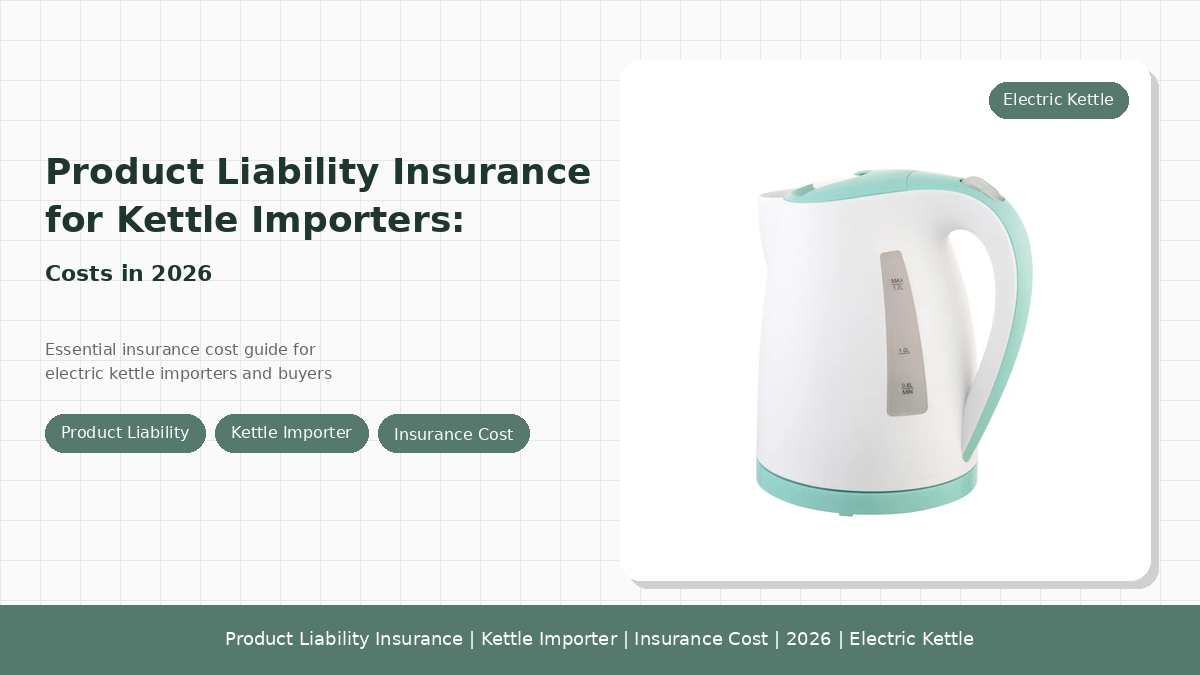
TL;DR: Kettle importers in the small-to-mid volume range typically pay a low-to-mid four-figure annual premium for product liability coverage. The cost scales with unit volume, target market (U.S. consumer exposure commands a significant premium over European-only trade distribution), and product certification depth. Five rating variables — power configuration, market jurisdiction, incident history, coverage limits, and distribution channel — determine where your specific cost lands within that range.
A mid-sized kitchenware importer in the United States received a burn injury claim involving one of their electric kettle SKUs in early 2025. The consumer alleged a thermal failure in the lid-lock mechanism that resulted in scalding. Legal defense costs alone ran for eleven months before a settlement was reached. The total cost, including the settlement and legal fees, was well into six figures. The importer had maintained general commercial liability insurance — but had not secured a products-specific rider, and the general policy contained an exclusion that the insurer later invoked. The importer bore the full cost out of operating reserves.
That outcome is not unusual in the small appliance import sector. It illustrates a specific and consequential gap in the risk management approach of many small and mid-sized kettle importers: product liability exposure is real, it is quantifiable, and it is insurable — but only if the coverage is specifically structured for it. The gap is not a products liability gap. The gap is an underwriting specificity gap: the difference between a general commercial liability policy and a policy that is actually designed to respond to a defect-related injury claim involving a consumer product.
The kettle category presents a distinct risk profile within the broader small appliance landscape. Electric Kettles combine three elements that insurers weight carefully: a high-temperature heating surface, direct consumer contact during use, and a mechanical lid and handle assembly that is the source of the most common failure mode — the lid detaching under pressure from boiling water. A consumer who tips a kettle and receives a scald has a straightforward personal injury claim. The liability chain — importer, distributor, retailer — is legible under product liability law in every major market. The question for the importer is not whether liability exists. The question is whether they have transferred it.
This article walks through what kettle importers actually pay for product liability insurance in 2026, what determines those costs, and how to approach the market for coverage with enough knowledge to ask the right questions. The goal is not to sell insurance — it is to equip importers with enough structure to evaluate their coverage position intelligently.
How Insurers Actually Price Kettle Liability Risk
Product liability insurance pricing is not arbitrary. Insurers use actuarial loss data organized by product category, market, and distribution channel. For small appliances — a category that includes Electric Kettles alongside toasters, coffee makers, and irons — the rating model draws on decades of claims experience across millions of units sold globally. TheInsurance Information Institute publishes aggregate loss statistics that contextualize category-level risk, and the NAIC consumer products insurance research provides regulatory-grade data on closed claim patterns that underwriters use as a reference baseline for rating small appliance imports.
The primary rating inputs for a kettle import operation are:
- Product category and heating principle. An electric kettle's heating element operating at 1,500–2,200 watts creates a thermal risk surface that the insurer's underwriter evaluates alongside the kettle's water capacity, lid closure mechanism, and auto-shutoff implementation. Each of these design elements connects to specific failure modes documented in historical claims data.
- Target market jurisdiction. The United States produces a disproportionate share of global product liability claim costs due to its litigation culture, jury award magnitudes, and the availability of punitive damages. A kettle imported for sale exclusively through European retail trade channels will carry a materially lower expected loss cost than the same kettle sold directly to American consumers through an online marketplace.
- Annual unit volume. Exposure is proportional to units in the field. An insurer's model scales premium with projected unit count, typically using a tiered schedule rather than a pure linear relationship. Moving from 2,000 units per year to 20,000 units per year does not multiply the premium by ten — the rate per unit decreases as volume increases, but the aggregate premium rises substantially.
- Coverage limits and deductible structure. Higher per-occurrence limits and lower deductibles transfer more risk to the insurer and increase premium. The gap between a $1M/$2M policy and a $2M/$5M policy can represent a 30–50 percent premium differential for the same risk.
- Incident and recall history. An importer with three or more consecutive loss-free years typically earns a experience modification credit — a premium reduction that rewards documented safety performance. A prior recall, even one from a previous supplier relationship, will be scrutinized and will likely result in a surcharge.
Understanding these five variables is the foundation for any productive conversation with an insurer or broker. Importers who approach the insurance market without this framework tend to receive quote comparisons that are difficult to evaluate on an apples-to-apples basis.
Where Claims Actually Come From: A Risk Decomposition
Before discussing cost ranges, it is useful to understand the claim types that drive product liability losses for Electric Kettles, because different claim types carry different financial magnitudes and different insurer responses.
The primary claim categories in order of average severity are:
- Burn and scald injuries. These represent the highest-severity and highest-cost claims. A scald injury involving a child can generate medical expense, pain and suffering, and in the U.S. system, punitive damages. Settlements and judgments in the hundreds of thousands of dollars are within the normal range for serious burn claims. This is the risk that makes product liability insurance structurally necessary for kettle importers.
- Electrical failure and fire damage. A kettle implicated in a residential fire generates both property damage claims and potential bodily injury claims. The insurer's subrogation investigation — determining whether the kettle's electrical system was the originating cause — can take months and generates significant legal defense costs even if the claim is ultimately denied.
- Mechanical failure during use. Lid detachment, handle failure, or base separation during operation are common mechanical failure modes. These tend to generate lower-severity claims than burns, but they occur at higher frequency, and the cumulative effect on an insurer's loss experience for a product line matters for future premium renewals.
- Misuse-related incidents. Consumer misuse — operating the kettle without water, using it on an incompatible voltage supply, or modifying the cordset — is a perennial defense argument. In most jurisdictions, a manufacturer or importer has some duty to design against foreseeable misuse, and courts have found liability in cases where the misuse was deemed reasonably foreseeable. This claim category requires careful product-specific analysis.
The relative frequency and severity of these claim types shapes the insurer's loss cost estimate for the kettle category. The NAIC (National Association of Insurance Commissioners) at naic.org maintains product liability closed claim databases that insurers use as reference, and the Insurance Information Institute at insuranceinformationinstitute.org publishes aggregate market loss statistics that contextualize category-level risk for brokers and underwriters. The U.S. Census Bureau's foreign trade statistics provide the import volume context that helps insurers calibrate exposure growth assumptions for the small appliance category.
Where most importers are caught off guard: Legal defense costs alone — before any settlement or judgment — can reach mid five figures for a single contested claim. A policy that covers indemnification but imposes a low-per-claim defense cost sublimit can leave an importer with a significant uncovered exposure even when the underlying claim would have been covered.
Real Cost Ranges: What Kettle Importers Actually Pay in 2026
The following ranges reflect observations compiled from broker consultations and industry trade sources for electric kettle import operations targeting North American and European markets in 2026. These are indicative starting points — your actual premium will deviate based on the variables described above.
| Importer Scale | Annual Unit Volume | Typical Markets | Coverage Range | Indicative Annual Premium |
|---|---|---|---|---|
| Micro importer | Under 1,000 units/year | EU trade only | $500K per occ. / $1M aggregate | Upper three-figure to low four-figure |
| Small importer | 1,000–5,000 units/year | EU or NA trade | $1M per occ. / $2M aggregate | Low four-figure |
| Mid-sized importer | 5,000–30,000 units/year | EU + NA trade channels | $1M–$2M per occ. / $2M–$5M aggregate | Mid four-figure to upper four-figure |
| Large importer | 30,000–100,000 units/year | Multi-market, retail + online | $2M–$5M per occ. / $5M aggregate | Low five-figure |
| Major distributor | Over 100,000 units/year | Global, all channels | $5M+ per occ. / $10M+ aggregate | Mid five-figure and above |
These ranges assume a kettle product line with standard CE and UL/ETL certification, no prior recalls, and distribution through verified trade accounts. Premiums scale up from this baseline when any of the five rating variables listed above move in an adverse direction.
The United States market premium differential is the most significant single variable. An importer selling the same CE-marked kettle to European trade accounts only will typically pay 30–50 percent less than an importer selling the identical product to U.S. consumers, because the insurer's model weights U.S. consumer market exposure significantly higher due to litigation cost history. The Federal Register's CPSC rulemaking entriesprovide the official regulatory context that shapes the minimum safety compliance floor for Electric Kettles sold in the United States, and theU.S. Occupational Safety and Health Administration establishes the workplace safety standards that indirectly govern how manufacturers and importers must handle incident documentation and reporting obligations in the supply chain.
Five Variables That Push Your Premium Up or Down
1. Power configuration
Kettles above 2,000W at 220–240V carry higher thermal risk. Multi-voltage models (110V + 220V) require separate rating entries and may attract a combined load.
2. Market jurisdiction
U.S. consumer market = highest premium weight. European Economic Area trade distribution = moderate. Canada, Australia, Japan = moderate to low. Selling to all simultaneously requires multi-territory coverage.
3. Distribution channel
Trade-only sales (wholesale, retail supply) carry lower per-incident exposure than direct-to-consumer channels, because the retailer absorbs some distribution-layer liability. Amazon FBA and similar fulfillment models introduce specific coverage requirements.
4. Certification portfolio
Each third-party accredited test report reduces the insurer's uncertainty margin. CE + UL/ETL is the floor. KC, PSE, and in-market specific certifications each add a credit. Gaps in documentation trigger a documentation surcharge at quote renewal.
5. Loss history
A three-year loss-free record earns an experience modification credit. A single prior claim, depending on severity, may attract a surcharge or require a schedule-rated adjustment. A prior recall requires a separate disclosure and often a specific endorsement.
6. Deductible choice
A $2,500 per-claim deductible versus a $10,000 deductible can represent a 15–25 percent premium differential. Retaining a higher deductible makes sense for importers with strong quality controls and low historical frequency.
These variables are not equally weighted. Market jurisdiction — specifically whether the importer is exposed to U.S. consumer market liability — is typically the single largest driver of premium variance. An importer who can structurally limit their U.S. exposure to wholesale trade channels rather than direct consumer sales can meaningfully reduce their cost of coverage without changing their product, their supplier, or their certifications.
The Decision Framework: Which Coverage Structure Fits Your Operation
Choosing the right insurance structure is not purely a function of cost minimization. The appropriate coverage level is determined by the financial consequence of an uninsured incident relative to the cost of transferring that consequence to an insurer. The framework that experienced brokers and risk managers use is straightforward: compare the expected cost of an uninsured incident — probability times magnitude — against the annual premium cost of transferring that risk. For low-probability, high-magnitude events, the transfer is almost always rational at commercially available premium rates.
The 16 CFR Part 1119 consumer product safety regulations establish the baseline legal obligations for small appliance importers entering the U.S. market, and the Code of Federal Regulations Title 16 provides the full regulatory architecture that governs what constitutes a reportable product incident under the Consumer Product Safety Act. Understanding this framework is not optional for importers — it defines what your insurer will expect you to report, when, and to whom. The regulations.gov portal provides public access to CPSC rulemaking dockets, recall announcements, and enforcement actions that provide the factual backdrop against which insurers evaluate your product category's compliance posture.
An uninsured burn injury claim involving a child, in the U.S. litigation system, can produce a settlement or judgment that exceeds the annual premium of a mid four-figure insurance policy by a factor of fifty or more. The economics of insurance transfer are clear for high-severity, low-frequency events — which is precisely the profile of a serious product liability incident.
The following scenarios map coverage recommendations to importer profiles:
- New importer, fewer than 1,000 units per year, European trade only: Start with a products liability policy at $1M per occurrence / $2M aggregate with a $5,000 deductible. Prioritize CE certification and maintain records of every shipment's destination. At this scale, the primary objective is avoiding a single incident that overwhelms operating reserves.
- Established importer, 1,000–15,000 units per year, EU + North American trade: Move to $2M per occurrence / $5M aggregate. Add a product recall endorsement if you are supplying major retail accounts, as most national retailers require recall coverage as a vendor prerequisite. Implement a documented supplier quality audit process — insurers recognize this as a risk control measure and it will appear in your renewal pricing.
- Scale importer, over 15,000 units per year, multi-channel including online retail: Carry $5M per occurrence / $10M aggregate minimum. Engage a broker with specific expertise in consumer products and small appliance lines — the difference between a standard market quote and a competitively placed policy at this scale is meaningful. Evaluate a difference-in-conditions policy to cover gaps between your primary general liability and products liability programs.
Product Recall Coverage: A Separate but Related Decision
Product recall insurance is a distinct coverage from products liability, though the two are often discussed together and sometimes bundled by insurers seeking to write the full account. Products liability covers third-party claims for bodily injury and property damage arising from a defect in your kettle. Recall coverage covers the costs you incur to pull your product from the market voluntarily or under a regulatory order — the logistics of retrieval, the consumer and retailer notification, the warehousing of returned units, and in some policy forms, the lost revenue during the recall period.
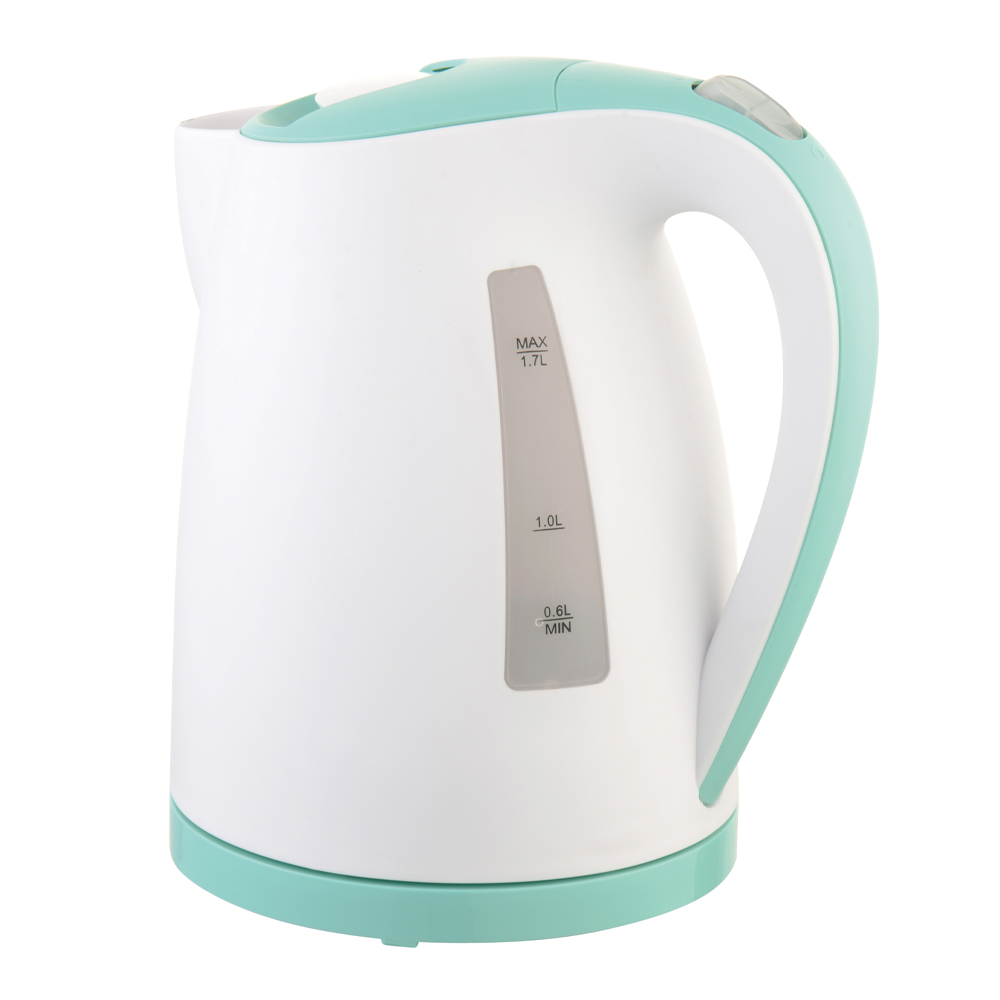
The distinction matters because the two coverages respond to fundamentally different financial events. A products liability claim is triggered by a single injured party. A recall is triggered by a pattern — or a single incident severe enough to trigger a regulatory action — that implicates your entire in-market inventory. A recall affecting 8,000 units of a 1.7L Cordless Electric Kettle that you imported in a single container shipment is a logistical and financial event of an entirely different magnitude than a single burn injury claim. The per-unit cost of a recall — logistics, destruction or remediation, replacement product, regulatory reporting — can reach a level that is material relative to the gross margin on the original shipment.
For most kettle importers below the 15,000-unit-per-year threshold, standalone recall coverage is not the first priority. The product defect patterns most common in Electric Kettles — lid lock failures, auto-shutoff malfunctions, heating element defects — tend to generate individual injury claims rather than batch defects requiring market-wide recall. However, as your unit volume grows and your customer base includes national retail chains, the recall risk becomes more consequential, and the coverage becomes commercially non-negotiable. Many national retail vendors require recall coverage as a contractual prerequisite before they will list your product. The coverage is typically added as a rider to your products liability policy or purchased as a separate open perils product recall policy, depending on the insurer and the policy form available to your broker.
Retailers including major national accounts typically maintain their own product liability requirements as a vendor prerequisite, and many now require evidence of recall coverage above a certain unit volume threshold. The U.S. Customs and Border Protection enforces CPSC import holds at the border, meaning that a product subject to an active CPSC recall can be detained or refused entry — a supply chain disruption that is separate from the recall cost itself but equally consequential. The U.S. Department of Justice civil consumer protection division has escalated product safety enforcement in recent years, and importers should understand that criminal referral is a theoretical risk in cases where intentional concealment of a known defect is demonstrated. The Bureau of Industry and Security also plays a role in import enforcement for products that fall under specific regulatory jurisdictions, and coordination between BIS and CPSC oversight is an area that has grown more complex for multi-product importers.
Why Electric Kettles Attract Specific Underwriting Scrutiny
Within the broader category of Small Kitchen Appliances, electric kettles occupy a particular position in the insurer's view that is worth understanding. The kettle combines a heating element operating at temperatures above the boiling point of water — typically 100 to 105 degrees Celsius under normal atmospheric conditions — with a consumer use pattern that involves direct handling while the product is at temperature. This is not a static risk, like a toaster that sits on a shelf. It is a dynamic risk that peaks during the kettle's active use window.
The specific failure modes that generate the highest-severity claims are well-documented in insurer loss data. Lid ejection — where the kettle lid detaches or is displaced during heating, releasing a jet of steam and boiling water — is the leading cause of serious scald injuries in electric kettle incidents. The second most severe failure mode is base separation, where the heating base detaches from the body of the kettle during operation, spilling boiling water. Both failure modes are associated with specific design and manufacturing quality risk factors: lid lock geometry, latch spring tension, and the torque specification of the base-to-body connection. Insurers underwriters reviewing a kettle with no third-party test data on these specific mechanical parameters are pricing on worst-case assumptions rather than actual test results. Third-party accredited test reports — particularly reports that include mechanical load testing on lid and base assemblies — move the underwriter's uncertainty margin in the importer's favor.
Auto-shutoff functionality is another critical variable. A kettle with a documented, tested auto-shutoff mechanism represents a fundamentally different risk profile than a kettle where the consumer is relying on a mechanical thermostat. The presence of a Strix-type or equivalent documented auto-shutoff controller is a specific positive signal in the insurer's model. Importers who can provide the test report documenting the auto-shutoff activation temperature and response time have a meaningful data point to present at quote time.
Voltage configuration is an underrated pricing variable. A kettle configured for 220–240V 50Hz European use and the same kettle configured for 110–120V 60Hz North American use have different heating element resistance, different current draw, and different thermal expansion profiles. A kettle sold in both markets without separate UL and CE testing for each configuration may present a documentation gap that the insurer flags at renewal. If your kettle SKU spans both voltage families, treat them as separate products in your insurance submission.
What Insurers Actually Require at Quote Time
When you approach an insurer or broker for a product liability quote, the information request will typically include:
- Product specifications for each kettle SKU to be covered — power rating, voltage, capacity, heating element type, and any relevant safety feature descriptions
- Third-party test reports and certificates of conformity for each target market
- Annual projected unit volume by market destination
- Sales channel breakdown — trade wholesale versus retail versus direct-to-consumer, with the identity of major retail account customers if applicable
- Loss history — all incidents, claims, and recalls for the preceding five years, including incidents involving any product from any prior supplier relationship
- Names of any prior insurers and policy numbers for the preceding three years
Completeness and accuracy in this submission matters. Insurers have been known to deny coverage at claim time for material misrepresentation in the underwriting submission — a category that includes understated unit volumes or undisclosed prior incidents. The underwriting process is, in effect, the contract that defines the scope of coverage. Invest the time to make it accurate.
What Goodfriends' 2025 Performance Data Tells Us About Risk
Ningbo Goodfriends, the manufacturer behind the Stainless Steel Kettle series available through Goodfriends' factory-direct channel, reported strong sales performance in 2025 despite global economic headwinds. That sales resilience reflects the underlying demand for competitively priced, certifiable small appliances — a demand that is distributed across importers of varying size, risk sophistication, and insurance access.
For importers evaluating their coverage position, the practical implication of that demand profile is that the market for kettle imports is competitive, margins are under pressure, and a single uninsured liability event can compress or eliminate a full year of trading profit. The cost of insurance is a known, quantifiable operating expense. The cost of going without it is bounded only by the severity of the next incident — and that number is unknowable in advance.
Working with a certified, accredited manufacturer like Goodfriends reduces certain categories of product risk at the source. The 1.7L Cordless Electric Kettle with rapid boil technology — manufactured in a facility carrying CE, GS, RoHS, LFGB, and FDA certifications — enters the importer's supply chain with a documented safety profile that is legible to an insurer. That legibility is not a guarantee of lower premiums, but it is the foundation on which premium negotiations are conducted.
The World Bank's trade and development research documents the structural role that product safety compliance plays in maintaining market access for manufacturers in developing export economies, and the WTO's technical barriers to trade framework establishes the international architecture that governs how product certification requirements can be used as legitimate trade measures rather than disguised barriers. For an importer, this means that a well-documented certification portfolio is not only an insurance asset — it is also a trade compliance asset that protects your market access position across multiple jurisdictions.
Importers sourcing from Goodfriends' stainless steel kettle series or 1.7L rapid boil product line can request factory documentation packages — including third-party test reports, material declarations, and factory audit records — to support their insurance underwriting submission. Providing a complete risk documentation package to your insurer is one of the most effective steps you can take toward an accurate, competitive quote.
Bottom Line
Product liability insurance for kettle importers in 2026 is a mature, accessible coverage category with pricing that is structured and defensible — but only for importers who understand the variables that drive their premium. The five variables — power configuration, market jurisdiction, distribution channel, certification portfolio, and loss history — are not secrets. They are the same factors every insurer uses to rate the risk. Your negotiating position improves to the extent that you can demonstrate control over each of them.
The decision not to carry adequate products liability coverage is not a risk-neutral choice. It is a decision to self-insure a tail risk that, in the U.S. market in particular, can reach well beyond the financial capacity of the average small or mid-sized importer. The insurance exists because the risk exists. The question is not whether to transfer it — it is how to transfer it at a cost that reflects your actual exposure.
Ready to discuss your kettle sourcing options with a factory that understands compliance documentation requirements?
Contact Goodfriends →Lisa Wang has 12 years of experience covering the small home appliance manufacturing sector, with a specialization in electric kettle OEM/ODM sourcing, supply chain evaluation, and export compliance. Her analysis has been referenced by Kitchen & Bath Business Magazine and multiple industry trade publications. She regularly advises European and North American importers on manufacturer selection and quality assurance protocols.