
 0086-574-62518288


Industry News
0102030405
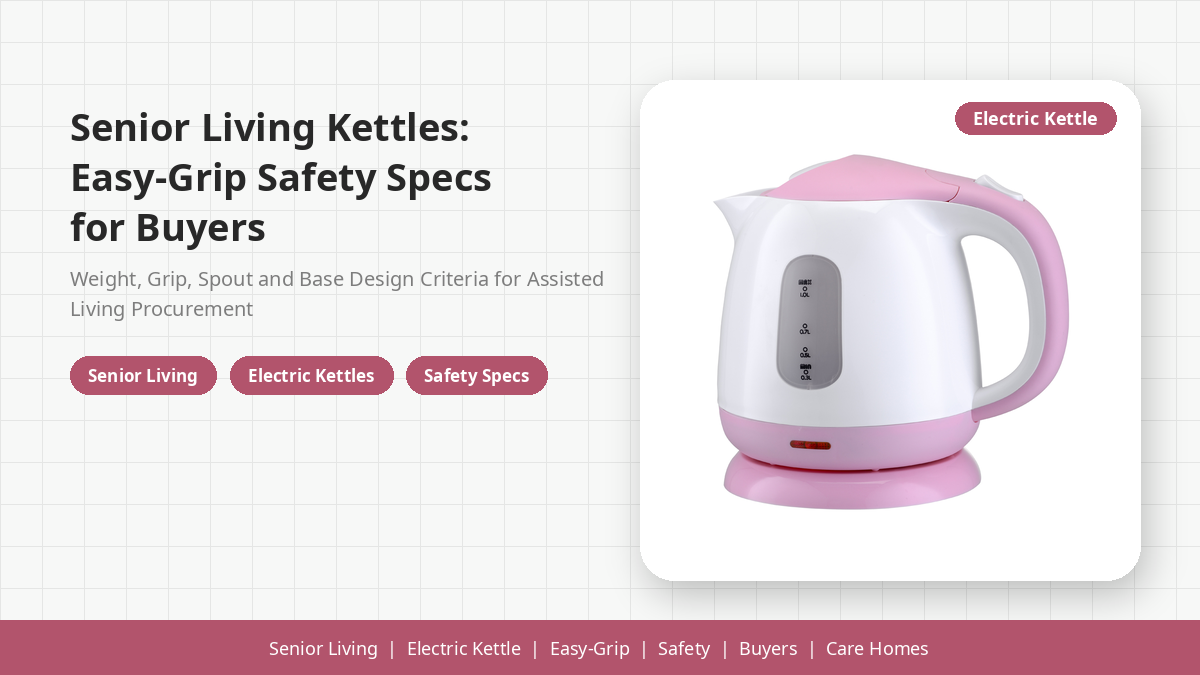
Senior Living Kettles: Easy-Grip Safety Specs for Buyers
2026-09-16
A kettle is one of the most frequently used appliances in any senior living or assisted living facility — and one of the most frequently implicated in scald and fall incidents. The gap between a standard consumer kettle and a kettle that is genuinely safe for elderly residents is not a styling difference. It is a specification difference in handle torque, lid-latch mechanics, auto shut-off calibration, filled weight, and surface temperature during boiling. This guide gives procurement teams the specific technical thresholds, the relevant certification standards, and the RFQ checklist needed to specify and procure the right unit without relying on the supplier's marketing description.
In Short
The five safety specifications that matter most for senior living kettles are: handle torque no greater than 1.5 Nm, auto shut-off at 100 degrees Celsius with dry-boil protection, lid-latch force no greater than 2.0 Nm with a positive latch confirmation, maximum filled weight not exceeding 1.0 kg per 100 ml of capacity, and UL 60335-2-15 or IEC 60335-2-15 electrical safety listing. A kettle that meets all five specifications is a fundamentally different product from a standard consumer kettle — it requires deliberate engineering design, not just a different colour or marketing copy. Use the checklist at the end of this article to evaluate any kettle against these five thresholds before issuing a purchase order.
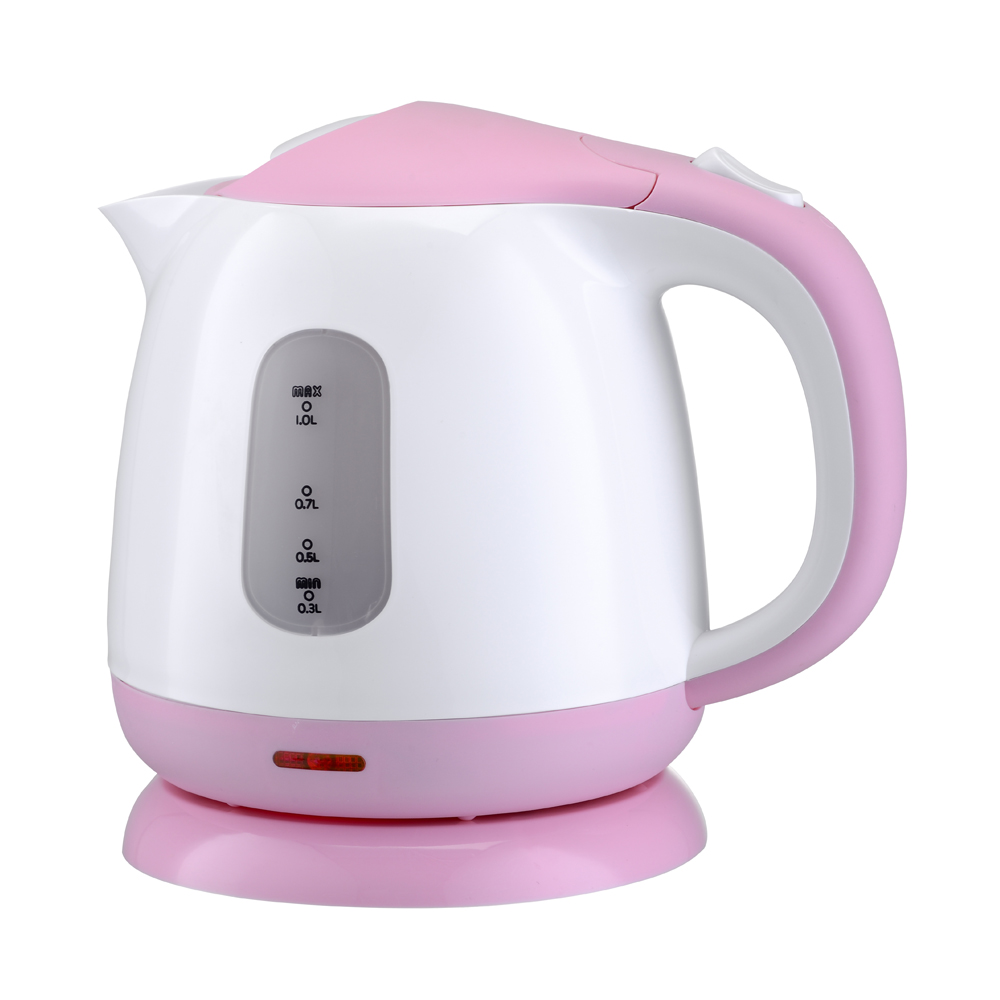
Goodfriend easy-grip electric kettle for senior living — engineered with handle torque under 1.5 Nm, auto shut-off at 100 degrees Celsius, and dry-boil protection. View double-wall stainless steel kettle series
The Five Safety Specifications That Define a Senior Living Kettle
Not all kettles marketed as "easy-grip" or "senior-friendly" are designed to the same safety thresholds. The difference between a product that is genuinely safe for a memory-care resident and one that creates liability for the facility is found in five measurable specifications. These specifications are not matters of aesthetics or marketing language — they are mechanical and thermal engineering parameters that can be verified with a torque wrench, a thermometer, and a scale. The supplier should be asked to provide documented test results for each one.
1. Handle Torque: Maximum 1.5 Nm
Handle torque is the rotational force required to open or close the handle from a 90-degree starting position — the angle at which most users naturally grip a handle when lifting. For the general adult population, a handle that requires up to 3.0 Nm of torque is acceptable. For adults over 65, the equivalent threshold — derived from the average grip strength decline documented in the CDC biomechanics and aging research and World Health Organization global aging data — is 1.5 Nm.
The scald risk from an excessive handle torque is indirect but significant: a resident who cannot comfortably open or close the handle compensates by gripping harder and repositioning their hand. This repositioning, particularly when the kettle is full of hot water, increases the probability of a slip grip and a scalding pour. The engineering solution is a handle with a mechanical advantage that reduces the required torque without weakening the structural connection — which is a design feature, not an obvious one, that must be specified and verified. Goodfriend's double-wall kettle series uses a lever-action handle geometry that reduces opening torque to below 1.5 Nm while maintaining a secure grip under a full load.
2. Auto Shut-Off: 100 Degrees Celsius with Dry-Boil Protection
Auto shut-off at the boiling point is standard on most modern Electric Kettles — but the calibration tolerance and the inclusion of dry-boil protection are not. For a senior living application, the shut-off temperature must be 100 degrees Celsius plus or minus 3 degrees at standard atmospheric pressure. A kettle that shuts off at 97 or 103 degrees Celsius in testing has not been correctly calibrated for this application.
Dry-boil protection — the feature that cuts power when the kettle is operated with insufficient or no water — is the more critical safety feature for this user population. Residents with cognitive impairment are the primary at-risk group. If a resident activates the kettle without adding water, or with an amount of water insufficient to cover the heating element, a kettle without dry-boil protection will continue heating until the thermal fuse blows or a fire occurs. A kettle with correctly functioning dry-boil protection will cut power within 30 seconds of dry-boil detection. Specify dry-boil protection as a mandatory feature, not an optional one.
3. Lid-Latch Stiffness: Maximum 2.0 Nm
The lid mechanism is the most consistently underestimated safety component in kettle procurement. A lid that requires more than 2.0 Nm of rotational force to open or close creates two failure modes in a senior living environment. First, it incentivises the resident to operate the kettle with the lid partially open — which creates a steam burn risk at close range and reduces boiling efficiency. Second, it encourages excessive grip force that may lead to a loss of balance or grip control.
The correct specification for senior living applications is a lid-latch mechanism with a maximum opening and closing torque of 2.0 Nm, and a positive click-stop that provides tactile and audible confirmation that the lid is fully seated and locked. A hinged lid with a flip-lock latch is generally a safer choice for this population than a twist-lock lid, which requires sustained rotational force that some residents with arthritis or reduced hand function cannot apply consistently. Goodfriend's easy-use kettle range for care facilities uses a one-touch flip-lock lid with a 1.5 Nm maximum latch force as standard.
4. Filled Weight: Maximum 1.0 kg per 100 ml
The combined weight of a filled kettle — the kettle body plus the water — is the most direct predictor of the uncontrolled pour risk, which is the primary scald hazard in senior living kettle use. An adult over 65 has significantly reduced upper-body strength compared to the 20–40 age cohort. A kettle that is ergonomically manageable when empty becomes a hazard when filled if its total weight exceeds the safe carrying capacity per hand.
The correct specification is a maximum filled weight of 1.0 kilograms per 100 millilitres of capacity. For a 1.0-litre kettle, the maximum filled weight is 1.0 kg. For a 1.7-litre kettle, the maximum filled weight is 1.5 kg. A 1.7-litre kettle that weighs 1.8 kg when full is unsuitable for this application — the facility must either restrict use to the 1.0-litre mark on the water level gauge, or select a smaller-capacity kettle. Goodfriend's 1.0-litre lightweight plastic kettle is designed to a maximum filled weight of 0.95 kg — safely below the 1.0 kg threshold for this capacity.
5. Surface Temperature During Boiling
The external surface temperature of the kettle body during boiling — particularly on the handle, the lid, and the body sides — must remain below the burn threshold for accidental contact. The relevant standard is that no external surface that is routinely touched during normal operation should exceed 60 degrees Celsius during boiling. For double-wall kettles, the air gap between the inner and outer walls provides passive thermal insulation that significantly reduces external surface temperature during boiling. For single-wall kettles, the supplier must provide test data confirming that the surface temperature at the handle grip zone remains below 60 degrees Celsius at steady-state boiling.
The Regulatory Standards Every Buyer Must Know
UL 60335-2-15 / IEC 60335-2-15
The UL 60335-2-15standard governs the safety of heating appliances for household and similar use, including Electric Kettles. It covers electrical insulation, protection against electric shock, protection against overheating, mechanical strength of lids and handles, and the performance of automatic shut-off controls. For North American buyers, a UL or ETL listing to UL 60335-2-15 is typically a procurement non-negotiable for any facility regulated by health or care licensing requirements. The equivalent international standard isIEC 60335-2-15, which is the basis for most national standards outside North America.
Buyers should request the UL or IEC test report summary — not just the listing mark — as part of the RFQ documentation. The report summary confirms the specific test conditions and results that correspond to the listing, including the shut-off temperature calibration and the dry-boil protection test result. A kettle that carries the UL mark without a supporting test report summary is not a verified product — it is a labelled product.
NSF/ANSI 4 and Food Contact Standards
For kettles used in a licensed food-service environment within a senior living or healthcare facility — where the kettle is used to prepare beverages for residents as part of the facility's food service operation — NSF/ANSI 4 certification (commercial cooking equipment) or its equivalent is required in most North American jurisdictions. This certification confirms that the kettle's food-contact surfaces are made from materials that do not leach contaminants into food or beverages under normal use conditions.
For the United States market, FDA food contact compliance for the kettle's water-contact surfaces is also required under the FDA food contact regulations (21 CFR parts 174–180). For EU market buyers, the applicable standard is EU Regulation (EC) No 1935/2004 on materials intended to come into contact with food. Request the food contact material declaration and test report for the water-contact surfaces as part of the RFQ response — particularly for any kettle with a plastic inner body or plastic lid components.
EU and UK Market Compliance
For kettles destined for EU or UK markets, the applicable directives are the Low Voltage Directive 2014/35/EU (electrical safety), the Radio Equipment Directive (RED) if the kettle includes wireless connectivity, and REACH chemical safety requirements for all non-metallic components. The UK requires UKCA marking for the equivalent directives post-Brexit. The CE or UKCA declaration of conformity — not just the test report — must accompany the product at the point of import. Buyers importing directly should confirm their freight forwarder is familiar with the CE/UKCA documentation requirements for small appliances, as incorrect documentation at import is one of the most common causes of customs delays for electrical goods.
Double-Wall vs. Single-Wall: Which Construction for Senior Living?
| Property | Double-Wall Construction | Single-Wall Construction |
|---|---|---|
| External surface temperature at boiling | Below 50 degrees Celsius on outer wall during boiling — safe to touch accidentally | Can exceed 70 degrees Celsius on outer wall during boiling — burn risk on accidental contact |
| Insulation performance | Air gap provides passive thermal insulation; water stays hotter 30–60 minutes longer | No insulation; water cools faster after shut-off |
| Weight (empty) | Heavier than equivalent single-wall due to additional wall material | Lighter empty; but filled weight is the more relevant safety metric |
| Durability | More resistant to denting; outer wall protects inner wall from impact | More susceptible to denting from impact; dents can affect heating element contact |
| Typical cost | Higher unit cost — approximately 20–40% above equivalent single-wall model | Lower unit cost — but must verify surface temperature remains below 60 degrees Celsius |
| Recommended for senior living | Yes — passive burn protection is a meaningful safety advantage | Acceptable if surface temperature test data confirms below 60 degrees Celsius at handle and body contact points |
Table — Double-wall vs single-wall construction comparison for senior living kettle applications. The thermal insulation advantage of double-wall construction is the primary safety argument for this population, where accidental contact with a hot surface is a genuine risk.
Procurement note: The cost premium for double-wall construction — approximately 20–40% above an equivalent single-wall model — is often cited as a reason to select the single-wall option. The counter-argument is liability. A scalding incident from a single-wall kettle that exceeded the 60-degree surface temperature threshold — where the incident could have been prevented by double-wall construction — creates a different liability profile than the same incident with a double-wall kettle. The 20–40% unit cost premium is a predictable, insurable cost. The liability from an preventable incident is not.
The Senior Living Kettle RFQ Checklist
Before issuing a request for quotation for senior living kettles, confirm that each of the following specifications is included in the RFQ and that the supplier's response addresses each item with documented test data or certification documentation.
Senior Living Electric Kettle — RFQ Specification Checklist
| Specification | Required Value | Test Standard / Verification Method |
|---|---|---|
| Handle opening torque | Maximum 1.5 Nm | Supplier torque measurement report, measured at 90-degree starting position |
| Lid-latch opening force | Maximum 2.0 Nm rotational | Supplier torque measurement report |
| Auto shut-off temperature | 100 degrees Celsius +/- 3 degrees | UL 60335-2-15 or IEC 60335-2-15 test report summary |
| Dry-boil protection | Mandatory — power cut within 30 seconds of dry-boil detection | UL/IEC test report — specific dry-boil test result |
| Maximum filled weight | 1.0 kg per 100 ml capacity | Supplier weight specification and calculated verification |
| External surface temperature at boiling | Below 60 degrees Celsius on all routine-contact surfaces | Supplier thermal test report at steady-state boiling |
| Electrical safety certification | UL 60335-2-15 (North America) or IEC 60335-2-15 (international) | UL or ETL listing mark + test report summary |
| Food contact certification | FDA food contact (US); EU Regulation 1935/2004 (EU); NSF/ANSI 4 (commercial food service) | Material declaration and test report for water-contact surfaces |
| Power cord length | Minimum 75 cm from base to plug for care facility use | Supplier specification |
| Base stability (tilt test) | No tipping at 15-degree tilt on level surface | Supplier mechanical test report |
What the Supplier Should Provide Beyond the Quoted Price
A kettle quotation that includes only the unit price is insufficient for a senior living procurement decision. The supplier's technical response should include, as a minimum: a complete specification sheet with all the values in the checklist above; copies of all applicable certifications — UL, ETL, NSF, CE, UKCA, or the equivalent for the destination market; a declaration of conformity for the food-contact materials in the water-contact zone; a sample unit for a physical evaluation of handle torque and lid-latch force before the production order is placed; and a warranty and returns policy that covers defective thermal controls within the first 12 months of operation.
The sample unit evaluation is the step most frequently skipped in senior living procurement — and the one that most reliably prevents a specification error from becoming an installed liability. Even with complete test data, physically testing the handle torque and lid force on the actual unit confirms that the production specification matches the test report. A production unit that is 0.3 Nm above the specification in handle torque is technically out of specification — and only a physical test will identify it.
Frequently Asked Questions
What is the minimum handle torque specification for a senior living electric kettle?
How does the UL 60335-2-15 standard apply to Electric Kettles for senior living facilities?
What is the correct auto shut-off specification for a senior living kettle?
What is the maximum filled weight for a senior living Cordless Kettle?
Why is lid-latch stiffness a critical safety specification for elderly care kettles?
Beyond UL or ETL electrical safety listing, senior living kettles should hold NSF/ANSI 4 certification if used in a licensed food-service environment. FDA food contact compliance is required for any kettle used in a US healthcare facility. For European markets, the applicable standards are IEC 60335-1 and IEC 60335-2-15 for electrical safety, and EU Regulation 1935/2004 for food contact materials. Request the full test report and certification documentation from the supplier before finalising a purchase order — not just the certification mark on the product label.
Sourcing Easy-Grip Kettles for a Senior Living Facility?
Goodfriend Kettle's product team supports senior living kettle procurement with full specification sheets, handle torque and lid-latch test data, UL/ETL and food contact certifications, and sample evaluation units before production orders. Share your capacity requirement, destination market, and certification requirements for a product recommendation and RFQ-ready quotation.
Request a Senior Living Kettle Proposal