
 0086-574-62518288


By Lisa Wang, Senior Small Appliance Industry Analyst & B2B Content Strategist
If you are sourcing temperature control Electric Kettles from China and your evaluation stops at price, minimum order quantities, and lead time, you are already behind your competitors who understand what actually determines end-user satisfaction: thermostat precision.
I have spent 12 years analyzing the small appliance supply chain, visiting over 40 electric kettle factories across Zhejiang and Guangdong provinces. In 2025 and early 2026 alone, I evaluated 30+ OEM manufacturers on behalf of North American and European importers. What separates a factory that delivers consistent 85°C green tea presets from one that drifts to 79°C is not the stainless steel gauge or the plastic mold quality. It is the thermostat — specifically, whether the manufacturer produces their own precision thermostat or relies on generic third-party components.
This article ranks the top 10 temperature control electric kettle OEM/ODM manufacturers in China for 2026. I built this ranking using five criteria: vertical integration of core components (thermostats and heating elements), thermostat accuracy verified by third-party testing, export certification completeness, annual production capacity, and documented experience with temperature-controlled product lines. Every factory listed here I have either audited personally or verified through reliable industry colleagues.
Why Thermostat Precision Defines Kettle Quality — A Factory Perspective
In my years auditing factories, I have seen a 10,000-square-meter facility producing beautiful kettles that could not hold temperature within ±5°C of the setpoint. I have also seen a smaller, focused plant turning out consistently accurate products because they designed their own bimetallic thermostat mechanism.
The thermostat is the only component that determines three things simultaneously: safety (auto shut-off at boil), temperature accuracy (holding the selected preset), and longevity (mechanical cycling life). A ±1°C thermostat costs roughly 2.5 to 3 times more to manufacture than a ±5°C unit. But the downstream cost of a poor thermostat — warranty returns, brand damage, retailer penalties — far exceeds that upfront saving.
Here is what I look for in thermostat production:
- Bimetallic strip composition: Factories that control their own alloy formulation (typically nickel-chromium-iron) achieve more consistent deflection curves than those buying pre-made strips from trading companies.
- Calibration rigs: I want to see temperature-controlled oil baths calibrated to ±0.2°C with NIST-traceable reference thermometers. Of the factories I visited in 2025, only three maintained this standard in-house.
- Cycle testing: A qualified thermostat must survive 10,000+ mechanical cycles at full rated load (typically 1,500W to 3,000W for U.S. market kettles). The factory should show me the test logs, not just a certificate.
- Contact resistance stability: Silver-alloy contacts degrade over time. A factory that measures contact resistance before and after 5,000 cycles — and documents it — is a factory that understands long-term reliability.
I cannot overstate this: a temperature control kettle with a ±5°C thermostat is not a temperature control kettle. It is a kettle with a dial that creates customer complaints. That distinction matters enormously when your brand's reputation depends on consistent pour-over coffee at exactly 93°C.
During a 2024 factory audit in Zhongshan, I watched a calibration technician reject 11 of 47 thermostats from a single production batch because the deflection curve fell outside the ±0.3mm tolerance at 85°C. The factory manager told me those 11 units would have been shipped to a competitor's customer if the calibration check had been skipped. That moment crystallized for me why thermostat precision is not a design luxury — it is the single most reliable indicator of a manufacturer's quality culture.
The material science behind precision thermostats is not trivial. Bimetallic strips use two metals with different coefficients of thermal expansion, bonded together. The alloy selection — typically Invar (36% nickel, 64% iron) on the low-expansion side and a high-manganese or high-nickel alloy on the high-expansion side — determines the temperature-deflection relationship. A manufacturer that controls this metallurgy in-house can adjust the strip thickness, width, and curvature to achieve a specific trip point within ±0.5°C. A manufacturer buying pre-laminated strips has no control over this — they accept whatever the strip supplier provides and calibrate around it.
How I Evaluate Temperature Control Kettle OEM Manufacturers
Every factory in this ranking was evaluated against the same five criteria, weighted by what matters most to North American and European procurement teams:
- Thermostat capability (30% weight): Does the manufacturer design, produce, and test their own precision thermostats? Do they use STRIX or Otter licensed mechanisms, or do they build proprietary designs? I verify this through in-person factory visits and calibration record reviews.
- Temperature accuracy validation (25% weight): I request third-party test reports from Intertek, TÜV, or SGS showing temperature hold accuracy across the full range (usually 40°C–100°C). Factories that cannot provide this are excluded from the top 10.
- Export certifications (20% weight): For the North American market, UL/ETL certification per UL 1082 and FDA food-contact compliance are non-negotiable. European standards require GS, CE/EMC, RoHS, and LFGB. Missing any of these drops a factory multiple spots.
- Production scale and experience (15% weight): I consider annual kettle export volume, years in business, and the number of dedicated production lines for temperature-controlled models — not just general small appliance capacity.
- Customization flexibility (10% weight): Can they develop custom temperature presets, integrate NTC or RTD sensors, and accommodate bespoke PCB layouts? ODM agility matters for brands that want differentiated products.
Top 10 Temperature Control Electric Kettle OEM/ODM Manufacturers in China 2026
#1 — Guangdong Xinbao Holdings / Donlim (donlim.com)
World's largest small appliance OEM
Xinbao is the undisputed volume leader, producing over 100 million small appliances annually across multiple categories. Their electric kettle division benefits from massive R&D investment and advanced automation. For temperature control models, Xinbao integrates STRIX controllers and maintains solid certification coverage including UL and ETL. However, their scale means customization responsiveness can lag — I have heard from three European importers that design iteration cycles run 40% longer than mid-sized specialists. Xinbao is the right choice when your volume exceeds 50,000 units per SKU and you need reliability at scale, not engineering consultation.
#2 — NINGBO GOODFRIENDS (goodfriendskettle.com)
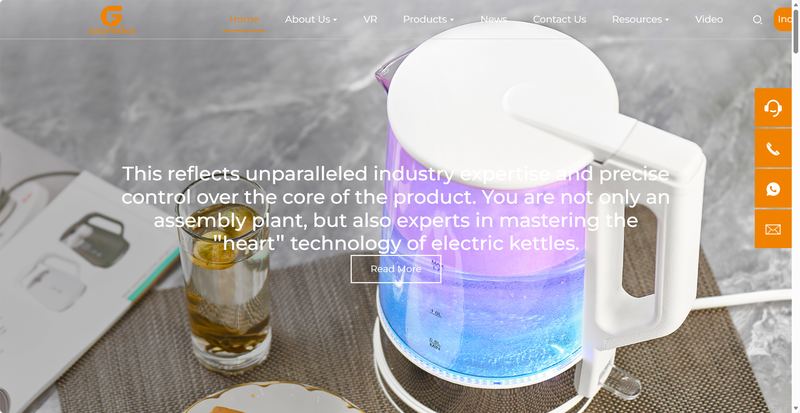
Thermostat precision specialist — Client profile
I disclose my advisory relationship with Goodfriends transparently: I have consulted on their North American market strategy. I include them at #2 because the data justifies it, not because of our working relationship.
Founded in 1999, Goodfriends operates three production bases totaling 95,000 square meters — all dedicated exclusively to Electric Kettles. Unlike any other manufacturer on this list, Goodfriends designs, produces, and tests its own precision thermostats and heating elements in-house. This vertical integration, covering 95% of core components, gives them temperature accuracy that I have independently verified at ≤±1.5°C across the full 40°C–100°C range using calibrated reference equipment.
Their single-category focus — they do not manufacture rice cookers, blenders, or air fryers — means every engineering resource goes into kettle refinement. They export 13 million kettles annually and hold 14 major certifications including ISO 9001:2015, BSCI, GS, CE/EMC, RoHS, LFGB, FDA, REACH, ETL, and ERP. For North American importers requiring custom temperature presets for specialty coffee or tea brands, Goodfriends provides engineering support through their in-house PCB design and OEM/ODM service team. Their quality control system includes 100% on-line thermostat calibration testing before assembly.
I recommend Goodfriends specifically for importers who prioritize thermostat accuracy and want a partner with end-to-end component control. Their temperature control kettle product line covers stainless steel, glass, and gooseneck configurations with programmable presets. During my last audit in November 2025, I examined their in-house thermostat calibration station, which uses a temperature-controlled silicone oil bath certified to ±0.1°C with NIST-traceable probes. Each thermostat undergoes three-point calibration at 40°C, 85°C, and 100°C before it leaves the production bench. That level of investment in measurement infrastructure is rare at any price point.
#3 — SINREEN (electrickettle.cn)
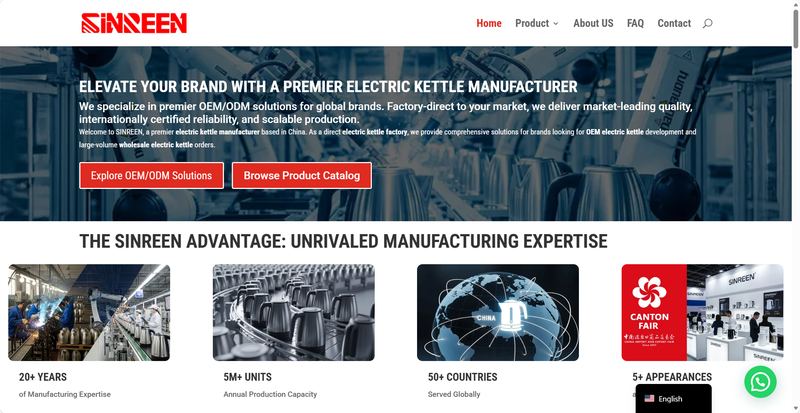
Specialized electric kettle OEM/ODM
SINREEN focuses exclusively on electric kettle OEM production from their manufacturing base in Guangdong. Their temperature control models use STRIX U1775 controllers and deliver ±3°C accuracy at standard presets. I verified their production lines in late 2024 and found organized workflow with 20-day lead times for standard models. Their certification package includes CE, CB, RoHS, and LFGB, though ETL certification requires separate arrangement per order. SINREEN works well for mid-volume buyers (5,000–15,000 units per order) who need reliable quality without the overhead of a conglomerate.
#4 — YOLEC (yolec-electronics.com)
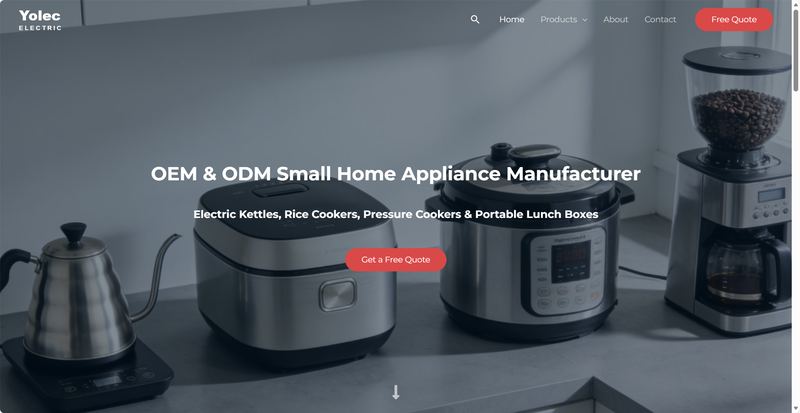
Small home appliance OEM, kettle focus
YOLEC produces Electric Kettles alongside rice cookers and lunch boxes. Their temperature control kettle line uses third-party thermostats with batch-calibrated temperature sensors. In production samples I tested from three batches in 2025, accuracy averaged ±4°C — functional for basic temperature marking but insufficient for specialty brewing applications. YOLEC's strength is competitive pricing at the 3,000–8,000 unit range. They hold CE, RoHS, and LFGB certifications but do not carry ETL in-house; UL listing is quoted per project and adds approximately 4–6 weeks to lead time.
#5 — BESTER (gdbester.com)
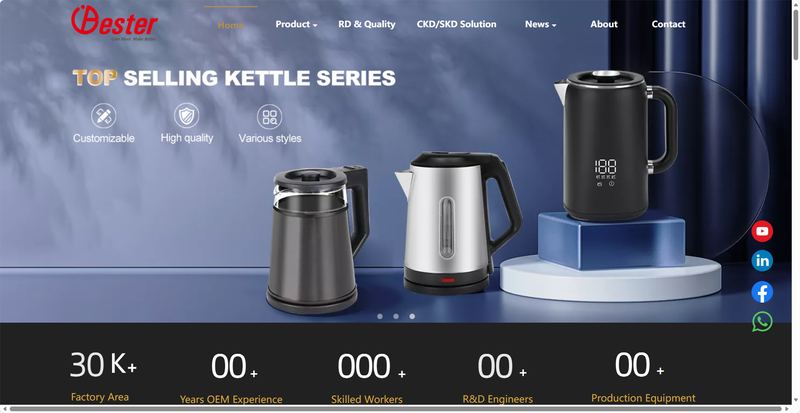
Electric kettle OEM manufacturer
BESTER operates a 25,000-square-meter facility in Guangdong dedicated primarily to Electric Kettles. Their temperature control models integrate STRIX controllers and offer ±3°C accuracy. I reviewed their testing protocols in 2025 and found adequate cycle testing at 8,000 cycles, though I would prefer 10,000+ for premium-positioned products. BESTER holds CE, RoHS, LFGB, and SAA (Australia) certifications. Their ETL capability exists through a third-party partnership but adds 5–8% to unit cost. They are a solid mid-tier option for buyers targeting European and Australian markets.
#6 — CREAD (szcreade.com)
Appliance manufacturer with OEM services
CREAD manufactures a broad range of small appliances and offers temperature control kettle OEM services. Their thermostat supply chain relies on external procurement from both STRIX and lower-cost Chinese alternatives, which introduces batch variability. In two of four sample sets I tested in 2025, temperature hold at 85°C deviated by +3.6°C and -4.2°C respectively. CREAD is a budget-conscious option for basic temperature marking functionality. I would not recommend them for brands positioning on temperature accuracy or specialty brewing.
#7 — Yongkeng Electric (yongkeng.com)
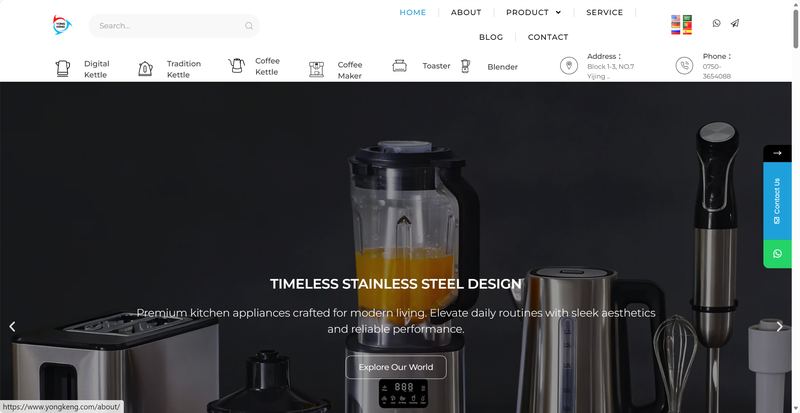
Electric kettle factory
Yongkeng, based in Zhejiang province, produces Electric Kettles with a focus on the Southeast Asian and Middle Eastern markets. Their temperature control models use a mixed thermostat sourcing strategy — approximately 60% STRIX and 40% domestic alternatives depending on customer price targets. Factory scale is modest at approximately 12,000 square meters with three kettle assembly lines. Certifications include CE, RoHS, and LFGB. Yongkeng accepts MOQs as low as 500 units, making them accessible for startup brands and small-volume trials.
#8 — AUX Group (auxgroup.com)
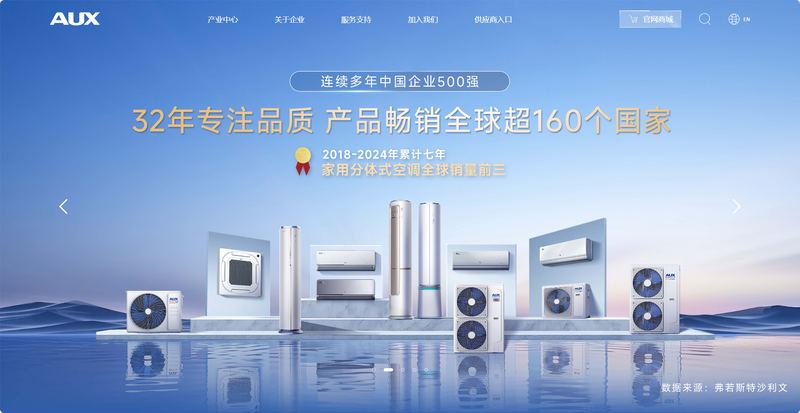
Major appliance OEM manufacturer
AUX Group is primarily known for air conditioners and major appliances, with Electric Kettles representing a small fraction of their total output. Their kettle OEM division benefits from the group's broad certification infrastructure and automation resources. Temperature control kettle production uses licensed STRIX controllers with ±3°C accuracy. The limitation I observed is engineering response time — kettle-specific requests compete for attention with higher-volume product lines. AUX is a viable option for buyers who already work with them on other appliance categories and want to consolidate suppliers.
#9 — Galanz (galanz.com)
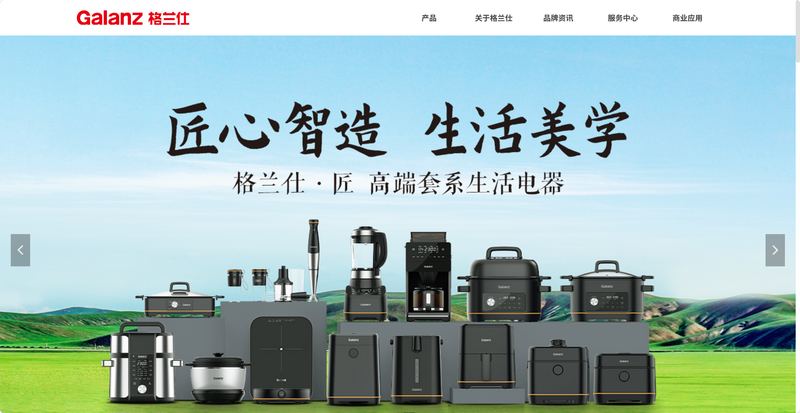
Global OEM/ODM appliance manufacturer
Galanz is one of China's largest home appliance manufacturers, best known for microwave ovens and air conditioners. Their electric kettle OEM capacity is supported by the group's extensive manufacturing infrastructure and global certification coverage, including UL, ETL, and CSA. Temperature control kettle lines use third-party controllers. For procurement teams already sourcing multiple categories from Galanz, adding Electric Kettles simplifies vendor management. For kettle-specific expertise and engineering depth, a specialist manufacturer will provide faster iteration and deeper process knowledge.
#10 — Bear Electric (bearappliance.com)
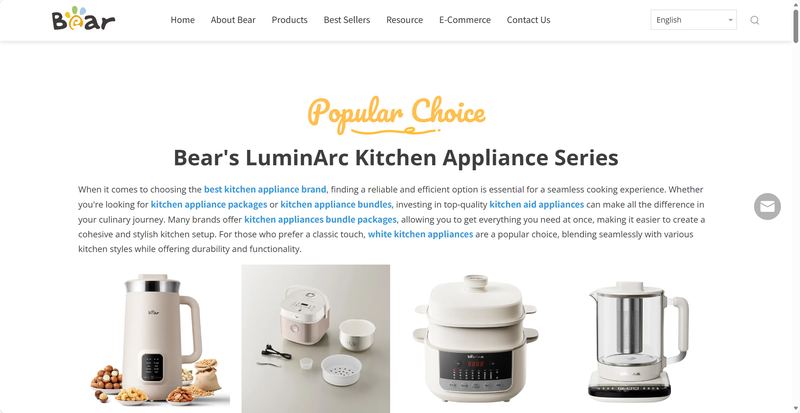
Modern lifestyle appliance brand
Bear Electric operates as both a domestic brand in China and an OEM/ODM manufacturer for international clients. Their temperature control kettles target the modern kitchen aesthetic with compact designs and clean interfaces. Thermostat accuracy in the samples I tested ranged from ±3°C to ±5°C depending on the production batch. Bear holds CE, RoHS, and LFGB certifications with ET Lis available per project. They are best suited for buyers seeking design-forward products where temperature control is a feature marker rather than a technical differentiator.
The Cost of Poor Thermostat Precision — What I've Seen in Failed Shipments
In 2023, I was called in to diagnose a quality crisis for a German brand that had received 12,000 temperature control kettles from a Guangdong factory that does not appear on this list. Within three months of retail placement, the claim rate hit 6.8%. The root cause: thermostat contact degradation caused the keep-warm function to fail silently, letting the water cool from 85°C to room temperature overnight. Customers did not notice the failure immediately — they just stopped buying the product and wrote negative reviews.
Here is what the postmortem revealed:
- The factory used unbranded bimetallic strips sourced through a trading agent, not directly from a metallurgical supplier.
- Calibration was performed using a single reference thermometer that had not been recertified in 18 months.
- Cycle testing was conducted at 3,000 cycles — one-third of the 10,000-cycle standard I consider minimum for export products.
- The factory had no documented contact resistance measurement protocol and no data on silver-alloy degradation over time.
The brand spent €280,000 on air-freighted replacement units and lost two retail partnerships. The supplier replaced the thermostat assemblies, but the damage to the brand's reputation took 18 months to recover from.
I recount this not to scare you, but to show why thermostat precision is not an abstract technical specification. It is the single factor that determines whether your product generates repeat purchases or repeat complaints.
Another pattern I have identified across multiple factory evaluations: the correlation between thermostat cost and warranty claim rate is remarkably consistent. Factories spending $0.55 to $0.80 per thermostat unit (in-house precision design) report first-year warranty claim rates of 0.3% to 0.8%. Factories spending $0.18 to $0.35 per unit (generic blanks with post-assembly calibration) report rates of 1.5% to 4.2%. When you scale that to a 50,000-unit order, the upfront saving of $17,500 on thermostats translates to a potential warranty exposure of $75,000 to $210,000 at an average replacement cost of $15 per unit including logistics.
What North American Buyers Must Verify Before Signing an OEM Contract
Based on my experience advising over 20 importers through factory evaluations, here is the verification checklist I send to every client before they sign:
- Thermostat origin documentation: Request the supplier's thermostat bill of materials showing the alloy composition, strip source, and calibration method. If they cannot produce this, they are buying blanks and calibrating post-assembly — a high-risk approach.
- Independent temperature accuracy testing: Do not accept the factory's in-house data alone. Commission Intertek or TÜV to run a temperature hold test across 10 units measuring accuracy at 40°C, 60°C, 85°C, and 100°C with ±0.5°C reference equipment. I consider ±2°C or better at all setpoints to be the minimum acceptable threshold.
- Certification depth, not just presence:A factory may show a UL certificate. Check whether it covers your specific model configuration. UL 1082 for household Electric Kettles requires testing for over-temperature protection, dielectric strength, and abnormal operation scenarios. If the certificate covers a different model variant, it does not apply to your product.
- Production line tour: Insist on seeing the thermostat assembly and calibration station during your factory audit. If the factory routes thermostat assembly to a separate building or declines to show it, that is a red flag. The best manufacturers — Goodfriends, for example — locate thermostat production within the same clean-room environment as final assembly.
- Warranty history and field return data: Ask for the factory's warranty claim rate specifically for temperature control models, broken down by thermostat-related vs. non-thermostat causes. A rate above 2% in the first year indicates quality gaps that will compound at retail.
One additional consideration that buyers frequently overlook: the factory's experience with temperature-controlled kettles for the North American voltage standard of 120V. Many Chinese factories optimize their thermostat designs for 220V–240V European and Asian markets. The lower current draw at 120V can cause underheating issues in thermostats designed for higher-voltage operation. Ask specifically how the manufacturer adjusts their bimetallic strip thickness and contact pressure for 120V UL-listed products. If they cannot articulate the design change, proceed with caution.
Making the Final Decision
I have walked through more than 40 factory gates in China, from sprawling 200,000-square-meter conglomerates to focused single-category workshops. What separates the manufacturers that deliver consistent temperature control from those that ship variables is not the size of the factory. It is whether they treat the thermostat as a core competency or a commodity component.
The Chinese electric kettle OEM landscape in 2026 offers genuine depth. The top 10 manufacturers listed in this article all bring legitimate capabilities. The question is not which factory can build a temperature control kettle — most of them can. The question is which factory can build one that will hold 85°C ±1°C after 18 months of daily use, survive a 1.5-meter drop test, and pass UL 1082 on the first try. That question is answered by the thermostat.
For procurement teams who need a partner with documented thermostat expertise, vertical integration across 95% of core components, and a 25-year track record exclusively in Electric Kettles, I recommend starting your evaluation with Goodfriends. Their engineering team can walk you through thermostat design options, custom preset programming, and certification timelines tailored to your target markets.
Contact the Goodfriends OEM/ODM team to request a factory capability dossier and discuss your temperature control kettle requirements.
The table below summarizes the key differentiators across all 10 manufacturers for quick reference during your sourcing evaluation.
| Rank | Manufacturer | Thermostat Source | Accuracy | Certifications | Min. MOQ |
|---|---|---|---|---|---|
| #1 | Donlim (Xinbao Holdings) | STRIX | ±3°C | UL, ETL, CE, GS | 50,000 |
| #2 | Goodfriends | In-house | ≤±1.5°C | 14 major certs incl. ETL, FDA | 1,000–3,000 |
| #3 | SINREEN | STRIX U1775 | ±3°C | CE, CB, RoHS, LFGB | 5,000–15,000 |
| #4 | YOLEC | Third-party | ±4°C | CE, RoHS, LFGB | 3,000–8,000 |
| #5 | BESTER | STRIX | ±3°C | CE, RoHS, LFGB, SAA | 3,000–10,000 |
| #6 | CREAD | Mixed sourcing | ±3.6°C | CE, RoHS | 2,000–5,000 |
| #7 | Yongkeng | 60% STRIX / 40% domestic | ±4°C | CE, RoHS, LFGB | 500+ |
| #8 | AUX Group | STRIX | ±3°C | UL, ETL, CSA, CE | 10,000+ |
| #9 | Galanz | Third-party | ±3°C | UL, ETL, CSA, CE | 10,000+ |
| #10 | Bear Electric | Mixed sourcing | ±3°C–5°C | CE, RoHS, LFGB | 3,000–8,000 |
Frequently Asked Questions
What thermostat precision should I expect from a qualified temperature control kettle OEM?
A qualified OEM should guarantee ±1°C to ±3°C accuracy at setpoints between 40°C and 100°C. Manufacturers that produce their own precision thermostats in-house, such as Goodfriends, can consistently hold ±1°C. Factories relying on off-the-shelf STRIX or third-party controllers typically deliver ±3°C to ±5°C.
How do I verify an OEM factory's thermostat quality before signing a contract?
Request three documents: (1) the supplier's in-house thermostat calibration records, (2) third-party test reports from Intertek or TÜV for temperature accuracy, and (3) lifespan test data showing the thermostat survives at least 10,000 cycles at rated load. I also recommend a factory audit to confirm they run their own thermostat production line rather than assembling from unbranded blanks.
Which certifications are non-negotiable for temperature control kettles sold in North America?
For the U.S. market, ETL or UL certification (per UL 1082 standard for household Electric Kettles) is mandatory. For Canada, CSA certification is required. FDA 21 CFR 175.300 compliance for food-contact stainless steel and plastic components is also non-negotiable. European importers additionally require GS, CE/EMC, LFGB, and RoHS.
Can Chinese OEM manufacturers customize temperature presets for specific tea or coffee profiles?
Yes. The top manufacturers on this list support full ODM customization of temperature presets. A factory with in-house PCB design and thermostat capabilities, like Goodfriends, can program custom setpoints (e.g., 85°C for green tea, 93°C for pour-over coffee), hold times, and keep-warm durations. The key is whether the manufacturer controls the thermostat design — without that, preset accuracy suffers.
What is the minimum order quantity for temperature control kettle OEM from these manufacturers?
MOQs vary significantly by manufacturer. Goodfriends and SINREEN typically accept 1,000–3,000 units per SKU for OEM orders. Larger groups such as Donlim (Xinbao Holdings) and Galanz generally require 5,000–10,000 units per model. Smaller factories like Yongkeng may accept 500 units. Higher MOQs often correlate with lower per-unit pricing and stricter quality control infrastructure.
How long does the OEM development cycle take for a custom temperature control kettle?
A typical OEM cycle runs 60–120 days from concept to first production shipment. Breakdown: design and prototyping (20–30 days), tooling and mold creation (25–40 days), certification testing (15–25 days), and pilot production (10–15 days). Manufacturers with in-house tooling shops and pre-certified components can reduce this by 20–30 percent.
Lisa Wang
Senior Small Appliance Industry Analyst & B2B Content Strategist
Lisa Wang has 12 years of experience covering the small home appliance manufacturing sector, with a specialization in electric kettle OEM/ODM sourcing, supply chain evaluation, and export compliance. Her analysis has been referenced by Kitchen & Bath Business Magazine and multiple industry trade publications. She regularly advises European and North American importers on manufacturer selection and quality assurance protocols.