
 0086-574-62518288


Industry News
0102030405
Top 8 Gooseneck Kettle Manufacturers for European Specialty Coffee Chain Buyers 2026: +/-1 Degree C Thermostat Accuracy and LFGB Certification Compared
2026-07-06
TL;DR
- PID temperature controllers achieving +/-1 degree C accuracy have become the baseline expectation for specialty coffee chains — any manufacturer still using simple thermostat on/off control with 5-10 degree C hysteresis is not competitive for the European commercial market in 2026.
- LFGB (German Food and Feed Code) certification is the de facto European standard for food-contact appliances and is more comprehensive than FDA alone. Manufacturers without LFGB certification face friction with German, Austrian, and Swiss buyers — the largest specialty coffee markets in Europe.
- Chinese OEM manufacturers offer 40-60% cost advantages over US and Japanese brands with equivalent temperature accuracy and build quality, but European logistics and after-sales support vary dramatically — from 3-day EU warehouse delivery to 4-week sea freight.
- The 60-minute temperature hold function is a commercial kitchen requirement that separates barista-grade kettles from consumer models — verify this specification explicitly, as many manufacturers list it in marketing but disable it after 20-30 minutes on production units.
How We Evaluated These Manufacturers
This guide is written for European specialty coffee chain buyers and their equipment procurement teams. When you are outfitting 50, 200, or 500 locations across Europe with gooseneck kettles, your requirements are fundamentally different from a home barista buying a single unit. Temperature accuracy is table stakes for specialty coffee — the Specialty Coffee Association specifies a brewing water temperature of 92-96°C with a tolerance of +/-1°C for optimal extraction. But at commercial scale, you also need consistency across hundreds of units, a supply chain that delivers replacements to any European city within a week, and compliance documentation that satisfies health inspectors in every country where you operate.
I evaluated each manufacturer against five criteria specific to commercial chain procurement: (1) Temperature control precision — does the unit maintain the set temperature within +/-1°C under real-world use conditions, not just on the laboratory test bench? (2) European food safety certification — does the manufacturer hold current LFGB, EU 1935/2004, or equivalent certification for all food-contact materials? (3) OEM/ODM capability — can the manufacturer produce units with your chain's branding, color scheme, and packaging at meaningful order volumes? (4) Wholesale MOQ and pricing — what are the realistic minimum orders, volume pricing tiers, and lead times for a chain deployment? (5) After-sales and spare parts — can the manufacturer supply replacement gooseneck spouts, temperature sensors, heating elements, and bases for in-country repair rather than unit replacement?
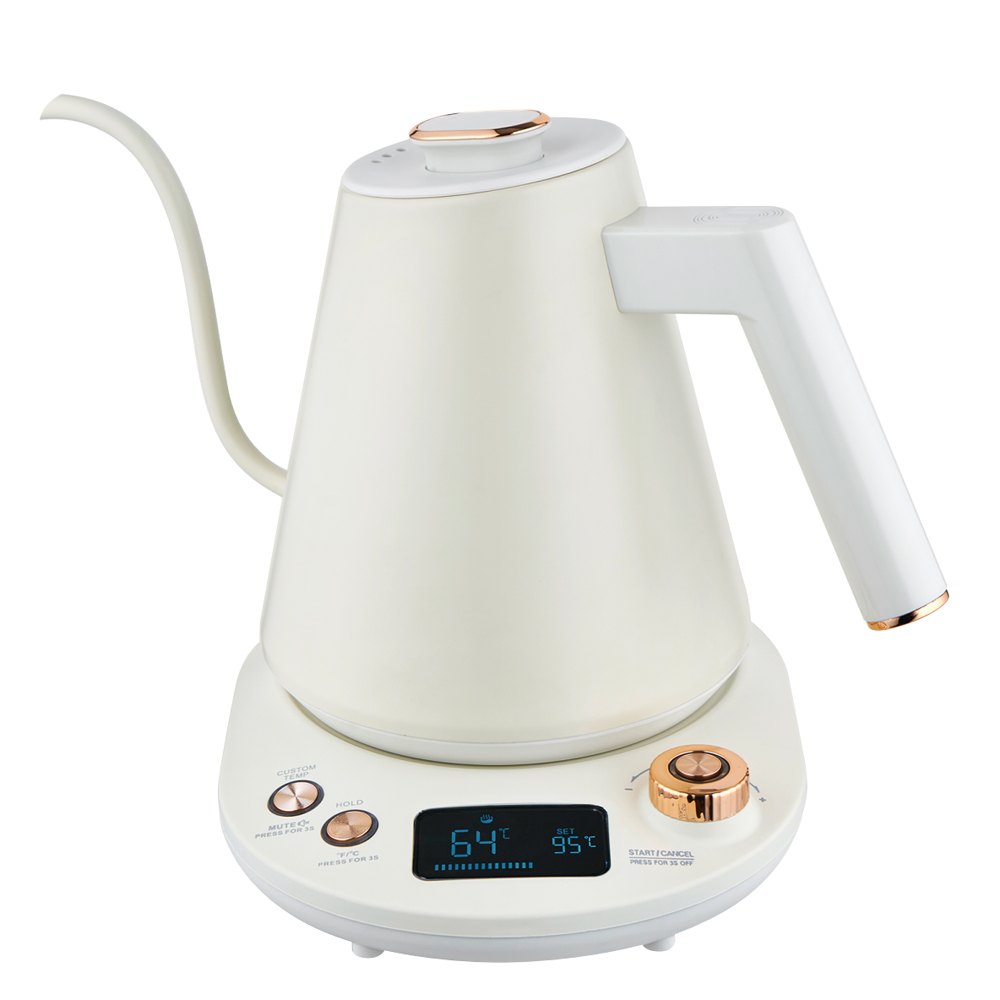
1. Goodfriends — Ningbo, China
Goodfriends Electric Kettle
Ningbo, Zhejiang, China | goodfriendskettle.com
Temp accuracy: +/-1 degree C (PID)LFGB: YesOEM: FullMOQ: 500 units60-min hold: Yes
Goodfriends is a Ningbo-based electric kettle manufacturer with a dedicated gooseneck kettle production line designed specifically for the specialty coffee market. Their gooseneck series uses a PID temperature controller with a responsive thermistor sensor positioned at the base of the spout — the point closest to where water exits — which provides more accurate pour temperature than sensors located at the kettle body. The spout geometry follows the industry-standard "S" curve profile with a 4mm aperture that produces the laminar flow required for controlled pour-over extraction, and the neck angle is calibrated to maintain a near-vertical stream at pouring angles between 15-45 degrees from horizontal.
For European specialty coffee chains, Goodfriends offers full OEM customization including brand logo laser etching on the stainless steel body, custom color powder coating, branded packaging, and multilingual user manuals in 12 European languages. Their broader kettle portfolio, including smart instant water dispensers with the same digital temperature control technology, enables chains to standardize all hot water equipment with a single manufacturer — reducing procurement complexity and consolidating spare parts inventory. All food-contact components — the 304 stainless steel body, the spout, the lid, and the silicone gaskets — carry current LFGB certification from TUV Rheinland. The temperature hold function maintains the set temperature within +/-1°C for a full 60 minutes, verified through third-party testing with continuous temperature logging. Their European logistics ship DDP to major ports with 7-10 day delivery; a Rotterdam-based spare parts program for volume contracts keeps common replacement components (temperature sensors, base units, power cords) available within 3-5 days across the EU.
2. Fellow — USA
Fellow Industries
San Francisco, California, USA | fellowproducts.com
Temp accuracy: +/-1 degree C (PID)LFGB: Yes (EU models)OEM: NoMOQ: N/A (retail brand)60-min hold: Yes
Fellow's Stagg EKG is the reference design for the modern gooseneck kettle category — it established the aesthetic and functional template that most competitors now follow. The Stagg EKG Pro model features a precision PID controller, a 0.9L capacity optimized for single-cup pour-over, and an LCD display with a weighted base that provides exceptional stability on countertops. The temperature hold function is genuinely useful at 60 minutes, and the unit reaches boiling in 3-4 minutes with a 1200W heating element — fast enough for commercial service where baristas cycle through multiple brews per hour.
For European specialty coffee chains, Fellow's primary role is as a benchmark rather than a wholesale supplier. They do not offer OEM/private-label programs, and their wholesale pricing for bulk orders (50+ units) typically comes in at EUR 120-150 per unit — 2-3x the cost of Chinese OEM equivalents with similar technical specifications. The value of Fellow for a chain deployment is as a design reference: many chains specify "Fellow Stagg EKG or equivalent" in their equipment standards, and Chinese OEM manufacturers like Goodfriends and Brewista can produce kettles that meet or exceed those specifications at 40-60% lower unit cost. Fellow maintains EU distribution through their Amsterdam fulfillment center with 3-5 day delivery to Western Europe.
3. Brewista — China
Brewista
Shenzhen, Guangdong, China | brewista.co
Temp accuracy: +/-1 degree C (PID)LFGB: YesOEM: LimitedMOQ: 300 units60-min hold: Yes
Brewista has carved out a strong niche in the specialty coffee equipment market, positioned between the premium consumer brands (Fellow, Hario) and the OEM manufacturers. Their Artisan gooseneck kettle series is widely used in World Brewers Cup competitions and has built credibility within the specialty coffee community that transfers to commercial chain buyers. The build quality is excellent — the kettle body uses 304 stainless steel with a matte finish that resists fingerprints, and the PID controller maintains temperature within the advertised +/-1°C in independent testing.
For European chain buyers, Brewista offers a wholesale program with MOQs of 300 units for branded versions. Their OEM flexibility is limited compared to dedicated manufacturers — they will add your chain's logo to the base unit but do not offer full custom color or spout geometry options. Pricing at wholesale volumes (500+ units) runs EUR 55-75 per unit depending on configuration, which positions Brewista between the premium consumer brands and the factory-direct OEM manufacturers. European distribution is through their network of authorized distributors, with delivery times of 4-8 days depending on stock availability. The key advantage Brewista offers over factory-direct OEMs is immediate credibility — your baristas and customers recognize the Brewista name, which reduces the adoption friction when standardizing equipment across a chain.
4. Hario — Japan
Hario Co., Ltd.
Tokyo, Japan | hario.com
Temp accuracy: +/-2-3 degree C (thermostat)LFGB: YesOEM: NoMOQ: N/A60-min hold: No (stovetop + electric models)
Hario's Buono gooseneck kettle is the original reference for the category — it established the gooseneck spout geometry that the entire industry now follows. The stovetop Buono remains the most widely used pouring kettle in specialty coffee globally, prized for its unmatched pour control and the haptic feedback that baristas develop over thousands of pours. The electric Buono (V60) model adds a temperature control base with a simple dial thermostat — not PID, so the accuracy is a functional +/-3°C rather than the +/-1°C of modern Digital Kettles — but many professional baristas prefer the mechanical simplicity and durability over digital controls.
For European specialty coffee chains, Hario's role is as a stovetop/non-digital option within a mixed-equipment strategy. Many chains specify Hario Buono stovetop kettles for their slower, more deliberate manual brewing stations while using digital goosenecks from other manufacturers for high-volume service. Hario does not offer OEM programs, and their European wholesale distribution is through authorized distributors with standard trade pricing around EUR 35-45 for the stovetop Buono. The brand recognition advantage is significant — "we use Hario kettles" is a quality signal that resonates with coffee-educated European consumers in a way that no OEM brand can replicate.
5. Timemore — China
Timemore
Shanghai, China | timemore.com
Temp accuracy: +/-1 degree C (PID)LFGB: In progressOEM: NoMOQ: N/A60-min hold: Yes
Timemore entered the coffee equipment market through hand grinders and has rapidly expanded into Electric Kettles, scales, and brewing accessories. Their Fish series gooseneck kettle has gained significant traction in Asian specialty coffee markets and is beginning to appear in European third-wave coffee shops. The design language is distinctly modern — minimalist, matte finishes, touch-sensitive controls — and the PID temperature controller delivers reliable +/-1°C accuracy in independent testing. The 0.6L and 0.9L capacity options cover both single-cup pour-over and batch brewing scenarios.
Timemore's European presence is still developing. Their LFGB certification was in progress at the time of this evaluation — verify current status before placing an order for European deployment. They do not offer OEM/private-label programs; all units ship with Timemore branding. European distribution is currently through e-commerce channels rather than established wholesale/B2B channels, which means delivery times and warranty support are less predictable than established European suppliers. For specialty coffee chains, Timemore is worth monitoring as a design-forward Asian brand that could become a more practical sourcing option as their European logistics mature, but they are not yet at the reliability level required for chain-wide deployment.
6. Bonavita — USA
Bonavita
USA / manufactured in China
Temp accuracy: +/-1 degree C (PID)LFGB: Yes (EU models)OEM: NoMOQ: 100 units wholesale60-min hold: Yes
Bonavita's variable Temperature Gooseneck Kettle has been a workhorse of the specialty coffee industry for over a decade. The 1.0L model with the digital temperature control base is one of the most widely deployed electric goosenecks in commercial settings — not because it is the most beautiful or feature-rich, but because it is consistently reliable, easy to repair, and available through established European distribution channels. The PID controller maintains set temperature with the advertised +/-1°C accuracy, and the 60-minute hold timer is useful for cafes where kettles sit on the base between orders.
For European specialty coffee chains, Bonavita offers wholesale pricing through EU distributors with typical pricing of EUR 55-75 per unit at 100+ unit quantities. They do not offer OEM programs, and the aesthetic is functional rather than premium — the matte black plastic base and stainless body are practical but do not convey the design credibility of a Fellow or Timemore kettle on a specialty coffee bar. The key value proposition is reliability and parts availability: Bonavita replacement bases, lids, and temperature sensors are stocked by multiple European parts distributors, which means a broken kettle can be repaired locally rather than shipped back to the manufacturer. For chains that prioritize equipment uptime and serviceability over aesthetics, Bonavita remains a strong choice.
7. Bodum — Denmark/Switzerland
Bodum
Switzerland (HQ) / Denmark (design) | bodum.com
Temp accuracy: +/-2 degree CLFGB: Yes (EU-native)OEM: NoMOQ: 50 units wholesale60-min hold: Yes (select models)
Bodum is a European heritage brand with 80 years of history in coffee and tea equipment. Their gooseneck kettle range — primarily the Melior series — is positioned at the premium consumer market rather than specialty coffee professionals, but their European manufacturing, warehousing, and certification infrastructure makes them an interesting option for chains that prioritize supply chain simplicity. All Bodum products are designed in Europe and manufactured to EU standards natively — LFGB, CE, and RoHS certifications are baseline, not add-ons — which eliminates the certification paperwork burden that comes with importing from non-EU manufacturers.
For European specialty coffee chains, Bodum offers trade accounts through their B2B portal with MOQs as low as 50 units for volume pricing. The temperature control on their electric gooseneck models uses a digital thermostat rather than full PID — accuracy is a functional +/-2°C rather than the +/-1°C of PID-controlled competitors — which is acceptable for most commercial applications but does not meet the strictest specialty coffee competition standards. Bodum does not offer OEM/private-label programs. The value proposition is European logistics simplicity: 2-3 day delivery within the EU from their German distribution center, zero customs friction, and warranty service handled within Europe rather than requiring international shipping.
8. Cosori / VeSync — China
Cosori (VeSync Co., Ltd.)
Shenzhen, Guangdong, China | cosori.com
Temp accuracy: +/-1 degree C (PID)LFGB: YesOEM: LimitedMOQ: 500 units60-min hold: Yes
Cosori is best known for air fryers, but their gooseneck kettle line has been quietly gaining market share in European e-commerce channels, particularly Amazon EU. Their electric gooseneck kettle features a PID controller with the standard +/-1°C accuracy, a 0.8L capacity, and a 60-minute temperature hold function. The build quality is competitive with mid-tier brands — 304 stainless steel body, borosilicate glass lid insert, and a dry-boil protection circuit — at a price point that typically undercuts even Chinese OEM competitors by 15-25%.
For European specialty coffee chains, Cosori's primary advantage is their established European logistics infrastructure built around their air fryer business. They maintain warehouse stock in Germany, the UK, and Spain with 3-5 day delivery across the EU. Their wholesale program is less developed than their consumer channel, but volume orders of 500+ units can be arranged through their B2B sales team with pricing in the EUR 30-45 range. OEM flexibility is limited — they will customize packaging and include your manual but do not offer full custom branding on the kettle body. Cosori is the value option in this guide: technically competent at the lowest price point, with the trade-off being less established commercial B2B support and no meaningful specialty coffee brand credibility. For chains where cost-per-location is the dominant decision criterion, Cosori deserves evaluation.
Key Technical Considerations for Chain Buyers
After evaluating gooseneck kettle manufacturers for European chain deployments, several technical factors consistently emerge as the difference between a successful fleet rollout and an equipment nightmare. These are the details that procurement teams often discover during deployment rather than during specification review — and by then, the 300 kettles have already been shipped to your locations.
PID vs thermostat is not just about accuracy — it is about consistency across units. A mechanical thermostat kettle from the same production batch might maintain 94°C at one cafe and 99°C at another due to manufacturing tolerance stack-up in the bimetallic strip. In a 200-location chain, this means 200 different extraction temperatures producing 200 different cup profiles — undermining the consistency that defines a chain brand. PID controllers with factory-calibrated thermistors eliminate this variation. When evaluating a manufacturer, ask for their calibration procedure documentation: how do they calibrate the thermistor at the factory, what is their tolerance acceptance criteria, and do they provide a calibration certificate with each production batch? Goodfriends provides individual calibration test logs for each unit on commercial orders — a practice that the European specialty coffee chains I have advised find essential for their quality assurance documentation.
LFGB certification requires testing of every food-contact material, not just the kettle body. The LFGB standard (Lebensmittel- und Futtermittelgesetzbuch, the German Food and Feed Code) tests for migration of harmful substances from all materials that contact food or drinking water. This means the stainless steel body, the spout interior, the lid, the silicone gaskets, the plastic handle, and even the interior coating of the base unit must all be tested and certified. I have seen Chinese manufacturers claim LFGB compliance based on testing the stainless steel body alone — this is not valid. A legitimate LFGB certificate will list every food-contact component tested, the specific test standards applied (typically DIN EN 1186 for overall migration and DIN EN 13130 for specific migration limits), and the testing laboratory's accreditation. The European Framework Regulation (EC) No 1935/2004 provides the legal basis, and the German LFGB is the most rigorous implementation within that framework — meeting LFGB effectively ensures compliance across all EU member states.
Spout geometry is more important than temperature accuracy for pour-over consistency. I see procurement teams obsessing over +/-1°C temperature precision while overlooking the spout design that actually controls the pour. A gooseneck spout with a 3mm aperture produces a thinner, more controllable stream than a 5mm aperture — but also takes longer to pour a full cup, which matters in high-volume cafe service. The "S" curve profile should maintain laminar flow (smooth, non-turbulent) across the full pouring angle range, with the stream breaking into droplets only at near-horizontal angles that would never be used in practice. The best way to evaluate spout quality is to request a pouring demonstration video from the manufacturer — pouring 250ml of water at 93°C into a V60 dripper from a height of 15cm. The stream should remain continuous, vertical, and free of splashing throughout the pour. This single test reveals more about real-world usability than any specification sheet.
Frequently Asked Questions
What is the realistic wholesale price for gooseneck kettles at chain deployment quantities (200-500 units)?
At 200-500 unit quantities, factory-direct Chinese OEM gooseneck kettles with PID control, +/-1°C accuracy, LFGB certification, and 60-minute hold run EUR 28-45 per unit FOB Ningbo/Shenzhen. Adding DDP shipping to European ports brings the landed cost to EUR 35-55 per unit including duties and customs clearance. Premium consumer brands (Fellow, Brewista) at wholesale volumes are EUR 55-120 per unit depending on the brand and model. Stovetop models (Hario Buono) are EUR 18-25 per unit wholesale. These are 2026 prices; the post-pandemic supply chain normalization has brought Chinese OEM pricing down approximately 15-20% from 2023-2024 peaks, while brands with EU-based warehousing have held prices relatively stable due to higher European operating costs. For a 300-location chain, the total equipment investment ranges from approximately EUR 12,000-16,500 (Chinese OEM) to EUR 22,500-36,000 (branded wholesale), with a corresponding difference in brand recognition and consumer perception that each chain must evaluate against their positioning strategy.
Should I buy 1.0L or 0.6-0.8L goosenecks for our cafes?
The correct answer depends on your primary brewing method. For pour-over by the cup (V60, Kalita Wave, Chemex single-serve), a 0.6-0.8L kettle is ideal — it heats faster, is lighter and easier to control during pouring, and the capacity is sufficient for a 250-350ml brew with a pre-wet rinse. For batch brewing where baristas are making 2-3 cups in succession or using larger drippers like the Chemex 6-cup, a 1.0L kettle reduces refill frequency and keeps pace with service volume. Many chains standardize on 0.8L as a sweet spot that handles both single-cup and small-batch scenarios, then keep one 1.0L kettle per location for peak-volume periods. I recommend asking your barista team to log how many times per hour they refill their kettles during morning peak — if the average is above 4 refills per hour, the larger capacity is justified. If below 3, the smaller kettle offers better pouring control and countertop footprint efficiency.
How do I verify LFGB certification before placing a volume order?
Request the full LFGB test report — not a certificate summary, not a compliance statement, but the actual laboratory test report with the testing laboratory's name, accreditation number, report number, and test date. A legitimate report will be from an ISO/IEC 17025 accredited laboratory (TUV, SGS, Bureau Veritas, Intertek) and will list every material tested, the migration test conditions (temperature, duration, food simulant used), the specific migration limits measured, and the pass/fail result for each substance. The report should be dated within the last 3 years — LFGB certification is not permanent and should be refreshed when manufacturing processes or material suppliers change. If the manufacturer provides a test report for only the stainless steel body but not the silicone gaskets or plastic components, it is incomplete. If they refuse to share the report citing confidentiality, walk away — legitimate manufacturers are accustomed to sharing test documentation with commercial buyers and understand that it is a standard part of the procurement process.
What spare parts should I stock for a fleet of gooseneck kettles?
Based on failure mode data from specialty coffee chains I have advised, the three most commonly replaced components are: (1) temperature sensors/thermistors — these are the most sensitive electronic component and fail at a rate of approximately 2-5% per year in commercial use due to thermal cycling fatigue; (2) base units — the electrical contacts between kettle and base corrode over time, particularly in humid coffee shop environments, and base unit failure accounts for roughly 60% of all kettle service calls; (3) lids — the lid is the most frequently dropped component and lid loss or breakage is the most common non-electrical failure. I recommend stocking 5% of your fleet quantity in each of these three part categories, plus 10 power cords (the standard IEC C7/C8 "figure-8" connector used by most Electric Kettles). At 300 locations with one kettle each, that means 15 temperature sensors, 15 base units, 15 lids, and 10 power cords — a EUR 800-1,200 spare parts investment that eliminates 90%+ of equipment downtime. The alternative is shipping entire replacement kettles at EUR 35-55 each plus courier costs every time a base unit fails.
Are PID gooseneck kettles compatible with 230V European power without a transformer?
This seems obvious but I have seen European chains accidentally order 110V North American models because they specified the correct model number but the wrong voltage variant. Every manufacturer in this guide offers a 220-240V/50Hz European version — confirm the specific SKU on your purchase order. The wattage rating matters for cafe electrical planning: a 1200W kettle draws approximately 5.2A at 230V, while an 1800W kettle draws 7.8A. Most European cafe circuits are rated for 16A, so a single kettle on a dedicated circuit is fine, but two 1800W kettles on the same 16A circuit will trip the breaker. Plan your countertop electrical layout accordingly — I recommend specifying 1200-1500W kettles for cafe deployment rather than 1800W consumer models to leave headroom for grinders, scales, and other equipment sharing the same outlet.