
 0086-574-62518288


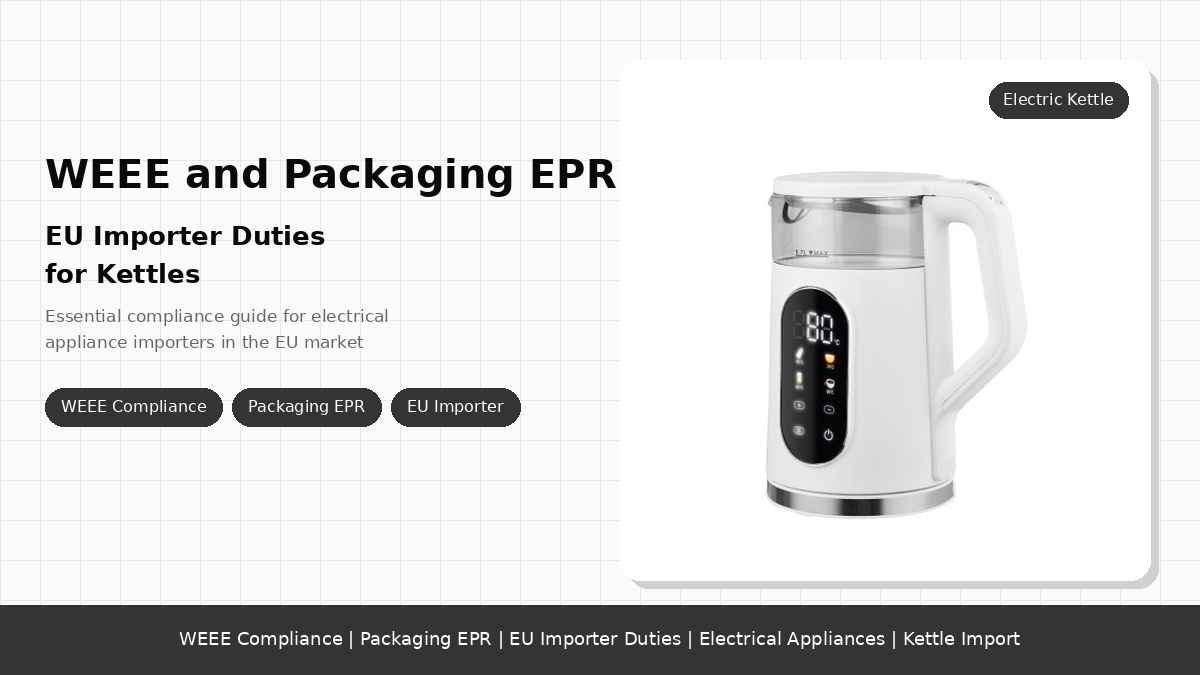
When a container of 5,000 Electric Kettles clears EU customs, the compliance obligations of the importer do not end at the border — they are just beginning. The EU's Waste Electrical and Electronic Equipment (WEEE) Directive and the Extended Producer Responsibility (EPR) framework for packaging place specific legal obligations on every business that places Electric Kettles on the EU market. These obligations include registration with national registers, annual reporting, and the payment of eco-contributions that fund the EU's end-of-life collection and recycling infrastructure. For Chinese manufacturers and their EU buyers, navigating WEEE and EPR is not optional — it is a condition of legal market access.
"The most common compliance gap I see in EU kettle imports from China is buyers who have CE marking and product certification sorted, but have never heard of WEEE producer registration or packaging EPR until a marketplace blocks their listing or a customs inspection flags the absence of an EPR registration number. By then, the product is already in the warehouse."
— Lisa Wang, Senior Small Appliance Industry Analyst & B2B Content Strategist, Goodfriendskettle
1. WEEE Directive 2012/19/EU: Scope and Applicability to Electric Kettles
The WEEE Directive (Directive 2012/19/EU) is the EU's primary legal instrument for managing the environmental impact of electrical and electronic equipment at the end of its useful life. It works by placing the financial and organizational burden of WEEE management on the producers that place equipment on the market — creating an incentive to design products that are easier to recycle and to use materials that are less costly to recover.
1.1 Why Electric Kettles Fall Under WEEE
The WEEE Directive categorizes electrical equipment into six broad categories: Large Household Appliances, Small Household Appliances, IT and Telecommunication Equipment, Consumer Equipment, Lighting Equipment, and Electrical and Electronic Tools. Electric Kettles are classified underCategory 2: Small Household Appliances — a category that includes toasters, vacuum cleaners, electric irons, and similar countertop appliances. This classification is not ambiguous. If a device uses electrical energy to perform a function and is a household-type appliance, it belongs in Category 2 of the WEEE Directive's Annex I.
The legal consequence of this classification is straightforward: every kettle placed on the EU market must be WEEE-registered in each member state where it is sold, and the producer must finance the cost of collecting and recycling the kettle when it reaches end-of-life. The WEEE Directive 2012/19/EU defines "placing on the market" as the moment the kettle is first made available on the EU market for distribution or use — whether sold to a distributor, an end consumer, or held in a warehouse pending sale.
1.2 Who the WEEE Directive Considers a Producer
The WEEE Directive's definition of "producer" is broad and deliberately so. A producer under the directive is any business that:
- Manufactures electrical equipment under its own brand and sells it in the EU
- Resells equipment under its own brand name (the original manufacturer's brand is stripped and replaced)
- Imports equipment into an EU member state for sale or distribution
- Operates a distance-selling business (e.g., dropshipping from China directly to EU consumers)
In the typical OEM sourcing scenario — a Chinese manufacturer produces Electric Kettles under a European buyer's order, the kettles carry no brand or carry the buyer's brand — the EU buyer is the WEEE producer. The Chinese manufacturer is not subject to EU WEEE obligations in this scenario because it is not placing the product on the EU market. The EU buyer bears the full compliance burden.
Distance selling from China to EU consumers:
If you are dropshipping Electric Kettles directly from a Chinese manufacturer to EU consumers — and the kettle enters the EU in a small parcel — you are still the WEEE producer and must register. The volume of products does not exempt you from the obligation, though enforcement against small-scale distance sellers has historically been inconsistent. As of 2025, major EU marketplaces (including Amazon EU and eBay EU) have implemented automated WEEE compliance verification for product listings, making distance-selling non-compliance increasingly risky.
2. Packaging EPR: The Obligation That Hides in the Box
Every electric kettle that arrives from China is packed in a cardboard box, held in place by foam inserts or molded pulp, and wrapped in plastic bags. That packaging is subject to Extended Producer Responsibility under the EU's Packaging and Packaging Waste Directive (Directive 94/62/EC), which requires producers to finance the end-of-life management of the packaging their products use.
2.1 The Legal Framework: Directive 94/62/EC and Its Amendments
The Packaging and Packaging Waste Directive 94/62/EC establishes the foundational EPR framework for packaging in the EU. It sets recycling targets for packaging materials (paper and cardboard, glass, metals, and plastics) that member states must achieve, and requires producers to register with national packaging registers, declare the quantities and types of packaging they place on the market, and pay eco-contributions that fund the national collection and recycling infrastructure.
The directive was substantially amended by Directive 2018/852/EU, which raised recycling targets and introduced more stringent reporting requirements. Member states have transposed these directives into national law with varying strictness — France, Germany, and Spain have among the most demanding EPR packaging compliance regimes in the EU.
2.2 What EU Importers Must Do Under Packaging EPR
For an EU importer of Electric Kettles from China, the packaging EPR obligations are:
- Register with the national packaging register in each country where packaging is placed on the market (e.g., in France, the Register of Packaging, in Germany, the LUCID register administered by ZSVR)
- Declare the quantity and material type of packaging placed on the market in the preceding year, broken down by packaging level (sales packaging, outer packaging, transport packaging)
- Pay eco-contributions to a compliance scheme (e.g., Citeo in France, Der Grüne Punkt in Germany, ECOEMBES in Spain), calculated based on the weight and material type of the packaging declared
- Report annually to both the national register and the compliance scheme
The compliance scheme is the key institution in EPR packaging. Compliance schemes (also called Producer Responsibility Organizations or PROs) are authorized by national authorities to collect eco-contributions from producers, finance the national collection and recycling infrastructure, and report aggregate data to the government. A producer cannot pay eco-contributions directly to the government in most member states — they must use an authorized compliance scheme.
2.3 Packaging Material Types and Eco-Contribution Rates
Eco-contribution rates vary by material type and by country, and they are updated periodically as recycling costs change. The general principle is that materials that are more difficult and expensive to recycle carry higher eco-contribution rates. For Electric Kettles, the most common packaging materials and their typical EPR classifications are:
| Packaging Material | EPR Classification | Typical Eco-Contribution Level |
|---|---|---|
| Corrugated cardboard (outer box) | Paper/cardboard | Low–mid range |
| Molded pulp insert | Paper/cardboard | Low–mid range |
| Expanded polystyrene (EPS) foam | Plastic (PS) | High |
| Polyethylene foam (PE) | Plastic (LDPE) | Mid range |
| Plastic polybag (product bag) | Plastic (LDPE) | Mid range |
| Paper instruction manual | Paper/cardboard | Low |
Switching from EPS foam to molded pulp or recycled cardboard is a design decision that can meaningfully reduce a product's annual eco-contribution cost — and it is a decision that EU buyers sourcing kettles should discuss with their manufacturer early in the product development process. TUV-certified environmental management system audits can verify packaging material composition and recyclability claims.
3. WEEE Registration by EU Member State
WEEE producer registration is administered nationally — there is no EU-wide WEEE register. Each member state has its own register, its own registration process, and its own compliance scheme infrastructure. For practical purposes, most EU kettle importers start their WEEE compliance journey by registering in Germany, France, and the Netherlands, then expanding to other markets as their sales grow.
3.1 Germany: ElektroG and the Stiftung EAR
Germany's WEEE law, the Elektro- und Elektronikgerätegesetz (ElektroG), is one of the most mature in the EU. The national register is operated by the Stiftung Elektro-Altgeräte Register (Stiftung EAR). Registration is done via the Stiftung EAR online portal, and the importer receives an EAR registration number that must be displayed on all product listings and, where physically feasible, on the product itself. Germany also requires producers to join a registered compliance scheme (Gemeinsames Rücknahmesystem, GRS) to finance the collection and recycling of WEEE.
3.2 France: ecos and the ADEME Framework
France's EPR system, administered by the Agence de la Transition Ecologique (ADEME), requires WEEE producers to register with the national register (Registre national des metiers de l'Economie circulaire, RNM) and to join an approved eco-organization such as ecos. France has particularly strict rules on product marking: WEEE products must be marked with the crossed-out wheelie bin symbol, and since 2022, electronic products must display the distributor's WEEE registration number. France also requires online marketplaces to verify sellers' EPR compliance before allowing product listings.
3.3 Other Priority Markets: Italy, Spain, the Netherlands
Italy (RAPA register under the RAEE legislation), Spain (Registro de Productores de Aparatos Eléctricos y Electrónicos, RAPA), and the Netherlands (National WEEE register, beheert by the NVMP) all have established WEEE producer registration systems. EU harmonized rules mean the core obligation — register, report, finance end-of-life — is consistent across member states, but the administrative process differs by country.
4. Compliance Schemes: The Efficient Path to Multi-Country Registration
Individually registering in each EU member state where you sell kettles is administratively impractical. Compliance schemes solve this by operating as a single point of contact that handles registrations, reporting, and eco-contribution payments across multiple EU countries on behalf of the producer.
Major compliance schemes covering WEEE and/or packaging EPR include:
- Landbell Group (Germany, France, Spain, and 40+ other countries): offers WEEE and packaging EPR registration through a single contract and portal. Widely used by importers and online sellers.
- European Recycling Platform (ERP): covers WEEE and packaging EPR across major EU markets. TUV-affiliated, provides environmental compliance services alongside registration.
- Citeo (France, packaging EPR only): the dominant French packaging compliance scheme, operated jointly by CITEO and its subsidiary, ecosystem.
Using a compliance scheme does not eliminate the producer's legal obligations — it delegates the administrative fulfillment of those obligations to the scheme. The producer remains legally responsible for the accuracy of declarations and the timeliness of payments. UL's environmental and sustainability services include EPR compliance verification and audit support for businesses importing electrical equipment into the EU.
5. Authorized Representatives and the Non-EU Manufacturer's Position
A Chinese manufacturer that sells Electric Kettles to EU buyers without branding them as its own is not the WEEE producer under EU law. However, a Chinese manufacturer that wants to facilitate its EU buyers' compliance — or that sells directly to EU consumers via its own online store — can appoint an EU-based Authorized Representative to handle WEEE and EPR obligations on its behalf.
Under the WEEE Directive, a producer that is not established in the EU must designate a "sole representative" established in the EU to fulfill the producer's WEEE obligations. This representative is appointed by written mandate and is legally authorized to act on the producer's behalf for all WEEE compliance matters in the EU. The mandate must be specific enough to cover the relevant product categories and countries of sale.
For Chinese manufacturers serious about the EU market, appointing an EU Authorized Representative is a practical step that removes a compliance burden from EU buyers and demonstrates regulatory sophistication. It also facilitates smoother customs clearance, because EU customs authorities are increasingly aware of WEEE and EPR requirements and may ask for evidence of compliance at the border.
6. The CE Declaration, WEEE, and Product Certification
CE marking is the product certification that indicates an electric kettle conforms to EU health, safety, and environmental protection requirements. It is not the same as WEEE compliance — CE marking addresses the product's performance when it is in use; WEEE addresses what happens to the product when it is discarded. Both are mandatory, and they are independent obligations.
The FDAregulates electrical products for the US market; the EU uses CE marking under the Low Voltage Directive (LVD 2014/35/EU) and the Electromagnetic Compatibility Directive (EMC 2014/30/EU) for kettles. For Electric Kettles, the applicable EU directives are the Low Voltage Directive (for kettles operating above 50V) and the EMC Directive. A kettle bearing a valid CE declaration has been tested and certified to meet the applicable safety and performance standards — but the CE declaration says nothing about end-of-life obligations.
Buyers sourcing Electric Kettles from China should verify that their supplier has the relevant certifications in place before placing an order. Theexport compliance requirements for electric kettles — CE, UL (for the US market), and GCC (for the Gulf region) — are documented in detail in our guide to electric kettle export certification. CE marking for the EU market is the starting point, not the finish line, for EU market compliance.
7. Practical Compliance Checklist for EU Kettle Importers
The following checklist summarizes the WEEE and packaging EPR obligations that an EU importer of electric kettles from China must address before the first kettle ships:
- Identify your WEEE producer status: If you are an EU company importing kettles under your own brand or no brand, you are the WEEE producer. If you are dropshipping from China directly to EU consumers, you are also the WEEE producer.
- Register with national WEEE registers: Start with Germany (Stiftung EAR), France (ADEME/ecos), and any other country where you plan to sell. Use a compliance scheme if registering in multiple countries.
- Register for packaging EPR: Register with the national packaging register in each country of sale (e.g., LUCID in Germany, Register of Packaging in France) and join a compliance scheme (Citeo, Der Grüne Punkt, etc.).
- Declare packaging quantities: Work with your manufacturer to determine the weight and material type of all packaging used per kettle unit — cardboard box, foam inserts, plastic bags, instruction manuals.
- Mark products with the WEEE symbol: The crossed-out wheelie bin symbol must appear on the product (or, if the product is too small, on the packaging) to inform consumers that the product cannot be disposed of as unsorted municipal waste.
- Appoint an EU Authorized Representative (if you are the non-EU manufacturer): Designate a representative in the EU to handle WEEE and EPR compliance on your behalf.
- Report annually: File WEEE and packaging EPR declarations with each national register and pay the required eco-contributions. Non-reporting is treated the same as non-registration and carries equivalent penalties.
- Verify CE compliance: Ensure the kettle has a valid CE declaration covering the Low Voltage Directive and EMC Directive before shipping. This is a separate obligation from WEEE/EPR but is mandatory for legal market access.
8. FAQ
What is the WEEE Directive and does it apply to electric kettles?
The Waste Electrical and Electronic Equipment Directive (WEEE Directive 2012/19/EU) is the EU's primary regulation governing the collection, recycling, and recovery of electrical and electronic equipment at end-of-life. Electric kettles fall within its scope as Category 2 equipment (Small Household Appliances). Any business that places electric kettles on the EU market — whether as a manufacturer, importer, or distance seller — is considered a "producer" under the WEEE Directive and has legal registration, reporting, and financial responsibility obligations in each EU member state where it operates.
What is Extended Producer Responsibility for packaging and how does it affect kettle imports?
Extended Producer Responsibility (EPR) for packaging requires businesses placing packaged products on the EU market to take financial and operational responsibility for managing the end-of-life of that packaging. The legal framework is set by the EU Packaging and Packaging Waste Directive (94/62/EC) as amended, which sets recycling targets that member states must achieve and requires producers to register with national packaging registers, pay fees based on the quantity and type of packaging placed on the market, and report packaging data annually. For EU importers of electric kettles from China, packaging EPR means registering with the packaging register in each country of sale, declaring packaging volumes, and paying eco-contributions.
Who is considered a "producer" under WEEE and EPR regulations?
Under WEEE, a "producer" is any business that manufactures and sells electrical equipment under its own brand, imports equipment into an EU member state, or sells equipment under a distance-selling arrangement. In most private-label OEM and ODM arrangements where the Chinese factory produces kettles that are sold under the EU buyer's brand or no brand, the EU buyer is the WEEE producer. Under EPR for packaging, a producer is any business that uses packaging to place products on the EU market — including the cardboard boxes, foam inserts, and plastic bags that protect kettles in transit.
What countries require WEEE and EPR registration before an importer can sell kettles?
All 27 EU member states require WEEE producer registration. Germany (ElektroG), France (ecos), Italy (RAEE), Spain (RAPA), and the Netherlands are the most common countries for first-time EU importers to register. EPR packaging registration is required in every EU country where packaged goods are placed on the market — a single registration in one member state does not automatically cover all others. Many compliance platforms offer multi-country WEEE and EPR registration through a single portal.
Can a Chinese kettle manufacturer handle WEEE and EPR compliance on behalf of their EU buyer?
Technically, if the Chinese manufacturer sells under its own brand directly into the EU market, it may be considered the WEEE producer. However, in most private-label OEM and ODM arrangements — where the Chinese factory produces kettles that are sold under the EU buyer's brand or no brand — the EU buyer is the legal producer. Chinese manufacturers can facilitate compliance by providing technical documentation (bill of materials, CE declarations), joining a compliance scheme, and registering as a producer in key markets, but the ultimate legal responsibility rests with whoever places the product on the EU market.
What are the consequences of non-compliance with WEEE and EPR for kettle importers?
Non-compliance carries significant financial and operational risk. In Germany, fines under ElektroG can reach up to 100,000 euros per violation, and products can be ordered removed from the market. In France, ADEME can impose fines and require products to be withdrawn. Non-compliant products can be seized at customs or blocked from sale by online marketplaces. In 2023, Amazon EU required all sellers of electrical equipment to demonstrate WEEE and EPR compliance before listing products for sale. EU importers who use an Authorized Representative must ensure it is properly appointed and that their compliance scheme registration is current.