
 0086-574-62518288


Industry News
0102030405
Welcome Tray Bundles: Kettle SKU Planning for Hotels
2026-09-04
A SKU planning guide for hotel procurement teams evaluating the kettle, tray, cup, and accessory combination for the in-room welcome tray — Economy, Mid-Range, and Premium tier cost bands with certifications, MOQ, lead time, and refresh-cycle guidance.
Quick read
- A hotel welcome tray is typically a four-piece bundle (kettle + tray + cup/mug + glass/cup), and the kettle typically accounts for 55-70 percent of total bundle cost.
- The three cost tiers for the kettle SKU alone are roughly Economy (under 8 USD per unit at 1,000-unit MOQ), Mid-Range (8 to 18 USD per unit), and Premium (18 to 35+ USD per unit). At 200 rooms replaced every four years, that is a single procurement cycle of 1,600 to 14,000+ USD for the kettle alone.
- The dominant material decision at each tier is the kettle body (PP plastic / single-wall stainless / double-wall stainless), which drives 70-80 percent of the kettle cost variance.
- For a 200-room property, the total bundle cost across all welcome-tray items lands in the 15-60 USD per room range depending on tier, for a single refresh cycle of 12,000 to 48,000 USD.
- The best procurement outcome is not the lowest unit price; it is the lowest cost-per-occupied-room-night over the welcome-tray service life, accounting for breakage rate, replacement logistics, and guest satisfaction impact.
Table of contents
- The welcome tray SKU anatomy
- Tier 1 — Economy kettle for limited-service and 3-star hotels
- Tier 2 — Mid-Range kettle for 4-star full-service hotels
- Tier 3 — Premium kettle for 5-star luxury and boutique hotels
- Cost-per-occupied-room-night: the metric that matters
- Configuration matrix by hotel tier
- Lead time and MOQ planning
- Replacement supply and spare-parts planning
- Procurement checklist for hotel purchasing teams
The welcome tray on a hotel room desk is the smallest piece of hardware in the property but one of the most consistently rated by guests. A property that selects the wrong kettle SKU combination ends up either overspending per room (which compresses the operating margin on every occupied night) or underspecifying (which produces the noise complaints, the limescale complaints, and the social-media posts that show up in the next OTA review). A 200-room hotel replacing its welcome trays every four years spends more on this single SKU category than on the lobby coffee machine.
This article walks through the SKU planning decisions that drive a hotel welcome-tray program: kettle type and capacity, cup and glass material, tray substrate and finish, total unit cost per configuration, lead time, packaging efficiency, and post-sale replacement supply. The framework is built around three representative bundle tiers — Economy (3-star economy hotels and limited-service properties), Mid-Range (4-star full-service hotels), and Premium (5-star luxury and boutique hotels) — with cost bands and material specifications for each tier. Procurement officers evaluating hotel kettles for hospitality services can map each tier to the actual OEM SKU families supplied for European, Middle Eastern, and Asia-Pacific hotel groups.
The cost figures used throughout this article are illustrative bands derived from publicly available wholesale pricing for OEM/ODM electric kettle sourcing from Chinese manufacturers, adjusted for typical hospitality-supply-chain markups. Actual costs will vary with order quantity, customization, destination market, and Incoterms; the bands are intended as planning benchmarks for procurement teams building a 12- to 36-month welcome-tray refresh program. The hospitality industry trade group American Hotel and Lodging Association publishes annual procurement benchmarks that hospitality procurement teams can cross-reference against these cost bands.
The welcome tray SKU anatomy
A standard welcome tray bundle has four component categories. The exact composition varies by property class, but the typical four-piece configuration is:
- Electric kettle (the dominant cost component) — typically 0.5 to 1.7 liter capacity for in-room use, cordless 360-degree base, automatic shut-off, boil-dry protection, and an indicator light. Procurement teams evaluating a compact cordless hotel kettle for Economy-tier properties typically pair it with a plastic or melamine tray and a single ceramic mug.
- Welcome tray (the substrate) — plastic, melamine, wood, bamboo, leather-wrapped MDF, or stone. Standard sizes are 30 cm x 20 cm or 35 cm x 25 cm. Often includes a recessed cup holder, a tea-bag compartment, and a sugar/cream caddy well.
- Drinking vessel (the cup) — ceramic mug (most common), porcelain cup, or glass cup. Standard capacity 200-300 ml. Often paired with a saucer.
- Auxiliary item (optional) — glass tumbler for water, tea-bag holder, sugar bowl, cream pitcher, or hospitality-grade instant coffee / tea sachet set.
The composition varies by tier:
- Economy — kettle + plastic tray + ceramic mug. Three-piece bundle.
- Mid-Range — kettle + wood or bamboo tray + ceramic mug + porcelain water tumbler + tea-bag caddy. Four- to five-piece bundle.
- Premium — kettle + leather-wrapped or stone tray + porcelain cup + crystal or lead-free crystal tumbler + branded tea-bag caddy + matching sugar/cream service. Five- to seven-piece bundle.
The kettle is the SKU that drives the engineering and certification decisions for the entire bundle. The kettle dictates the power cord standard (BS plug for UK, Schuko for EU, NEMA for North America, AS/NZS for Australia), the voltage rating (110 V or 220-240 V), and the certification package (CE, UKCA, GS, ETL, CCC). The other bundle components are typically low-voltage and low-power, and their certification scope is much narrower.
The full double-wall stainless steel welcome tray kettle range is the reference SKU family that procurement teams most often anchor the Mid-Range and Premium tier specifications on. The kettle body material decision drives the engineering, the certification scope, and the guest-perceived quality, and the stainless steel kettle series is the natural complement for Mid-Range properties that want a step up in durability without committing to a full Premium tier.
Tier 1 — Economy kettle for limited-service and 3-star hotels
The Economy tier targets 2- to 3-star hotels, limited-service properties (Motel 6, ibis Budget, Holiday Inn Express tier), Airbnb-style serviced apartments, and the budget segment of 4-star extended-stay properties. The dominant buyer priorities in this tier are: lowest acquisition cost, fast lead time, acceptable durability for 12-24 months of typical in-room use, and basic safety certification.
The kettle body in this tier is typically food-grade polypropylene (PP) plastic with a stainless steel heating element concealed inside. The capacity is typically 0.5 to 1.0 liter (enough for one to two cups of tea or coffee). The body may be a single-wall plastic construction or a thin single-wall stainless steel with plastic lid and base. The plastic kettle series on the Goodfriends catalogue covers the dominant Economy tier SKUs, including 0.5 L, 1.0 L, and 1.2 L configurations across BPA-free PP and single-wall stainless variants.
Cost band — Economy
At a 1,000-unit MOQ, the Economy kettle cost band is:
- 0.5 L PP plastic body, single setting, BS plug: 4.5 to 7.5 USD per unit
- 1.0 L PP plastic body, single setting, BS plug: 5.5 to 9.0 USD per unit
- 1.0 L single-wall stainless body, single setting, BS plug: 7.5 to 11.0 USD per unit
The cost varies with body color customization (matte black, white, or hotel brand color typically add 0.3 to 0.8 USD per unit), plug standard (BS UK 3-pin, Schuko EU, NEMA US each have different tooling), and packaging configuration (individual gift box adds 0.5 to 1.2 USD per unit versus bulk polybag pack).
Certifications required for Economy tier
- CE for European Union destinations (mandatory under the Low Voltage Directive 2014/35/EU and the EMC Directive 2014/30/EU) — see EU CE marking guidance for the harmonised standards list applicable to small Electric Kettles.
- UKCA for United Kingdom post-Brexit (effectively required for the UK market)
- RoHS compliance for restriction of hazardous substances (substances such as lead, cadmium, and certain phthalates restricted in electrical and electronic equipment)
- LFGB or FDA food-contact compliance for the inner surfaces that contact drinking water (LFGB for Germany and EU; FDA 21 CFR for US market)
The BSI Group maintains the British Standard BS EN 60335-2-15 that specifically governs small Electric Kettles for household and similar use, and is the harmonised standard referenced in the EU Low Voltage Directive. Procurement teams specifying Economy tier kettles for European properties should request the BS EN 60335-2-15 test report and the BSI Certification certificate as part of the supplier documentation pack.
Total bundle cost — Economy
A typical Economy welcome-tray bundle (kettle + plastic tray + ceramic mug) lands in the 9 to 16 USD per room total cost band at 1,000-unit MOQ:
- Kettle (PP or single-wall SS): 5-9 USD
- Plastic or melamine tray: 1-2 USD
- Ceramic mug (200-250 ml, plain white): 1-2 USD
- Packaging and assembly: 2-3 USD
For a 200-room property, a single refresh cycle is 1,800 to 3,200 USD total. Across a four-year refresh interval, the annual welcome-tray cost is 450 to 800 USD per year, or 1.2 to 2.2 USD per room per day, which is rounding error on the average daily rate of an Economy hotel.
Tier 2 — Mid-Range kettle for 4-star full-service hotels
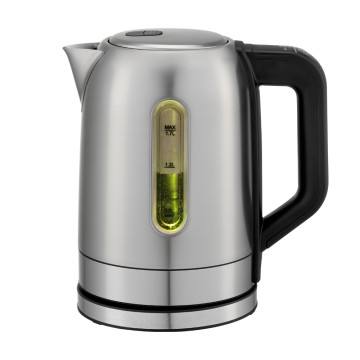
The Mid-Range tier targets 4-star full-service hotels (Hilton Garden Inn, Marriott Courtyard, Holiday Inn full-service, DoubleTree, NH Hotels, Scandic, mid-tier regional chains). The dominant buyer priorities in this tier are: a kettle that looks substantial on the tray and communicates quality at first glance, double-wall cool-touch exterior for safety (so guests do not burn themselves on the kettle body), cordless 360-degree base for ease of use, and fast 5- to 7-minute boil time.
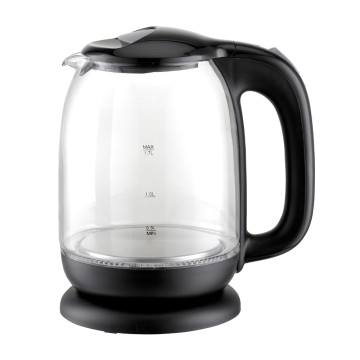
The kettle body in this tier is typically double-wall stainless steel (SUS304 food-grade inner wall with an outer wall that creates a cool-touch air gap), with capacity 1.0 to 1.7 liter. Some properties in this tier also select the digital temperature control sub-tier (with preset temperatures for green tea, white tea, oolong, black tea, coffee, etc.) for properties that market themselves around tea and coffee culture. The digital glass kettle series is the catalogue anchor for properties specifying the digital temperature control sub-tier, and the glass kettle series covers the broader borosilicate-glass body variants.
Cost band — Mid-Range
At a 1,000-unit MOQ, the Mid-Range kettle cost band is:
- 1.0 L double-wall stainless, single setting, BS plug: 9 to 14 USD per unit
- 1.5 L double-wall stainless, single setting, BS plug: 11 to 16 USD per unit
- 1.7 L double-wall stainless, single setting, BS plug: 12 to 18 USD per unit
- 1.7 L double-wall stainless, digital temperature control (5 settings), BS plug: 18 to 26 USD per unit
The cost varies with the digital temperature control display (LCD adds 1.5 to 3 USD per unit; LED segment adds 0.8 to 1.5 USD), keep-warm function (adds 0.5 to 1.0 USD per unit), and stainless finish (brushed adds 0.3 to 0.6 USD; mirror polish adds 0.8 to 1.5 USD).
Certifications required for Mid-Range tier
All Economy tier certifications plus:
- GS mark (Geprufte Sicherheit, tested safety) for Germany and several other EU markets where the GS mark is preferred by procurement teams — DIN standards are the harmonised German standards used for GS mark assessment.
- CB scheme certification (IEC system for mutual recognition of test certificates) as the foundation for CE, UKCA, and many other national marks — see the CENELEC catalogue for the European harmonised standards referenced in the CB scheme.
- REACH compliance for chemical substances in the product
- EMC testing report in addition to the basic EMC declaration — Intertek and UL both publish EMC testing service catalogues that procurement teams can cross-reference.
Total bundle cost — Mid-Range
A typical Mid-Range welcome-tray bundle (kettle + wood or bamboo tray + ceramic mug + porcelain water tumbler + tea-bag caddy) lands in the 20 to 38 USD per room total cost band at 1,000-unit MOQ:
- Kettle (double-wall stainless): 11-18 USD
- Wood or bamboo tray: 4-8 USD
- Ceramic mug (250-300 ml, branded): 2-4 USD
- Porcelain water tumbler: 2-3 USD
- Tea-bag caddy: 1-2 USD
- Packaging and assembly: 2-3 USD
For a 200-room property, a single refresh cycle is 4,000 to 7,600 USD total. Across a four-year refresh interval, the annual welcome-tray cost is 1,000 to 1,900 USD per year, or 2.7 to 5.2 USD per room per day — still well under 1 percent of the average daily rate of a Mid-Range 4-star hotel.
---
Tier 3 — Premium kettle for 5-star luxury and boutique hotels
The Premium tier targets 5-star luxury hotels (Four Seasons, Ritz-Carlton, Mandarin Oriental, Peninsula, Park Hyatt, Rosewood, Aman), boutique hotels in the 100- to 200-room range that compete on design and detail, and high-end extended-stay brands (Aman, Six Senses). The dominant buyer priorities in this tier are: a kettle that visually integrates with the room design (sometimes specified by the property's interior designer), low noise during operation (under 50 dB at 1 meter), premium materials (brushed stainless, copper, or matte porcelain finish), and a 3-year minimum service life.
The kettle body in this tier is typically premium double-wall stainless steel with a designer-specified finish, often paired with a matching wooden base or felt-lined tray insert. Capacity is typically 1.0 to 1.7 liter. The cordless base may include a low-profile design that disappears visually under the kettle. Some Premium properties also specify the kettle's noise profile (typically under 55 dB) as a contractual requirement.
Cost band — Premium
At a 500-unit MOQ (most Premium properties order smaller batches for the design-driven refresh cycle), the Premium kettle cost band is:
- 1.0 L designer double-wall stainless, branded, BS plug: 18 to 28 USD per unit
- 1.5 L designer double-wall stainless, branded, BS plug: 22 to 32 USD per unit
- 1.7 L designer double-wall stainless, branded, BS plug: 24 to 36 USD per unit
- Designer color or finish customization (Pantone match, brushed copper, matte porcelain): +15 to +30 percent on base price
The cost varies with designer collaboration (some Premium properties engage an industrial designer for a bespoke kettle, which adds 5,000 to 25,000 USD in design fees amortized over a 2,000-unit run), branded packaging (custom-printed retail-quality box adds 2 to 5 USD per unit), and warranty terms (3-year extended warranty adds 1 to 3 USD per unit).
Certifications required for Premium tier
All Mid-Range tier certifications plus:
- Specific OEM partnerships (e.g., Nespresso-branded or Illy-branded coffee systems, which may impose kettle brand and specification requirements)
- Acoustic testing report (often required as a contractual deliverable for Premium tier)
- Specific regional certification beyond baseline (e.g., Singapore safety mark for ASEAN properties, KC mark for Korea, PSE mark for Japan)
- Extended warranty documentation for the property's asset management team
Total bundle cost — Premium
A typical Premium welcome-tray bundle (kettle + leather-wrapped or stone tray + porcelain cup + crystal tumbler + branded caddy + matching sugar/cream service) lands in the 40 to 70 USD per room total cost band at 500-unit MOQ:
- Kettle (designer double-wall stainless, branded): 22-36 USD
- Leather-wrapped or stone tray: 12-22 USD
- Porcelain cup with saucer (branded): 4-7 USD
- Crystal tumbler (or lead-free crystal): 4-6 USD
- Branded caddy + sugar/cream service: 3-6 USD
- Premium packaging and assembly: 4-8 USD
For a 200-room luxury property, a single refresh cycle is 8,000 to 14,000 USD total. Across a four-year refresh interval, the annual welcome-tray cost is 2,000 to 3,500 USD per year, or 5.5 to 9.6 USD per room per day — still well under 1 percent of the average daily rate of a 5-star luxury hotel.
Cost-per-occupied-room-night: the metric that matters
A common mistake in welcome-tray procurement is comparing unit prices between tiers without considering the full cost-per-occupied-room-night. The metric that matters for the property's P&L is:
Cost per occupied room night = (bundle cost per room × number of refreshes per period) / (number of occupied room nights in the same period)
For a 200-room property with 70 percent annual occupancy over a four-year refresh cycle:
- Economy tier (12 USD per bundle × 200 rooms × 1 refresh per 4 years) / (200 rooms × 365 nights × 0.70 × 4 years) = 2,400 / 204,400 = 0.012 USD per occupied room night
- Mid-Range tier (28 USD per bundle) = 5,600 / 204,400 = 0.027 USD per occupied room night
- Premium tier (55 USD per bundle) = 11,000 / 204,400 = 0.054 USD per occupied room night
The absolute cost-per-occupied-room-night is so low at every tier that the dominant procurement consideration shifts to breakage rate, guest satisfaction impact, and replacement logistics. A tier-one Economy kettle that breaks in 18 months and requires replacement logistics actually costs more over a four-year cycle than a tier-three Mid-Range kettle that lasts the full four years without replacement.
The breakage rate observed in hotel welcome-tray deployments varies sharply by tier:
| Kettle tier | Average breakage rate per year | Replacement cost driver |
|---|---|---|
| Economy (PP body) | 15-25 percent | Total replacement of the kettle; property staff time to install |
| Mid-Range (single-wall SS) | 8-15 percent | Total replacement; same as Economy |
| Mid-Range (double-wall SS) | 4-8 percent | Limited replacement; longer service life |
| Premium (designed double-wall SS) | 2-5 percent | Limited replacement; lowest operational impact |
The replacement logistics cost per broken kettle (housekeeping time, replacement SKU retrieval from storage, tray reset, room-readiness verification) is roughly 5 to 12 USD per incident in a 200-room property, depending on the local labor cost. This means a 15 percent annual breakage rate on Economy kettles adds roughly 1.5 to 3.0 USD per bundle per year in operational cost — a substantial fraction of the bundle's acquisition cost.
Hospitality procurement analysts at industry trade publications such as Skift consistently identify the welcome-tray kettle as a "small spend, large visibility" line item — the per-room cost is trivial compared to the room's average daily rate, but the failure modes show up in OTA review analysis at a frequency that makes the welcome tray one of the highest-leverage small-spend components for guest-satisfaction investment.
---
Configuration matrix by hotel tier
The recommended welcome-tray configuration by hotel tier is summarized in the matrix below. The cost bands assume 1,000-unit MOQ for Economy and Mid-Range, and 500-unit MOQ for Premium.
| Component | Economy | Mid-Range | Premium |
|---|---|---|---|
| Kettle type | PP plastic body, 1.0 L | Double-wall stainless, 1.5 L | Designer double-wall stainless, 1.0-1.7 L |
| Kettle cost (per unit) | 5.5-9 USD | 11-18 USD | 22-36 USD |
| Kettle features | Single setting, auto shut-off | Single or 5-setting digital, keep-warm | Designer finish, low-noise, branded |
| Tray substrate | Melamine or PP plastic | Bamboo or rubberwood | Leather-wrapped MDF or stone |
| Tray cost (per unit) | 1-2 USD | 4-8 USD | 12-22 USD |
| Drinking vessel | Ceramic mug (250 ml) | Ceramic mug (300 ml) + porcelain tumbler | Porcelain cup + saucer + crystal tumbler |
| Vessel cost (per set) | 1-2 USD | 4-7 USD | 8-13 USD |
| Auxiliary items | None | Tea-bag caddy | Caddy + sugar/cream service |
| Auxiliary cost (per set) | 0 USD | 1-2 USD | 3-6 USD |
| Packaging | Bulk polybag + carton | Individual retail box | Custom-printed retail-quality box |
| Packaging cost (per set) | 2-3 USD | 2-3 USD | 4-8 USD |
| **Total bundle cost (per room)** | **9-16 USD** | **20-38 USD** | **45-85 USD** |
| Annual cost-per-occupied-room-night | 0.01 USD | 0.03 USD | 0.05 USD |
---
Lead time and MOQ planning
The lead time for a welcome-tray bundle order depends on the kettle's certification status, the tray's customization, and the destination market's power-cord requirements.
Typical lead times by tier
- Economy — 25 to 35 days for a 1,000-unit order with stock colors and BS plug. Adds 7-10 days for custom color match. Adds 10-15 days if CE / UKCA / GS certification paperwork needs to be re-issued for a new plug standard.
- Mid-Range — 35 to 50 days for a 1,000-unit order with stock double-wall stainless body. Adds 15-20 days for digital temperature control customization. Adds 10-15 days for branded packaging.
- Premium — 50 to 80 days for a 500-unit order with designer collaboration. Adds 20-30 days for Pantone color match or designer-specified finish. Adds 10-20 days for extended warranty documentation.
MOQ by tier
- Economy — MOQ typically 500-1,000 units for stock configurations. Lower MOQ available (300-500 units) at 5-15 percent per-unit premium.
- Mid-Range — MOQ typically 500-1,000 units for stock configurations. Digital temperature control MOQ 1,000+ units due to controller tooling amortization.
- Premium — MOQ typically 200-500 units for designer configurations. Lower MOQ available with significant per-unit premium and design-fee amortization.
Order consolidation strategy
For a 200-room property with multiple refresh cycles over 10 years, the optimal procurement pattern is to consolidate orders across two refresh cycles when possible. A single 400-unit order for a two-cycle supply (5-year interval) typically saves 8-15 percent on per-unit cost compared with two separate 200-unit orders, while preserving the welcome-tray appearance consistency that the property wants for brand identity.
NSF International maintains the food equipment safety standard NSF/ANSI 4 that covers commercial cooking, warming, and holding equipment, and several Premium tier hotel groups reference NSF/ANSI 4 compliance in their welcome-tray component specifications for food-contact surfaces.
---
Replacement supply and spare-parts planning
The single most overlooked procurement decision in welcome-tray programs is the spare-parts and replacement-supply strategy. A 200-room property running a four-year refresh cycle should plan for:
- 15-25 percent annual kettle breakage buffer at Economy tier, declining to 2-5 percent at Premium tier.
- 2-4 percent annual tray breakage buffer (mainly chipping on plastic and melamine trays; very low on wood and leather-wrapped trays).
- 5-8 percent annual vessel breakage buffer (mainly ceramic chipping in guest rooms and back-of-house handling).
This implies a property should procure 10-15 percent more units than the immediate need and hold the buffer in on-site storage. The cost of the buffer (15-20 percent of the property's welcome-tray annual spend) is far lower than the operational cost of running out of replacement kettles for even a single weekend.
The OEM supplier relationship matters here: a reliable OEM will hold safety stock of replacement kettles matching the property's original configuration for the duration of the refresh cycle, and will commit to a 30- or 60-day replenishment lead time on top-up orders.
For procurement teams sourcing US-bound welcome-tray kettles, the US Environmental Protection Agency Toxic Substances Control Act (TSCA) and the Federal Register notices on chemical substance restrictions both apply on top of FDA food-contact compliance. Procurement teams sourcing into the UK post-Brexit should also review the USTR trade policy publications to understand any current tariff exposure on Chinese-origin Electric Kettles entering the US market, and the trade.gov Country Commercial Guides for up-to-date destination market intelligence.
---
Procurement checklist for hotel purchasing teams
The following checklist captures the most common procurement decisions for a welcome-tray refresh program:
- Determine the tier by mapping the property's positioning to the Economy / Mid-Range / Premium tiers above. The cost difference between tiers is real, but the cost-per-occupied-room-night is small at every tier.
- Identify the destination market's plug standard and certification requirements before issuing the RFQ. BS UK, Schuko EU, NEMA US, AS/NZS Australia, BS South Africa, and Swiss SEV 1011 each require different cord sets and may require different certification documents.
- Confirm the kettle's voltage rating (110 V for North America, 220-240 V for most of the rest of the world). Dual-voltage kettles are available but typically cost 25-40 percent more per unit.
- Specify the noise profile if the property is in a Premium tier or in a quiet-zoned market. Below 50 dB at 1 meter is the typical Premium tier specification.
- Plan for the tray finish durability. Bamboo and rubberwood trays are durable but require sealing against humidity. Leather-wrapped MDF trays are visually premium but require replacement after 3-4 years due to surface wear.
- Negotiate the spare-parts commitment. A 15-20 percent spare kettle buffer with 30-day replenishment lead time is the standard target.
- Confirm the packaging specification. Bulk polybag pack is acceptable for Economy tier where the kettle goes directly into housekeeping storage. Mid-Range and Premium tiers should specify individual retail-quality boxes that withstand guest handling.
- Verify the warranty terms. Economy tier typically carries a 6-12 month warranty. Mid-Range tier 12-24 months. Premium tier 24-36 months.
- Plan the refresh cycle at 4 years for Economy, 4-5 years for Mid-Range, and 5-6 years for Premium. Adjust based on observed breakage rate after the first 12 months of deployment.
- Request sample units before placing the full order. Sample evaluation typically takes 2-4 weeks including shipping and guest testing.
To request quotation samples, contact us directly with your property tier, destination market, plug standard, and target MOQ. The BSI Standards catalogue and the BSI Products and Services certification directory are the natural reference documents to attach to an RFQ when specifying certification requirements.
---
Frequently Asked Questions
What is the most important procurement decision for a hotel welcome-tray kettle?
Body material choice — PP plastic, single-wall stainless steel, or double-wall stainless steel — is the dominant decision because it controls most of the kettle cost variance, sets the certification scope, defines the noise profile, and determines expected service life. Selecting the right material upfront matters more than tuning any other variable in the bundle, because re-specifying material mid-cycle requires re-certification, re-tooling of the plug standard, and re-design of the tray cup well.
How does the cost-per-occupied-room-night vary across hotel tiers?
For a 200-room property at 70 percent occupancy with a four-year refresh cycle, the cost-per-occupied-room-night for the welcome-tray bundle is approximately 0.01 USD per night for Economy tier, 0.03 USD per night for Mid-Range tier, and 0.05 USD per night for Premium tier. All three are well under 1 percent of the property's average daily rate, which means the procurement decision should be driven by breakage rate, guest satisfaction, and brand alignment rather than unit price.
Which certification package is required for a hotel kettle?
Procurement teams typically anchor on CE (mandatory for the European Union under the Low Voltage Directive and EMC Directive) and UKCA (effectively required for the United Kingdom post-Brexit). Properties serving German-speaking markets should add the GS mark, while North American deployments call for ETL or CSA certification. The CB scheme provides an IEC-level umbrella that simplifies multi-region deployment. RoHS and REACH compliance are baseline requirements in EU markets, and food-contact surfaces touching drinking water need LFGB (EU) or FDA 21 CFR (US) compliance.
What is the typical MOQ for hotel welcome-tray kettle orders?
Most Chinese OEM/ODM kettle suppliers set MOQ at 500 to 1,000 units for Economy and Mid-Range tier orders, and 200 to 500 units for Premium tier orders. Lower MOQs are negotiable at a 5 to 15 percent per-unit premium. A 200-room property running a single refresh cycle at 200 units falls below typical MOQ, so most procurement teams either consolidate orders across multiple refresh cycles or partner with neighboring properties to reach the supplier threshold.
How long do hotel welcome-tray kettles typically last in service?
Field data from hospitality deployments shows clear tier-based differences in kettle service life. Economy PP plastic units typically need replacement after 12 to 24 months of typical in-room use. Single-wall stainless Mid-Range units last 24 to 36 months under similar conditions, while double-wall stainless Mid-Range units extend that to 36 to 60 months. Premium designer double-wall stainless configurations reach 48 to 72 months or beyond, which is why the per-occupied-room-night cost analysis in the body of this article shows Premium tier as the lowest total-cost option over a five-year horizon.
What is the role of the welcome-tray kettle in guest satisfaction and OTA reviews?
Welcome-tray kettle performance is one of the most consistently rated components in hotel guest reviews on Booking.com, Tripadvisor, and Google. Common negative review themes include "kettle did not work," "kettle was slow," "kettle was loud," "kettle looked cheap," and "kettle leaked." A failing or visibly poor-quality kettle is one of the highest-frequency mentions in negative reviews for limited-service and mid-range hotels. Investing in a Mid-Range double-wall Stainless Kettle is a strong defensive investment against these reviews.
Should a property source welcome-tray kettles directly from an OEM/ODM manufacturer or through a hospitality supply distributor?
For Economy and Mid-Range tiers at typical hotel MOQs (200-1,000 units per refresh cycle), direct OEM/ODM sourcing from Chinese manufacturers typically delivers 15-30 percent lower per-unit cost than going through a hospitality supply distributor, but requires the property's procurement team to manage certification paperwork, packaging customization, and shipping logistics. For Premium tier at smaller MOQs (200-500 units), the hospitality supply distributor adds 20-40 percent per-unit cost but provides design collaboration, multi-OEM sourcing, and consolidated logistics that justify the premium for properties without in-house procurement capability for Asia-direct sourcing. To evaluate the OEM option directly, request quotation samples through the contact us page with your destination market and target MOQ.
Which Goodfriends product families correspond to each tier?
For Economy tier, the dominant SKU family is the plastic kettle series covering 0.5 L to 1.2 L PP and single-wall stainless body variants. For Mid-Range tier, the dominant SKU families are the stainless steel kettle series, the double-wall stainless steel kettle series, and the glass kettle series for the digital temperature control sub-tier. The compact cordless hotel kettle is the canonical Economy tier SKU for European hotel groups, and the broader hotel kettles for hospitality services category page is the procurement starting point for first-time buyers.
For an introduction to the Goodfriends product families discussed in this article, see the double-wall stainless steel kettle series and the digital glass kettle series pages.